
Homework Answers
Add Answer to:
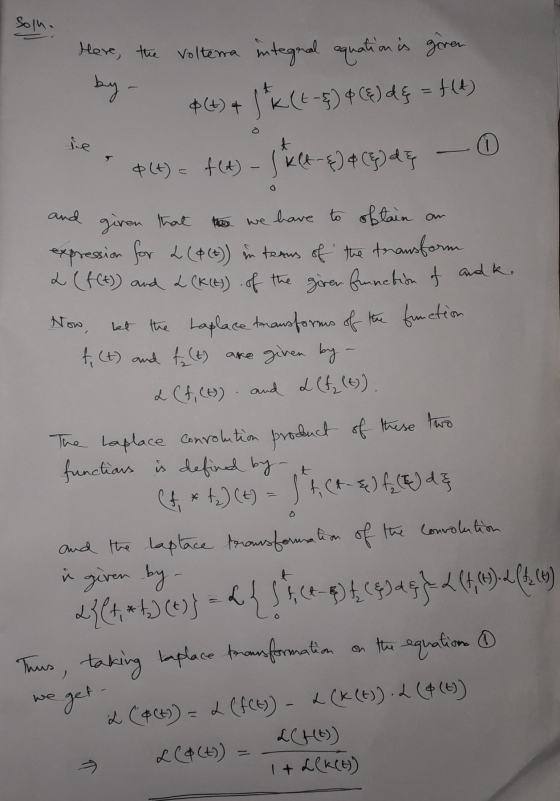
(2) (Volterra Integral Theoretical) Consider the equation (1.3) o(t) + k(t – $)() dě = f(t),...
Consider the following integral equation, so called because the unknown dependent variable y appears within an...
 Consider the following integral equation, so called because the
unknown dependent variable y appears within an
integral:
t
∫
0
sin[5(t − w)] y(w) dw
= 5t2
This equation is defined for t ≥ 0.
(a)
Use convolution and Laplace transforms to find the Laplace
transform of the solution.
(b)
Obtain the solution y(t).
Consider the following integral equation, so called because the unknown dependent variable y appears within an integral: Ś sin sin[5(t – w)] y(w) dw = 5t2...
Consider the following integral equation, so called because the
unknown dependent variable y appears within an
integral:
t
∫
0
sin[5(t − w)] y(w) dw
= 5t2
This equation is defined for t ≥ 0.
(a)
Use convolution and Laplace transforms to find the Laplace
transform of the solution.
(b)
Obtain the solution y(t).
Consider the following integral equation, so called because the unknown dependent variable y appears within an integral: Ś sin sin[5(t – w)] y(w) dw = 5t2...
Help on this question of Differential Equation, thanks. There are also equations, known as integro-differential equations,...
 Help on this question of Differential Equation, thanks.
There are also equations, known as integro-differential equations, in which both derivatives and integrals of the unknown function appear. Solve the given integro-differential equation by using the Laplace transform. D'(o) – 4 (1 - 1)?°(E) dě = –31, $(0) = 3 Enclose arguments of functions in parentheses. For example, sin (2x). (t) = QB
Help on this question of Differential Equation, thanks.
There are also equations, known as integro-differential equations, in which both derivatives and integrals of the unknown function appear. Solve the given integro-differential equation by using the Laplace transform. D'(o) – 4 (1 - 1)?°(E) dě = –31, $(0) = 3 Enclose arguments of functions in parentheses. For example, sin (2x). (t) = QB
(3 points) Use Laplace transforms to solve the integral equation y(t) -3 / sin(3v)y(t - v)...
 (3 points) Use Laplace transforms to solve the integral equation y(t) -3 / sin(3v)y(t - v) dv - sin(t) The first step is to apply the Laplace transform and solve for Y(s) = L()(1) Y(s) = Next apply the inverse Laplace transform to obtain y(t) y(t) =
Show work please (1 point) Use Laplace transforms to solve the integral equation y(t) – v...
 Show work please
(1 point) Use Laplace transforms to solve the integral equation y(t) – v yết – U) do = 4. The first step is to apply the Laplace transform and solve for Y(s) = L(y(t)) Y(s) = Next apply the inverse Laplace transform to obtain y(t) y(t) =
Show work please
(1 point) Use Laplace transforms to solve the integral equation y(t) – v yết – U) do = 4. The first step is to apply the Laplace transform and solve for Y(s) = L(y(t)) Y(s) = Next apply the inverse Laplace transform to obtain y(t) y(t) =
Problem #6: Consider the following integral equation, so called integral because the unknown depe...
 Problem #6: Consider the following integral equation, so called integral because the unknown dependent variable y appears within an This equation is defined for t0 (a) Use convolution and Laplace transforms to find the Laplace transform of the solution (b) Obtain the solution y(t) Enter your answer as a symbolic function of s, as in these examples Problem #6(a): Enter your answer as a symbolic function of t, as in these examples Problem #6(b): Just Save Submit Problem #6 for...
Use the Laplace transform to solve the given integral equation. f(t) + t (t − τ)f(τ)dτ...
 Use the Laplace transform to solve the given integral
equation.
f(t) +
t
(t −
τ)f(τ)dτ
0
= t
Use the Laplace transform to solve the given integral
equation.
f(t) +
t
(t −
τ)f(τ)dτ
0
= t
Use the Laplace transform to solve the given integral equation. f(t) = tet + S'ence- tf(t...
 Use the Laplace transform to solve the given integral equation. f(t) = tet + S'ence- tf(t - t) dr f(t) =
1. Consider a smooth function f(t) defined on 0 t
 Applied Mathematics Laplace Transforms
1. Consider a smooth function f(t) defined on 0 t<o, with Laplace transform F(s) (a) Prove the First Shift Theorem, which states that Lfeatf(t)) = F(s-a), where a is a constant. Use the First Shift Theorem to find the inverse trans- form of s2 -6s 12 6 marks (b) Prove the Second Shift Theorem, which states that L{f(t-a)H(t-a))-e-as F(s), where H is the Heaviside step function and a is a positive constant. Use the First and...
Applied Mathematics Laplace Transforms
1. Consider a smooth function f(t) defined on 0 t<o, with Laplace transform F(s) (a) Prove the First Shift Theorem, which states that Lfeatf(t)) = F(s-a), where a is a constant. Use the First Shift Theorem to find the inverse trans- form of s2 -6s 12 6 marks (b) Prove the Second Shift Theorem, which states that L{f(t-a)H(t-a))-e-as F(s), where H is the Heaviside step function and a is a positive constant. Use the First and...
Use the Laplace transform to solve the given integral equation. 0 f(t) = Need Help? Reade...
 Use the Laplace transform to solve the given integral equation. 0 f(t) = Need Help? Reade 이 Lru Talk to a Tutor
differential equations Definition 7.1.1 Laplace Transform Let f be a function defined for t 2 0....
 differential equations
Definition 7.1.1 Laplace Transform Let f be a function defined for t 2 0. Then the integral 00 L{f(t)} = -192 e-stf(t) dt is said to be the Laplace transform of f, provided that the integral converges. 16, f(t) = {6, ost<4 t24 Complete the integral(s) that defines L{f(t)}. L{f(t)} = Datet (" dt Find L{f(t)}. (Write your answer as a function of s.) L{f(t)} = (s > 0)
differential equations
Definition 7.1.1 Laplace Transform Let f be a function defined for t 2 0. Then the integral 00 L{f(t)} = -192 e-stf(t) dt is said to be the Laplace transform of f, provided that the integral converges. 16, f(t) = {6, ost<4 t24 Complete the integral(s) that defines L{f(t)}. L{f(t)} = Datet (" dt Find L{f(t)}. (Write your answer as a function of s.) L{f(t)} = (s > 0)
 Consider the following integral equation, so called because the
unknown dependent variable y appears within an
integral:
t
∫
0
sin[5(t − w)] y(w) dw
= 5t2
This equation is defined for t ≥ 0.
(a)
Use convolution and Laplace transforms to find the Laplace
transform of the solution.
(b)
Obtain the solution y(t).
Consider the following integral equation, so called because the unknown dependent variable y appears within an integral: Ś sin sin[5(t – w)] y(w) dw = 5t2...
Consider the following integral equation, so called because the
unknown dependent variable y appears within an
integral:
t
∫
0
sin[5(t − w)] y(w) dw
= 5t2
This equation is defined for t ≥ 0.
(a)
Use convolution and Laplace transforms to find the Laplace
transform of the solution.
(b)
Obtain the solution y(t).
Consider the following integral equation, so called because the unknown dependent variable y appears within an integral: Ś sin sin[5(t – w)] y(w) dw = 5t2...
 Help on this question of Differential Equation, thanks.
There are also equations, known as integro-differential equations, in which both derivatives and integrals of the unknown function appear. Solve the given integro-differential equation by using the Laplace transform. D'(o) – 4 (1 - 1)?°(E) dě = –31, $(0) = 3 Enclose arguments of functions in parentheses. For example, sin (2x). (t) = QB
Help on this question of Differential Equation, thanks.
There are also equations, known as integro-differential equations, in which both derivatives and integrals of the unknown function appear. Solve the given integro-differential equation by using the Laplace transform. D'(o) – 4 (1 - 1)?°(E) dě = –31, $(0) = 3 Enclose arguments of functions in parentheses. For example, sin (2x). (t) = QB
 (3 points) Use Laplace transforms to solve the integral equation y(t) -3 / sin(3v)y(t - v) dv - sin(t) The first step is to apply the Laplace transform and solve for Y(s) = L()(1) Y(s) = Next apply the inverse Laplace transform to obtain y(t) y(t) =
 Show work please
(1 point) Use Laplace transforms to solve the integral equation y(t) – v yết – U) do = 4. The first step is to apply the Laplace transform and solve for Y(s) = L(y(t)) Y(s) = Next apply the inverse Laplace transform to obtain y(t) y(t) =
Show work please
(1 point) Use Laplace transforms to solve the integral equation y(t) – v yết – U) do = 4. The first step is to apply the Laplace transform and solve for Y(s) = L(y(t)) Y(s) = Next apply the inverse Laplace transform to obtain y(t) y(t) =
 Problem #6: Consider the following integral equation, so called integral because the unknown dependent variable y appears within an This equation is defined for t0 (a) Use convolution and Laplace transforms to find the Laplace transform of the solution (b) Obtain the solution y(t) Enter your answer as a symbolic function of s, as in these examples Problem #6(a): Enter your answer as a symbolic function of t, as in these examples Problem #6(b): Just Save Submit Problem #6 for...
 Use the Laplace transform to solve the given integral
equation.
f(t) +
t
(t −
τ)f(τ)dτ
0
= t
Use the Laplace transform to solve the given integral
equation.
f(t) +
t
(t −
τ)f(τ)dτ
0
= t
 Use the Laplace transform to solve the given integral equation. f(t) = tet + S'ence- tf(t - t) dr f(t) =
 Applied Mathematics Laplace Transforms
1. Consider a smooth function f(t) defined on 0 t<o, with Laplace transform F(s) (a) Prove the First Shift Theorem, which states that Lfeatf(t)) = F(s-a), where a is a constant. Use the First Shift Theorem to find the inverse trans- form of s2 -6s 12 6 marks (b) Prove the Second Shift Theorem, which states that L{f(t-a)H(t-a))-e-as F(s), where H is the Heaviside step function and a is a positive constant. Use the First and...
Applied Mathematics Laplace Transforms
1. Consider a smooth function f(t) defined on 0 t<o, with Laplace transform F(s) (a) Prove the First Shift Theorem, which states that Lfeatf(t)) = F(s-a), where a is a constant. Use the First Shift Theorem to find the inverse trans- form of s2 -6s 12 6 marks (b) Prove the Second Shift Theorem, which states that L{f(t-a)H(t-a))-e-as F(s), where H is the Heaviside step function and a is a positive constant. Use the First and...
 Use the Laplace transform to solve the given integral equation. 0 f(t) = Need Help? Reade 이 Lru Talk to a Tutor
 differential equations
Definition 7.1.1 Laplace Transform Let f be a function defined for t 2 0. Then the integral 00 L{f(t)} = -192 e-stf(t) dt is said to be the Laplace transform of f, provided that the integral converges. 16, f(t) = {6, ost<4 t24 Complete the integral(s) that defines L{f(t)}. L{f(t)} = Datet (" dt Find L{f(t)}. (Write your answer as a function of s.) L{f(t)} = (s > 0)
differential equations
Definition 7.1.1 Laplace Transform Let f be a function defined for t 2 0. Then the integral 00 L{f(t)} = -192 e-stf(t) dt is said to be the Laplace transform of f, provided that the integral converges. 16, f(t) = {6, ost<4 t24 Complete the integral(s) that defines L{f(t)}. L{f(t)} = Datet (" dt Find L{f(t)}. (Write your answer as a function of s.) L{f(t)} = (s > 0)
Most questions answered within 3 hours.
-
Where is the error in this code sequence?
String s1 = "Hello";
String s2 = "ello";...
asked 10 months ago -
Financial data for Joel de Paris, Inc., for last year
follow:
Joel de Paris, Inc.
Balance...
asked 10 months ago -
Consider this reaction:
Al2(SO4)3 (aq)+ BaCl3
(aq) Al2Cl6 (aq)- +
3BaSO4(s) . What is the...
asked 10 months ago -
Suppose that Savneet is considering increasing her
recent random sample from 20 car rentals to 40...
asked 10 months ago -
Trucks arrive at an unloading terminal at an average rate of 120
per hour.
Trucks arrive...
asked 10 months ago -
Why are methanol and ethanol completely soluble in water while
octanol is not very little soluble....
asked 10 months ago -
A facilities manager at a university reads in a research report
that the mean amount of...
asked 10 months ago -
When the CuSO4 is rehydrated by adding water to the anhydrous
compound, is this an endothermic...
asked 10 months ago -
A ray of sunlight is passing from diamond into crown glass; the
angle of incidence is...
asked 10 months ago -
A block of mass 0.249 kg is placed on top of a light, vertical
spring of...
asked 10 months ago -
how do the kidneys compensate in the presences of acidosis
a) trigger hyperventilate
b) reserve acid...
asked 10 months ago -
Question 501 pts
The rental rate of capital to the firm increases. Which of the
following...
asked 10 months ago