Statistic ( Inference about a comparing two population)
Homework Answers
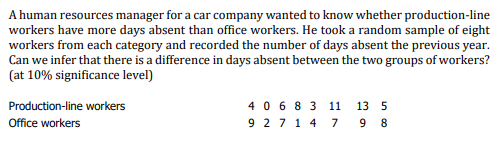
The data of the problem is provided as follows:
$$ \begin{array}{|c|c|c|c|c|c|c|c|c|} \hline \text { Production-line workers }\left(X_{1}\right) & 4 & 0 & 6 & 8 & 3 & 11 & 13 & 5 \\ \hline \text { Office workers }\left(X_{2}\right) & 9 & 2 & 7 & 1 & 4 & 7 & 9 & 8 \\ \hline \end{array} $$
Here, equal variance of t-test is used. Firstly, set the hypothesis as shown below:
State the null hypothesis:
\(H_{0}\) : There is no difference in days absent between the two groups of workers.
Against the alternative hypothesis:
\(H_{1}:\) There is significant difference in days absent between the two groups of workers.
The test statistic used is:
\(t=\frac{\left(\bar{x}_{1}-\bar{x}_{2}\right)-\left(\mu_{1}-\mu_{2}\right)}{\sqrt{s_{p}^{2}\left(\frac{1}{n_{1}}+\frac{1}{n_{2}}\right)}}\)
where \(s_{p}^{2}=\frac{\left(n_{1}-1\right) s_{1}^{2}+\left(n_{2}-1\right) s_{2}^{2}}{n_{1}+n_{2}-2}\)
and \(n_{1}\left(\right.\) or \(\left.n_{2}\right)=8\)
The mean of samples is:
\(\begin{aligned} \bar{X}_{1} &=\frac{\sum_{i=1}^{8} X_{i}}{n_{1}} \\ &=\frac{4+0+6 \ldots .+5}{8} \\ &=6.25 \end{aligned}\)
and
\(\bar{X}_{2}=\frac{\sum_{i=1}^{8} X_{i}}{n_{2}}\)
\(=\frac{9+2+7+\ldots+8}{8}\)
\(=5.88\)
The sample variances are:
\(\begin{aligned} s_{1}^{2} &=\frac{\sum_{i=1}^{8}\left(X_{i}-\bar{X}_{1}\right)}{n_{1}-1} \\ &=\frac{(4-6.25)^{2}+(0-6.25)^{2}+\ldots+(5-6.25)^{2}}{8-1} \\ &=18.21 \end{aligned}\)
and
\(s_{2}^{2}=\frac{\sum_{i=1}^{8}\left(X_{i}-\bar{X}_{2}\right)}{n_{2}-1}\)
\(=\frac{(4-6.25)^{2}+(0-6.25)^{2}+\ldots+(5-6.25)^{2}}{8-1}\)
\(=9.84\)
The pooled variance estimator is:
\(s_{p}^{2}=\frac{\left(n_{1}-1\right) s_{1}^{2}+\left(n_{2}-1\right) s_{2}^{2}}{n_{1}+n_{2}-2}\)
\(=\frac{(8-1)(18.21)+(8-1)(9.84)}{8+8-2}\)
\(=14.03\)
The number of degrees of test statistic is:
\(\begin{aligned} v &=n_{1}+n_{2}-2 \\ &=8+8-2 \\ &=14 \end{aligned}\)
Now, substitute the values in the test statistic as shown below :
\(t=\frac{\left(\bar{x}_{1}-\bar{x}_{2}\right)-\left(\mu_{1}-\mu_{2}\right)}{\sqrt{s_{p}^{2}\left(\frac{1}{n_{1}}+\frac{1}{n_{2}}\right)}}\)
\(=\frac{(6.25-5.88)-(0)}{\sqrt{(14.03)\left(\frac{1}{8}+\frac{1}{8}\right)}}\)
\(=0.20025\)
The rejection region is:
\(t_{a, v}=t_{0.10,14}\)
\(=1.761\)
From the above, it concludes that the calculated value of \(t\) is less than the tabulated value of \(t\), so null hypothesis is accepted. Therefore, it infers that there is no difference in days absent between the two groups of workers.
Statistic ( Inference about a population)

Statistic ( Inference about a population)
 After many years of teaching, a statistics professor computed the variance of the marks on her final exam and found it to be σ2 = 250. She recently made changes to the way in which the final exam is marked and wondered whether this would result in a reduction in the variance. A random sample of this year’s final exam marks are listed here. Can the professor infer at the 10% significance level that the variance has decreased?57 92 99 ...
Statistic ( Inference about a population)
 A management professor was in the process of investigating the relationship between education and managerial level achieved. The source of his data was a survey of 385 CEOs of medium and large companies. He discovered that there was only one CEO who did not have at least one university degree. Estimate (using a Wilson estimator) with 99% confidence the proportion of CEOs of medium and large companies with no university degrees.
We use a t distribution for inference about a population mean instead of the standard Normal...
We use a t distribution for inference about a population mean instead of the standard Normal distribution: if we do not know the population mean and must use the sample mean. if the original population does not have a Normal distribution. if we do not have a simple random sample. if we do not know the population standard deviation and must use the sample standard deviation.
4. Comparing two population proportions (independent samples)
 4. Comparing two population proportions (independent samples) Most major survey research organizations do not include wireless telephone numbers when conducting random-digit-dial telephone surveys. If there are differences between persons with and without landline phones, using a random-digit-dial telephone survey may introduce bias into the survey results. Data on a broad range of health topics are collected through personal household interviews of a representative sample of the U.S. civilian noninstitutionalized population in the National Health Interview Survey (NHIS) respondents are also asked about...
webwork / math243fall-masden /week 8b - ch20 inference about a population mean / 3 Week 8b...
 webwork / math243fall-masden /week 8b - ch20 inference about a population mean / 3 Week 8b - Ch20 Inference About a Population Mean: Problem 3 Previous Problem ListNext (1 point) An agricultural field trial compares the yield of two varieties of com. The researchers divide in half each of 10 fields of land in different locations and plarnt each corn variety in one half of each plot. After harvest, the yields are compared in bushels per acre at each location....
In a right-tailed test comparing two proportions, the test statistic was z calc = +1.81. The...
In a right-tailed test comparing two proportions, the test statistic was z calc = +1.81. The p-value is: please answer and explain
An independent-measures study comparing two treatment conditions produces a t statistic with df = 18. If...
An independent-measures study comparing two treatment conditions produces a t statistic with df = 18. If the two samples are the same size, how many participants were in each of the samples? a) 9 b) 10 c) 19 d) 20
An Independent Samples T Test is used to make an inference about whether two groups in...
 An Independent Samples T Test is used to make an inference about whether two groups in the population have different averages on some quantitative measure or dependent variable. This test could be used to compare the average annual earnings of High School graduates, compared to Community College graduates For this potential research question, answer the following questions. Please use only numeric values in your answers to questions 1, 2 and 3 and a word to answer question 4 1) According...
An Independent Samples T Test is used to make an inference about whether two groups in...
 An Independent Samples T Test is used to make an inference about whether two groups in the population have different averages on some quantitative measure or dependent variable. This test could be used to compare the average annual earnings of High School graduates, compared to Community College graduates For this potential research question, answer the following questions. Please use only numeric values in your answers to questions 1, 2 and 3 and a word to answer question 4 1) According...
 webwork / math243fall-masden /week 8b - ch20 inference about a population mean / 3 Week 8b - Ch20 Inference About a Population Mean: Problem 3 Previous Problem ListNext (1 point) An agricultural field trial compares the yield of two varieties of com. The researchers divide in half each of 10 fields of land in different locations and plarnt each corn variety in one half of each plot. After harvest, the yields are compared in bushels per acre at each location....
 An Independent Samples T Test is used to make an inference about whether two groups in the population have different averages on some quantitative measure or dependent variable. This test could be used to compare the average annual earnings of High School graduates, compared to Community College graduates For this potential research question, answer the following questions. Please use only numeric values in your answers to questions 1, 2 and 3 and a word to answer question 4 1) According...
 An Independent Samples T Test is used to make an inference about whether two groups in the population have different averages on some quantitative measure or dependent variable. This test could be used to compare the average annual earnings of High School graduates, compared to Community College graduates For this potential research question, answer the following questions. Please use only numeric values in your answers to questions 1, 2 and 3 and a word to answer question 4 1) According...
Most questions answered within 3 hours.
-
Where is the error in this code sequence?
String s1 = "Hello";
String s2 = "ello";...
asked 11 months ago -
Financial data for Joel de Paris, Inc., for last year
follow:
Joel de Paris, Inc.
Balance...
asked 11 months ago -
Consider this reaction:
Al2(SO4)3 (aq)+ BaCl3
(aq) Al2Cl6 (aq)- +
3BaSO4(s) . What is the...
asked 11 months ago -
Suppose that Savneet is considering increasing her
recent random sample from 20 car rentals to 40...
asked 11 months ago -
Trucks arrive at an unloading terminal at an average rate of 120
per hour.
Trucks arrive...
asked 11 months ago -
Why are methanol and ethanol completely soluble in water while
octanol is not very little soluble....
asked 11 months ago -
A facilities manager at a university reads in a research report
that the mean amount of...
asked 11 months ago -
When the CuSO4 is rehydrated by adding water to the anhydrous
compound, is this an endothermic...
asked 11 months ago -
A ray of sunlight is passing from diamond into crown glass; the
angle of incidence is...
asked 11 months ago -
A block of mass 0.249 kg is placed on top of a light, vertical
spring of...
asked 11 months ago -
how do the kidneys compensate in the presences of acidosis
a) trigger hyperventilate
b) reserve acid...
asked 11 months ago -
Question 501 pts
The rental rate of capital to the firm increases. Which of the
following...
asked 11 months ago