
Homework Answers

The path moved by the bug or displacement of bug is given by ;


The displacement is usually denoted
by 
- Therefore the x component is ,

- Therefore the y component is ,

We have to find rate of change of temperature at t=0.6

To find rate of change of temperature T , we use the chain rule
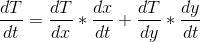
Now we have to find each part

![C (20) + de [10 -0.3672 +3 ***] 10e](http://img.homeworklib.com/questions/db9e46f0-bf12-11eb-8f2b-5f226c9d3084.png?x-oss-process=image/resize,w_560)







![=\left [0+10\frac{\mathrm{d} }{\mathrm{d} y}e^{-0.3(x^{2}+y^{2})} \right ]](http://img.homeworklib.com/questions/ded028e0-bf12-11eb-87dc-09200962bd64.png?x-oss-process=image/resize,w_560)
![=\left [10e^{-0.3(x^{2}+y^{2})}\frac{\mathrm{d} }{\mathrm{d} y}{-0.3(x^{2}+y^{2})} \right ]](http://img.homeworklib.com/questions/df3199b0-bf12-11eb-a500-2588cf108d01.png?x-oss-process=image/resize,w_560)
![=\left [10e^{-0.3(x^{2}+y^{2})}*{-0.3(0+2y)} \right ]](http://img.homeworklib.com/questions/df900e40-bf12-11eb-83d3-a39c29bb4543.png?x-oss-process=image/resize,w_560)


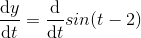
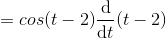
![dir dt (cos(t dt 2)]](http://img.homeworklib.com/questions/e0e00580-bf12-11eb-8a9a-296ea45e2eeb.png?x-oss-process=image/resize,w_560)
![=sin(t-2)\frac{\mathrm{d} }{\mathrm{d} t}\left [ t-2\right ]](http://img.homeworklib.com/questions/e13874a0-bf12-11eb-aff5-4744e862c052.png?x-oss-process=image/resize,w_560)









Add Answer to:
6. The temperature at (x,y) is T(x,y) = 20 + 100%+++") degrees (in Celsius). A bug...
The temperature at a point (x, y) is T(x,y), measured in degrees Celsius. A bug crawls...
 The temperature at a point (x, y) is T(x,y), measured in degrees Celsius. A bug crawls so that its position after t seconds is given by x = 4 + t, y = 8 where x and y are measured in centimeters. The temperature function satisfies Tx(5, 9) = 2 and Ty(5, 9) = 7. How fast is the temperature rising on the bug's path after 21 seconds? Step 1 We know that the rate of change of the temperature...
Pt 3. The temperature (in C) at the point (r, y) (r and y are measured in em) is T(r.y). A bug cr...
 pt 3. The temperature (in C) at the point (r, y) (r and y are measured in em) is T(r.y). A bug crawls along a path (see the picture below) from left to right toward the point P V T(P) (a) Find the directional derivative of the temperature at the point P in the direction of the bug's travel if the angle between this direction and VT(P) (the gradient of T at P) is r/3 and /VT(P)I-5 (b) At the...
y(m) 1. (10 points) The temperature of a plate in the ry-plane is given by 3 48 2 T(x, y) x2 2y2 2 1 T is in degrees Ce...
 y(m) 1. (10 points) The temperature of a plate in the ry-plane is given by 3 48 2 T(x, y) x2 2y2 2 1 T is in degrees Celsius (°C) and x, y are in meters (m). A contour plot of T(x, y) is shown at right. -3 -2 4 3 4 (a) At the point (-2,1) draw and label a vector in the direction 6 of VT(-2, 1 8 4 (b) At (-2, 1) draw and label both vectors...
5. The temperature of a metal plate at (x,y) is e rate of 8ft/min (.e. -2). degrees. A bug is wal...
 5. The temperature of a metal plate at (x,y) is e rate of 8ft/min (.e. -2). degrees. A bug is walking northeast at a dx dy dt dt a) From the bug's point of view, at what rate is the temperature changing with respect to distance as it crosses the origin? Label your answer with correct units. b) If the bug is sitting at the origin, in what direction should it start moving to experience the greatest rate of decrease...
Problem 3. (1 point) The temperature at a point (X,Y,Z) is given by T(x, y, z)...
 Problem 3. (1 point) The temperature at a point (X,Y,Z) is given by T(x, y, z) = 200e-x=y+14–2–19, where T is measured in degrees Celsius and x,y, and z in meters. There are lots of places to make silly errors in this problem; just try to keep track of what needs to be a unit vector. Find the rate of change of the temperature at the point (-1, 1,-1) in the direction toward the point (-4,-5, -5). In which direction...
6. (10 points) (a) (6 points) The gradient of the function o(x, y, z) at (1,2,3)...
 6. (10 points) (a) (6 points) The gradient of the function o(x, y, z) at (1,2,3) is the vector (2, 1, 1) and g(1,2,3) = 1 (1) (2 points) Find the equation of the tangent plane of the level surface g(r, y, z) = 1 at (1,2,3) (ii) (2 points) Find the maximum rate of change of g(x, y, z) at (1, 2, 3). hax. rarte ot change: 23 14 (iii) (2 points) Find the rate of change of g...
25. Given the following parametric curve X(t) = -1 + 3 cos(t) y(t) = 1 +...
 25. Given the following parametric curve X(t) = -1 + 3 cos(t) y(t) = 1 + 2 sin(t) 0<t<21 a) Express the curve with an equation that relates x and y. 7C b) Find the slope of the tangent line to the curve at the point t c) State the pair(s) (x,y) where the curve has a horizontal/vertical tangent line. 27.A particle is traveling along the path such that its position at any time t is given by r(t) =...
6) 6 Distance x (cm) Temperatuire 100 93 70 6255 A metal wire of length 8 centimeters (cm) is heated at one end. The table above gives selected values of thetemperature T(x), in degrees Celsius (...
 6) 6 Distance x (cm) Temperatuire 100 93 70 6255 A metal wire of length 8 centimeters (cm) is heated at one end. The table above gives selected values of thetemperature T(x), in degrees Celsius (°C), of the wire χ cm from the heated end. The function T is decreasing and is twice differentiable. a. Estimate T'(C7). Show the work that leads to your answer. Indicate units of measure b. Write an integral expression in terms of T(x) for the...
VBA The projectile motion equations are,x=x0+v0*cos(θ)*t, y=y0+v0*sin(θ)*t+0.5*g*t^2 where x and y are the current position at...
VBA The projectile motion equations are,x=x0+v0*cos(θ)*t, y=y0+v0*sin(θ)*t+0.5*g*t^2 where x and y are the current position at time t, x0 and y0 are the projectile’s initial position, v0 is the projectile’s initial speed, θ is the initial firing angle of the projectile, and g is the gravitational acceleration which is -9.81 m/s2 near Earth’s surface. The user (me) will input the initial x-position (m), y-position (m), speed (m/s), the firing angle (in degrees) in cells F2-F5 on Sheet2. Create a run...
F- [y - yz sin x,x + z cos x,y cos x] from OstsT/2 where the path is defined as follows x- 2t y =...
 F- [y - yz sin x,x + z cos x,y cos x] from OstsT/2 where the path is defined as follows x- 2t y = (1 + cost)2 z- 4(sint)3 m. F= [8xy®z, 12x2y®z, 4x2yaj from (2,0,0) to (0,2,π/2). The path is a helix of radius 2 advancing 1 unit along the positive z axis in one period of 2Tt. We were unable to transcribe this image
F- [y - yz sin x,x + z cos x,y cos x] from...
F- [y - yz sin x,x + z cos x,y cos x] from OstsT/2 where the path is defined as follows x- 2t y = (1 + cost)2 z- 4(sint)3 m. F= [8xy®z, 12x2y®z, 4x2yaj from (2,0,0) to (0,2,π/2). The path is a helix of radius 2 advancing 1 unit along the positive z axis in one period of 2Tt. We were unable to transcribe this image
F- [y - yz sin x,x + z cos x,y cos x] from...
 The temperature at a point (x, y) is T(x,y), measured in degrees Celsius. A bug crawls so that its position after t seconds is given by x = 4 + t, y = 8 where x and y are measured in centimeters. The temperature function satisfies Tx(5, 9) = 2 and Ty(5, 9) = 7. How fast is the temperature rising on the bug's path after 21 seconds? Step 1 We know that the rate of change of the temperature...
 pt 3. The temperature (in C) at the point (r, y) (r and y are measured in em) is T(r.y). A bug crawls along a path (see the picture below) from left to right toward the point P V T(P) (a) Find the directional derivative of the temperature at the point P in the direction of the bug's travel if the angle between this direction and VT(P) (the gradient of T at P) is r/3 and /VT(P)I-5 (b) At the...
 y(m) 1. (10 points) The temperature of a plate in the ry-plane is given by 3 48 2 T(x, y) x2 2y2 2 1 T is in degrees Celsius (°C) and x, y are in meters (m). A contour plot of T(x, y) is shown at right. -3 -2 4 3 4 (a) At the point (-2,1) draw and label a vector in the direction 6 of VT(-2, 1 8 4 (b) At (-2, 1) draw and label both vectors...
 5. The temperature of a metal plate at (x,y) is e rate of 8ft/min (.e. -2). degrees. A bug is walking northeast at a dx dy dt dt a) From the bug's point of view, at what rate is the temperature changing with respect to distance as it crosses the origin? Label your answer with correct units. b) If the bug is sitting at the origin, in what direction should it start moving to experience the greatest rate of decrease...
 Problem 3. (1 point) The temperature at a point (X,Y,Z) is given by T(x, y, z) = 200e-x=y+14–2–19, where T is measured in degrees Celsius and x,y, and z in meters. There are lots of places to make silly errors in this problem; just try to keep track of what needs to be a unit vector. Find the rate of change of the temperature at the point (-1, 1,-1) in the direction toward the point (-4,-5, -5). In which direction...
 6. (10 points) (a) (6 points) The gradient of the function o(x, y, z) at (1,2,3) is the vector (2, 1, 1) and g(1,2,3) = 1 (1) (2 points) Find the equation of the tangent plane of the level surface g(r, y, z) = 1 at (1,2,3) (ii) (2 points) Find the maximum rate of change of g(x, y, z) at (1, 2, 3). hax. rarte ot change: 23 14 (iii) (2 points) Find the rate of change of g...
 25. Given the following parametric curve X(t) = -1 + 3 cos(t) y(t) = 1 + 2 sin(t) 0<t<21 a) Express the curve with an equation that relates x and y. 7C b) Find the slope of the tangent line to the curve at the point t c) State the pair(s) (x,y) where the curve has a horizontal/vertical tangent line. 27.A particle is traveling along the path such that its position at any time t is given by r(t) =...
 6) 6 Distance x (cm) Temperatuire 100 93 70 6255 A metal wire of length 8 centimeters (cm) is heated at one end. The table above gives selected values of thetemperature T(x), in degrees Celsius (°C), of the wire χ cm from the heated end. The function T is decreasing and is twice differentiable. a. Estimate T'(C7). Show the work that leads to your answer. Indicate units of measure b. Write an integral expression in terms of T(x) for the...
 F- [y - yz sin x,x + z cos x,y cos x] from OstsT/2 where the path is defined as follows x- 2t y = (1 + cost)2 z- 4(sint)3 m. F= [8xy®z, 12x2y®z, 4x2yaj from (2,0,0) to (0,2,π/2). The path is a helix of radius 2 advancing 1 unit along the positive z axis in one period of 2Tt. We were unable to transcribe this image
F- [y - yz sin x,x + z cos x,y cos x] from...
F- [y - yz sin x,x + z cos x,y cos x] from OstsT/2 where the path is defined as follows x- 2t y = (1 + cost)2 z- 4(sint)3 m. F= [8xy®z, 12x2y®z, 4x2yaj from (2,0,0) to (0,2,π/2). The path is a helix of radius 2 advancing 1 unit along the positive z axis in one period of 2Tt. We were unable to transcribe this image
F- [y - yz sin x,x + z cos x,y cos x] from...
Most questions answered within 3 hours.
-
Where is the error in this code sequence?
String s1 = "Hello";
String s2 = "ello";...
asked 11 months ago -
Financial data for Joel de Paris, Inc., for last year
follow:
Joel de Paris, Inc.
Balance...
asked 11 months ago -
Consider this reaction:
Al2(SO4)3 (aq)+ BaCl3
(aq) Al2Cl6 (aq)- +
3BaSO4(s) . What is the...
asked 11 months ago -
Suppose that Savneet is considering increasing her
recent random sample from 20 car rentals to 40...
asked 11 months ago -
Trucks arrive at an unloading terminal at an average rate of 120
per hour.
Trucks arrive...
asked 11 months ago -
Why are methanol and ethanol completely soluble in water while
octanol is not very little soluble....
asked 11 months ago -
A facilities manager at a university reads in a research report
that the mean amount of...
asked 11 months ago -
When the CuSO4 is rehydrated by adding water to the anhydrous
compound, is this an endothermic...
asked 11 months ago -
A ray of sunlight is passing from diamond into crown glass; the
angle of incidence is...
asked 11 months ago -
A block of mass 0.249 kg is placed on top of a light, vertical
spring of...
asked 11 months ago -
how do the kidneys compensate in the presences of acidosis
a) trigger hyperventilate
b) reserve acid...
asked 11 months ago -
Question 501 pts
The rental rate of capital to the firm increases. Which of the
following...
asked 11 months ago