Explain why the following is true: If preferences are homothetic, then both goods are normal. Explain...
Explain why the following is true: If preferences are homothetic, then both goods are normal.
Explain why the following is false: If both goods are normal, then preferences are homothetic.
True or False: For U(X, Y) and the income offer curve is either a vertical line or horizontal line not out of the origin, then the Engels curve for one of the goods will be vertical line not out of the origin.
Explain why the following is true: If the Engels curve is upward sloping then the demand curve is downward sloping.
The utility equals the square of x times the square of y and he spends $347 on good y.
a. How much does he spend on good x if its price is $113?
A person has homothetic preferences. He only buys brandy and cigars. He is a profligate old codger and spends all of his income on these two goods. He spends 76% of his income on brandy.
a. If his income increases by $200 how much money does he spend on cigars?
Homework Answers
1) The statement is true because homothetic preferences means those preferences which are monotonic transformation of homogenous preferences. Now, the homogenous preferences have this property that these preferences are linear in prices and income. It means, demand for the given commodity increases (decreases) in the same proportion to increase (decrease) in income. If a commodity's demand increase/decrease with the rise/fall in consumer's income then the goods are said to be normal goods.
2) If both goods are normal, then preferences are homothetic. This statement is not true because homothetic preferences have this fundamental property that the income offer curve of such preferences is a straight line passing through origin which means that the as income of the consumer increase/decreases, the expenditure on both goods increase/decrease in the same proportion. However, this is not true even if both the goods are normal goods. For some goods, like luxury cars, expenditure rise more than proportionaltely to rise in consumer's income.
3) For U(X, Y) and the income offer curve is either a vertical line or horizontal line not out of the origin, then the Engels curve for one of the goods will be vertical line not out of the origin.
This is true. Engel curve represents the relationship of a commodity with income of consumer. Engel curve is drawn in income-quantity space. A vertical engel curve means that a commodity's demand is not at all affected by income of the consumer. If this is to be shown in an income offer curve, with all other commoditites that the consumer buys, then the income offer curve can not pass through origin, it will be either horizontal or vertical.
4) It is true that if the Engels curve is upward sloping then the demand curve must slope downwards because an upward sloping engel curve shows positive income effect. A positive income effect means the good is a normal good and for such goods, demand always slopes downwards.
Add Answer to:
Explain why the following is true: If preferences are
homothetic, then both goods are normal.
Explain...
multiple choices: Which of the following statements are True? (A) If preferences are homothetic, Engel curves...
multiple choices: Which of the following statements are True? (A) If preferences are homothetic, Engel curves must be straight lines. (B) An Engel curve is a demand curve with the vertical and horizontal axes reversed. (C) If preferences are non-satiated, it is impossible for all goods to be inferior goods. (D) If preferences are homothetic, Engel curves cannot be straight lines. (E) If preferences are homothetic, every good must be a normal good.
1. True or False, and explain briefly. 1) The assumption that more is better implies that...
 1. True or False, and explain briefly. 1) The assumption that more is better implies that the indifference curves are upward sloping 2) Convexity of indifference curves implies that consumers are willing to give up more to get an extra the more they have 3) Consider the following three bundles. Bundle Good Goody If Bundles A and B are on the same indifference curve, preferences satisfy all the usual assumptions introduced in the lecture, Bundle Cis preferred to Bundle A...
)For each of the following statements, determine whether it is true or false? Briefly explain. (24...
 )For each of the following statements, determine whether it is true or false? Briefly explain. (24 pts (a) If a con b) Assumin s preferences are transitive then they must be complete as well. False. sumer' g there are only two goods, if one good is a bad and the other is a good, then the indifference curves are upward sloping. c) can intersect only if the goods are perfect complements. Indifference curves ) If two utility functions u(-) and...
5. Otis B. Driftwood has preferences over seaweed (S) and conch (C) where the prices of...
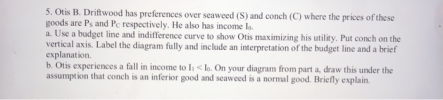 5. Otis B. Driftwood has preferences over seaweed (S) and conch (C) where the prices of these goods are Ps and Pc respectively. He also has income lo. a. Use a budget line and indifference curve to show Otis maximizing his utility. Put conch on the vertical axis. Label the diagram fully and include an interpretation of the budget line and a brief explanation. b. Otis experiences a fall in income to li<lo. On your diagram from part a, draw...
(38pts) Suppose a consumer spends all of her income on only two goods, z and y. Her preferences o...
 (38pts) Suppose a consumer spends all of her income on only two goods, z and y. Her preferences over these two goods are represented by the utility function u(r,y) min(, 4y). The price of good y is given to be S8. Her income and price of z are represented by m and ps, respectively. (a) (10 pts) Find the demand for good z as a function of m and pa. (b) (5 pts) Is good z ordinary or Giffen good?...
QUESTION 4 Reshad's preferences over goods 1 and 2 are given by the following utility function:...
 QUESTION 4 Reshad's preferences over goods 1 and 2 are given by the following utility function: U(q1, q2)q2Select all that applies: O a His preferences satisfy "more is better O b. His preferences fail the transitivity assumption C. His indifference curves are downward sloping His preferences are convex D e. He dislikes good 1 Marginal rate of substitution for his preferences is given by MRS12
Suppose that there are only two goods (x and y) and good y is an inferior...
Suppose that there are only two goods (x and y) and good y is an inferior good. The demand curve for good x cannot be vertical. True or false. Explain your answer graphically and intuitively.
Suppose X and Y are substitutes and are both normal goods. Assume X is on the...
Suppose X and Y are substitutes and are both normal goods. Assume X is on the horizontal axis and Y is on the vertical axis. If the price of X increase, which of the following will NOT happen? A) The slope of the income offer curve will become flatter B) The slope of the income offer curve will become steeper C) The Engel Curve for X will become steeper/ "shift" to the left D) The Engel Curve for Y will...
Suppose a consumer spend all of her income on only two goods, x and y. Her preferences over these two goods are represen...
Suppose a consumer spend all of her income on only two goods, x and y. Her preferences over these two goods are represented by the utility function u(x,y)=2x1/2+3y. Find the mrsxy. Is it diminishing or not? (In the solution of this problem our teachers prefers to solve this via MUx/ MUy this ratio. But in other schools they prefer to solve this MUx/ MUy . Which one is true ? Why they use minus sign ?
-shaped preferences. Person A has an income of $M and spends all of her income on...
-shaped preferences. Person A has an income of $M and spends all of her income on the only two goods in her world - good X with price px and good Y with pY which we will set equal to 1 (i.e. good y is the numeraire). Draw a well-labelled diagram showing an individual’s budget constraint. This includes intercepts and slope. Assume that Person A has Leontief preferences – that is, L-shaped indifference curves (such preferences are described by the...
 1. True or False, and explain briefly. 1) The assumption that more is better implies that the indifference curves are upward sloping 2) Convexity of indifference curves implies that consumers are willing to give up more to get an extra the more they have 3) Consider the following three bundles. Bundle Good Goody If Bundles A and B are on the same indifference curve, preferences satisfy all the usual assumptions introduced in the lecture, Bundle Cis preferred to Bundle A...
 )For each of the following statements, determine whether it is true or false? Briefly explain. (24 pts (a) If a con b) Assumin s preferences are transitive then they must be complete as well. False. sumer' g there are only two goods, if one good is a bad and the other is a good, then the indifference curves are upward sloping. c) can intersect only if the goods are perfect complements. Indifference curves ) If two utility functions u(-) and...
 5. Otis B. Driftwood has preferences over seaweed (S) and conch (C) where the prices of these goods are Ps and Pc respectively. He also has income lo. a. Use a budget line and indifference curve to show Otis maximizing his utility. Put conch on the vertical axis. Label the diagram fully and include an interpretation of the budget line and a brief explanation. b. Otis experiences a fall in income to li<lo. On your diagram from part a, draw...
 (38pts) Suppose a consumer spends all of her income on only two goods, z and y. Her preferences over these two goods are represented by the utility function u(r,y) min(, 4y). The price of good y is given to be S8. Her income and price of z are represented by m and ps, respectively. (a) (10 pts) Find the demand for good z as a function of m and pa. (b) (5 pts) Is good z ordinary or Giffen good?...
 QUESTION 4 Reshad's preferences over goods 1 and 2 are given by the following utility function: U(q1, q2)q2Select all that applies: O a His preferences satisfy "more is better O b. His preferences fail the transitivity assumption C. His indifference curves are downward sloping His preferences are convex D e. He dislikes good 1 Marginal rate of substitution for his preferences is given by MRS12
Most questions answered within 3 hours.
-
Where is the error in this code sequence?
String s1 = "Hello";
String s2 = "ello";...
asked 10 months ago -
Financial data for Joel de Paris, Inc., for last year
follow:
Joel de Paris, Inc.
Balance...
asked 10 months ago -
Consider this reaction:
Al2(SO4)3 (aq)+ BaCl3
(aq) Al2Cl6 (aq)- +
3BaSO4(s) . What is the...
asked 10 months ago -
Suppose that Savneet is considering increasing her
recent random sample from 20 car rentals to 40...
asked 10 months ago -
Trucks arrive at an unloading terminal at an average rate of 120
per hour.
Trucks arrive...
asked 10 months ago -
Why are methanol and ethanol completely soluble in water while
octanol is not very little soluble....
asked 10 months ago -
A facilities manager at a university reads in a research report
that the mean amount of...
asked 10 months ago -
When the CuSO4 is rehydrated by adding water to the anhydrous
compound, is this an endothermic...
asked 10 months ago -
A ray of sunlight is passing from diamond into crown glass; the
angle of incidence is...
asked 10 months ago -
A block of mass 0.249 kg is placed on top of a light, vertical
spring of...
asked 10 months ago -
how do the kidneys compensate in the presences of acidosis
a) trigger hyperventilate
b) reserve acid...
asked 10 months ago -
Question 501 pts
The rental rate of capital to the firm increases. Which of the
following...
asked 10 months ago