A chemist would like to 800.0 mL of a 5.00 M solution of potassium hydroxide. What...
A chemist would like to 800.0 mL of a 5.00 M solution of potassium hydroxide. What mass of KOH is needed to make this solution? (Molar mass of KOH = 56.10 g/mol)
Homework Answers

Add Answer to:
A chemist would like to 800.0 mL of a 5.00 M solution of
potassium hydroxide. What...
A chemist titrates 150.0 mL of a 0.1029 M potassium hydroxide (KOH) solution with 0.8645 M...
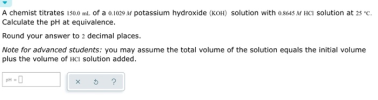 A chemist titrates 150.0 mL of a 0.1029 M potassium hydroxide (KOH) solution with 0.8645 M HCl solution at 25°C. Calculate the pH at equivalence. Round your answer to 2 decimal places. Note for advanced students: you may assume the total volume of the solution equals the initial volume plus the volume of HCl solution added. x 5 ?
A chemist must prepare 850.0 mL of potassium hydroxide solution with a pH of 12.20 at...
 A chemist must prepare 850.0 mL of potassium hydroxide solution with a pH of 12.20 at 25°C. He will do this in three steps: . Fill a 850.0 ml volumetric flask about halfway with distilled water. • Weigh out a small amount of solid potassium hydroxide and add it to the flask. • Fill the flask to the mark with distilled water. Calculate the mass of potassium Hydroxide that the chemist must weigh out in the second step. Round your...
Could someone answer the following questions? 1) 11.2 g of potassium hydroxide (KOH) is dissolved in...
Could someone answer the following questions? 1) 11.2 g of potassium hydroxide (KOH) is dissolved in sufficient water to make 1 L of solution. What is the concentration of KOH in the solution? a. 0.02 mol/L b. 0.1 mol/L c. 0.2 mol/L d. 0.01 mol/L 2) If the solution is neutral, which of the following must be true? a. [OH-] = [H2O] b. [H+] > [OH-] c. [H+] < [OH-] d. [H+] = [OH-] 3)A student titrates 0.5222 grams of...
A volume of 70.0 mL of aqueous potassium hydroxide (KOH) was titrated against a standard solution...
A volume of 70.0 mL of aqueous potassium hydroxide (KOH) was titrated against a standard solution of sulfuric acid (H2SO4). What was the molarity of the KOH solution if 15.2 mL of 1.50 M H2SO4 was needed? The equation is 2KOH(aq)+H2SO4(aq)?K2SO4(aq)+2H2O(l) part b: Redox titrations are used to determine the amounts of oxidizing and reducing agents in solution. For example, a solution of hydrogen peroxide, H2O2, can be titrated against a solution of potassium permanganate, KMnO4. The following equation represents...
Objective Knowledge Check Question 14 A chemist must prepare 500.0 mL of potassium hydroxide solution with...
 Objective Knowledge Check Question 14 A chemist must prepare 500.0 mL of potassium hydroxide solution with a pH of 12.10 at 25 °C. She will do this in three steps: Fill a 500.0 mlL volumetric flask about halfway with distilled water Weigh out a small amount of solid potassium hydroxide and add it to the flask. Fill the flask to the mark with distilled water. Calculate the mass of potassium hydroxide that the chemist must weigh out in the second...
Question 6 (0.5 marks) Two solids, 4.20 g of sodium hydroxide and 5.00 g potassium hydroxide...
 Question 6 (0.5 marks) Two solids, 4.20 g of sodium hydroxide and 5.00 g potassium hydroxide are added to 200.0 mL of water in a calorimeter. If the initial temperature of the water is 20.0 °C, Asolution H (NaOH) = - 44.3 kJ/mol, and solution H (KOH) = -56.0 kJ/mol, calculate the final temperature of the solution. You may need to obtain some data from your textbook when answering this question. Assume the specific heat capacity of the solution is...
Question 6 (0.5 marks) Two solids, 4.20 g of sodium hydroxide and 5.00 g potassium hydroxide...
 Question 6 (0.5 marks) Two solids, 4.20 g of sodium hydroxide and 5.00 g potassium hydroxide are added to 200.0 mL of water in a calorimeter. If the initial temperature of the water is 20.0 °C, Asolution H (NaOH) = -44.3 kJ/mol, and solution (KOH) = -56.0 kJ/mol, calculate the final temperature of the solution. You may need to obtain some data from your textbook when answering this question. Assume the specific heat capacity of the solution is the same...
A solution of potassium hydroxide (KOH, 56.11 g/mol) is 38% by mass with a density of...
A solution of potassium hydroxide (KOH, 56.11 g/mol) is 38% by mass with a density of 1.344 g/mol. WHat is the molality of the KOH?
A volume of 90.0 mL of aqueous potassium hydroxide (KOH) was titrated against a standard solution...
A volume of 90.0 mL of aqueous potassium hydroxide (KOH) was titrated against a standard solution of sulfuric acid (H2SO4). What was the molarity of the KOH solution if 25.7 mL of 1.50 M H2SO4 was needed? The equation is 2KOH(aq)+H2SO4(aq)→K2SO4(aq)+2H2O(l)
Potassium hydroxide is very soluble in water, resulting in extremely basic solutions. A 121 g sample...
 Potassium hydroxide is very soluble in water, resulting in extremely basic solutions. A 121 g sample KOH is dissolved in water at 25 °C to make up 100.0 mL of solution. The molar mass of KOH is 56.11 3. What is the pH of the solution at 25.0°C? • Round the answer to two decimal places.
 A chemist titrates 150.0 mL of a 0.1029 M potassium hydroxide (KOH) solution with 0.8645 M HCl solution at 25°C. Calculate the pH at equivalence. Round your answer to 2 decimal places. Note for advanced students: you may assume the total volume of the solution equals the initial volume plus the volume of HCl solution added. x 5 ?
 A chemist must prepare 850.0 mL of potassium hydroxide solution with a pH of 12.20 at 25°C. He will do this in three steps: . Fill a 850.0 ml volumetric flask about halfway with distilled water. • Weigh out a small amount of solid potassium hydroxide and add it to the flask. • Fill the flask to the mark with distilled water. Calculate the mass of potassium Hydroxide that the chemist must weigh out in the second step. Round your...
 Objective Knowledge Check Question 14 A chemist must prepare 500.0 mL of potassium hydroxide solution with a pH of 12.10 at 25 °C. She will do this in three steps: Fill a 500.0 mlL volumetric flask about halfway with distilled water Weigh out a small amount of solid potassium hydroxide and add it to the flask. Fill the flask to the mark with distilled water. Calculate the mass of potassium hydroxide that the chemist must weigh out in the second...
 Question 6 (0.5 marks) Two solids, 4.20 g of sodium hydroxide and 5.00 g potassium hydroxide are added to 200.0 mL of water in a calorimeter. If the initial temperature of the water is 20.0 °C, Asolution H (NaOH) = - 44.3 kJ/mol, and solution H (KOH) = -56.0 kJ/mol, calculate the final temperature of the solution. You may need to obtain some data from your textbook when answering this question. Assume the specific heat capacity of the solution is...
 Question 6 (0.5 marks) Two solids, 4.20 g of sodium hydroxide and 5.00 g potassium hydroxide are added to 200.0 mL of water in a calorimeter. If the initial temperature of the water is 20.0 °C, Asolution H (NaOH) = -44.3 kJ/mol, and solution (KOH) = -56.0 kJ/mol, calculate the final temperature of the solution. You may need to obtain some data from your textbook when answering this question. Assume the specific heat capacity of the solution is the same...
 Potassium hydroxide is very soluble in water, resulting in extremely basic solutions. A 121 g sample KOH is dissolved in water at 25 °C to make up 100.0 mL of solution. The molar mass of KOH is 56.11 3. What is the pH of the solution at 25.0°C? • Round the answer to two decimal places.
Most questions answered within 3 hours.
-
Where is the error in this code sequence?
String s1 = "Hello";
String s2 = "ello";...
asked 11 months ago -
Financial data for Joel de Paris, Inc., for last year
follow:
Joel de Paris, Inc.
Balance...
asked 11 months ago -
Consider this reaction:
Al2(SO4)3 (aq)+ BaCl3
(aq) Al2Cl6 (aq)- +
3BaSO4(s) . What is the...
asked 11 months ago -
Suppose that Savneet is considering increasing her
recent random sample from 20 car rentals to 40...
asked 11 months ago -
Trucks arrive at an unloading terminal at an average rate of 120
per hour.
Trucks arrive...
asked 11 months ago -
Why are methanol and ethanol completely soluble in water while
octanol is not very little soluble....
asked 11 months ago -
A facilities manager at a university reads in a research report
that the mean amount of...
asked 11 months ago -
When the CuSO4 is rehydrated by adding water to the anhydrous
compound, is this an endothermic...
asked 11 months ago -
A ray of sunlight is passing from diamond into crown glass; the
angle of incidence is...
asked 11 months ago -
A block of mass 0.249 kg is placed on top of a light, vertical
spring of...
asked 11 months ago -
how do the kidneys compensate in the presences of acidosis
a) trigger hyperventilate
b) reserve acid...
asked 11 months ago -
Question 501 pts
The rental rate of capital to the firm increases. Which of the
following...
asked 11 months ago