

Homework Answers


Add Answer to:
4) (12pt) An unknown mass M is non-uniformly distributed along a semi-circular arc of radius R...
A particle of mass m can slide frictionlessly along a circular ring of radius R that...
 A particle of mass m can slide frictionlessly along a circular ring of radius R that is rotating about its vertical diameter at a given (fixed) angular velocity of Ohm, as shown in the figure. Derive the equation of motion for the system.
4. Consider a circular loop of wire with a mass m and a radius R. The...
 4. Consider a circular loop of wire with a mass m and a radius R. The circular loop is vertical such that gravitational force on the loop points straight down. You may assume this is near the surface of the earth such that the force of gravity has a magnitude FGl mg. The upper half of the circular wire is immersed in a uniform magnetic field B pointing into the page. In the figure below this corresponds to the region...
A mass, m, is distributed non-uniformly over sphere of radius R. The mass distribution is described...
 A mass, m, is distributed non-uniformly over sphere of radius R. The mass distribution is described by the expression p br. Write the expression, dm, that represents the infinitesimal mass of a spherical shell of radius r and infinitesimal thickness dr
An electron with charge −e and mass m moves in a circular orbit of radius r...
An electron with charge −e and mass m moves in a circular orbit of radius r around a nucleus of charge Ze, where Z is the atomic number of the nucleus. Ignore the gravitational force between the electron and the nucleus. Find an expression in terms of these quantities for the speed of the electron in this orbit. (Use any variable or symbol stated above along with the following as necessary: k for Coulomb's constant.) v = ?
9. For the given half sphere with uniformly distributed mass, M and radius R, determine the...
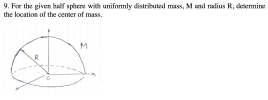 9. For the given half sphere with uniformly distributed mass, M and radius R, determine the location of the center of mass.
An object of mass m moves at a constant speed v in a circular path of radius r.
An object of mass m moves at a constant speed v in a circular path of radius r. The force required to produce the centripetal component of acceleration is called the centripetal force and is given by F=mv2/r. Newton's Law of Universal Gravitation is given by F=GMm/d2, where d is the distance between the centers of the two bodies of masses M and m, and G is a gravitational constant. The speed required for circular motion is v= √(GM/r). Use the...
A student is riding their bike when they come across a turn in the form of a circular arc of radius R 3.0m as pictured in the diagram below and travel along this arc in the clockwise direction. At on...
 A student is riding their bike when they come across a turn in the form of a circular arc of radius R 3.0m as pictured in the diagram below and travel along this arc in the clockwise direction. At one point along this trajectory (the origin of the given coordinate system) it makes sense to define the Cartesian coordinate system shown where the x-axis is tangent to the trajectory and the y-axis is perpendicular to it. At this point the...
3. A very thin circular hoop of mass m and radius r is made to roll,...
 3. A very thin circular hoop of mass m and radius r is made to roll, without slipping, down a ramp with an angle of inclination (with respect to the horizontal), as shown in the figure below. See Figure 3. Note: The moment of inertia of the thin circular hoop is given by: I houp = mra Consider a system consisting of a ladder with a painter climbing said ladder. The ladder has a length 1 = 5,00 meters and...
A circular hoop of mass m, radius r, and infinitesimal thickness rolls without slipping down a ramp inclined at an angle θ with the horizontal. (Intro 1figure)
 A circular hoop of mass m, radius r, and
infinitesimal thickness rolls without slipping down a ramp inclined at an angle θ with the
horizontal. (Intro 1figure)part a)What is the acceleration of
the center of the hoop?Express the acceleration in terms of physical constants and all or some of the
quantities m,r,and θ.part b)What is the minimum coefficient of
(static)friction needed
for the hoop to roll without slipping? Note that it is static and
not kinetic friction that is relevant here,...
A circular hoop of mass m, radius r, and
infinitesimal thickness rolls without slipping down a ramp inclined at an angle θ with the
horizontal. (Intro 1figure)part a)What is the acceleration of
the center of the hoop?Express the acceleration in terms of physical constants and all or some of the
quantities m,r,and θ.part b)What is the minimum coefficient of
(static)friction needed
for the hoop to roll without slipping? Note that it is static and
not kinetic friction that is relevant here,...
thank you Problem 5 A solid sphere of mass M-2.00 ks (uniformly distributed) and radius R...
 thank you
Problem 5 A solid sphere of mass M-2.00 ks (uniformly distributed) and radius R -0.100 m starts from rest at the top of an inclined plane of length L - 1.50 m and height H-0.500 m. The coefficient of static friction between the sphere and the inclined plane is H, -0.400. The sphere rolls without slipping down the inclined plane. The moment of inertia of the sphere about an axis through its center of mass is given by...
thank you
Problem 5 A solid sphere of mass M-2.00 ks (uniformly distributed) and radius R -0.100 m starts from rest at the top of an inclined plane of length L - 1.50 m and height H-0.500 m. The coefficient of static friction between the sphere and the inclined plane is H, -0.400. The sphere rolls without slipping down the inclined plane. The moment of inertia of the sphere about an axis through its center of mass is given by...
 A particle of mass m can slide frictionlessly along a circular ring of radius R that is rotating about its vertical diameter at a given (fixed) angular velocity of Ohm, as shown in the figure. Derive the equation of motion for the system.
 4. Consider a circular loop of wire with a mass m and a radius R. The circular loop is vertical such that gravitational force on the loop points straight down. You may assume this is near the surface of the earth such that the force of gravity has a magnitude FGl mg. The upper half of the circular wire is immersed in a uniform magnetic field B pointing into the page. In the figure below this corresponds to the region...
 A mass, m, is distributed non-uniformly over sphere of radius R. The mass distribution is described by the expression p br. Write the expression, dm, that represents the infinitesimal mass of a spherical shell of radius r and infinitesimal thickness dr
 9. For the given half sphere with uniformly distributed mass, M and radius R, determine the location of the center of mass.
 A student is riding their bike when they come across a turn in the form of a circular arc of radius R 3.0m as pictured in the diagram below and travel along this arc in the clockwise direction. At one point along this trajectory (the origin of the given coordinate system) it makes sense to define the Cartesian coordinate system shown where the x-axis is tangent to the trajectory and the y-axis is perpendicular to it. At this point the...
 3. A very thin circular hoop of mass m and radius r is made to roll, without slipping, down a ramp with an angle of inclination (with respect to the horizontal), as shown in the figure below. See Figure 3. Note: The moment of inertia of the thin circular hoop is given by: I houp = mra Consider a system consisting of a ladder with a painter climbing said ladder. The ladder has a length 1 = 5,00 meters and...
 A circular hoop of mass m, radius r, and
infinitesimal thickness rolls without slipping down a ramp inclined at an angle θ with the
horizontal. (Intro 1figure)part a)What is the acceleration of
the center of the hoop?Express the acceleration in terms of physical constants and all or some of the
quantities m,r,and θ.part b)What is the minimum coefficient of
(static)friction needed
for the hoop to roll without slipping? Note that it is static and
not kinetic friction that is relevant here,...
A circular hoop of mass m, radius r, and
infinitesimal thickness rolls without slipping down a ramp inclined at an angle θ with the
horizontal. (Intro 1figure)part a)What is the acceleration of
the center of the hoop?Express the acceleration in terms of physical constants and all or some of the
quantities m,r,and θ.part b)What is the minimum coefficient of
(static)friction needed
for the hoop to roll without slipping? Note that it is static and
not kinetic friction that is relevant here,...
 thank you
Problem 5 A solid sphere of mass M-2.00 ks (uniformly distributed) and radius R -0.100 m starts from rest at the top of an inclined plane of length L - 1.50 m and height H-0.500 m. The coefficient of static friction between the sphere and the inclined plane is H, -0.400. The sphere rolls without slipping down the inclined plane. The moment of inertia of the sphere about an axis through its center of mass is given by...
thank you
Problem 5 A solid sphere of mass M-2.00 ks (uniformly distributed) and radius R -0.100 m starts from rest at the top of an inclined plane of length L - 1.50 m and height H-0.500 m. The coefficient of static friction between the sphere and the inclined plane is H, -0.400. The sphere rolls without slipping down the inclined plane. The moment of inertia of the sphere about an axis through its center of mass is given by...
Most questions answered within 3 hours.
-
Where is the error in this code sequence?
String s1 = "Hello";
String s2 = "ello";...
asked 10 months ago -
Financial data for Joel de Paris, Inc., for last year
follow:
Joel de Paris, Inc.
Balance...
asked 10 months ago -
Consider this reaction:
Al2(SO4)3 (aq)+ BaCl3
(aq) Al2Cl6 (aq)- +
3BaSO4(s) . What is the...
asked 10 months ago -
Suppose that Savneet is considering increasing her
recent random sample from 20 car rentals to 40...
asked 10 months ago -
Trucks arrive at an unloading terminal at an average rate of 120
per hour.
Trucks arrive...
asked 10 months ago -
Why are methanol and ethanol completely soluble in water while
octanol is not very little soluble....
asked 10 months ago -
A facilities manager at a university reads in a research report
that the mean amount of...
asked 10 months ago -
When the CuSO4 is rehydrated by adding water to the anhydrous
compound, is this an endothermic...
asked 10 months ago -
A ray of sunlight is passing from diamond into crown glass; the
angle of incidence is...
asked 10 months ago -
A block of mass 0.249 kg is placed on top of a light, vertical
spring of...
asked 10 months ago -
how do the kidneys compensate in the presences of acidosis
a) trigger hyperventilate
b) reserve acid...
asked 10 months ago -
Question 501 pts
The rental rate of capital to the firm increases. Which of the
following...
asked 10 months ago