
Homework Answers
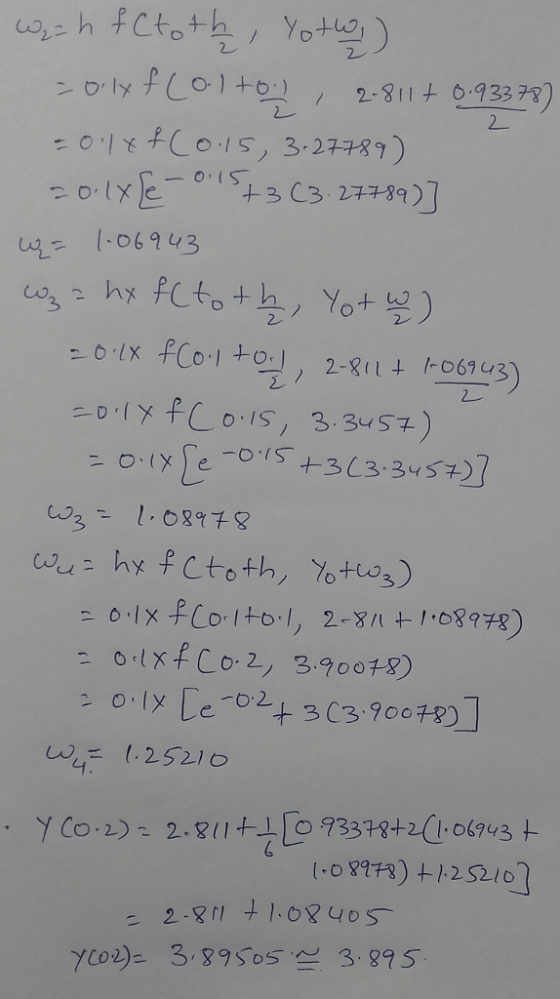
Add Answer to:
Use the Runge Kutta 4th Order (RK-4) Method on the function below to predict the value...
Hey Can someone write me a c++ pogramm using 4th order runge kutta method? h=0.1 y'...
 Hey
Can someone write me a c++ pogramm using 4th order runge kutta
method? h=0.1
y' = 3y, y(0) = 1
Hey
Can someone write me a c++ pogramm using 4th order runge kutta
method? h=0.1
y' = 3y, y(0) = 1
Implement the 4th order Runge-Kutta algotithm in MATLAB. Use the script you produced to integrate...
 Implement the 4th order Runge-Kutta algotithm in MATLAB. Use the script you produced to integrate the following function x(t)--10t + e-t , x(0)--1; t.-0 t, = 1 Vary At and observe the difference in your results. Let At 0.2 sec., 0.1 sec., 0.05 sec. and 0.01 sec. Now integrate the function analytically and compare your result with the results obtained numerically
Implement the 4th order Runge-Kutta algotithm in MATLAB. Use the script you produced to integrate the following function x(t)--10t...
Implement the 4th order Runge-Kutta algotithm in MATLAB. Use the script you produced to integrate the following function x(t)--10t + e-t , x(0)--1; t.-0 t, = 1 Vary At and observe the difference in your results. Let At 0.2 sec., 0.1 sec., 0.05 sec. and 0.01 sec. Now integrate the function analytically and compare your result with the results obtained numerically
Implement the 4th order Runge-Kutta algotithm in MATLAB. Use the script you produced to integrate the following function x(t)--10t...
use matlab Assignment: 1) Write a function program that implements the 4th Order Runge Kutta Method....
 use
matlab
Assignment: 1) Write a function program that implements the 4th Order Runge Kutta Method. The program must plot each of the k values for each iteration (one plot per k value), and the approximated solution (approximated solution curve). Use the subplot command. There should be a total of five plots. If a function program found on the internet was used, then please cite the source. Show the original program and then show the program after any modifications. Submission...
use
matlab
Assignment: 1) Write a function program that implements the 4th Order Runge Kutta Method. The program must plot each of the k values for each iteration (one plot per k value), and the approximated solution (approximated solution curve). Use the subplot command. There should be a total of five plots. If a function program found on the internet was used, then please cite the source. Show the original program and then show the program after any modifications. Submission...
Given the system of first order differential equations below use Runge Kuta 4th Order varying from...
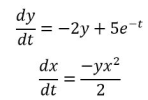 Given the system of first order differential equations below use
Runge Kuta 4th Order
varying from a range of t=0 to 0.4 and step size 0.2 Given
x(0)=4 and y(0)=2
Find the solution of x at t=0.2
Select one:
a. 2.08256
b. 1.36864
c. 2.18677
d. 1.58347
e. None of the given options
dy = -2y + 5e-t dt dx -yx dt 2
Given the system of first order differential equations below use
Runge Kuta 4th Order
varying from a range of t=0 to 0.4 and step size 0.2 Given
x(0)=4 and y(0)=2
Find the solution of x at t=0.2
Select one:
a. 2.08256
b. 1.36864
c. 2.18677
d. 1.58347
e. None of the given options
dy = -2y + 5e-t dt dx -yx dt 2
4. (25 points) Solve the following ODE using classical 4th-order Runge- Kutta method within the domain...
 4. (25 points) Solve the following ODE using classical 4th-order Runge- Kutta method within the domain of x = 0 to x= 2 with step size h = 1: dy 3 dr=y+ 6x3 dx The initial condition is y(0) = 1. If the analytical solution of the ODE is y = 21.97x - 5.15; calculate the error between true solution and numerical solution at y(1) and y(2).
Runge-Kutta method R-K method is given by the following algorithm. o y(xo)- given k2-f(xi5.yi tk,...
 Runge-Kutta method R-K method is given by the following algorithm. Yo = y(xo) = given. k1-f(xy) k4-f(xi +h,yi + k3) 6 For i = 0, 1, 2, , n, where h = (b-a)/n. Consider the same IVP given in problem 2 and answer the following a) Write a MATLAB script file to find y(2) using h = 0.1 and call the file odeRK 19.m b) Generate the following table now using both ode Euler and odeRK19 only for h -0.01....
Using the Runge-Kutta fourth-order method, obtain a solution to dx/dt=f(t,x,y)=xy^3+t^2; dy/dt=g(t,x,y)=ty+x^3 for t= 0 to t= 1 second. The initial conditions are given as x(0)=0, y(0) =1. Use a time...
Using the Runge-Kutta fourth-order method, obtain a solution to dx/dt=f(t,x,y)=xy^3+t^2; dy/dt=g(t,x,y)=ty+x^3 for t= 0 to t= 1 second. The initial conditions are given as x(0)=0, y(0) =1. Use a time increment of 0.2 seconds. Do hand calculations for t = 0.2 sec only.
Ordinary Differential Equations (a) Write a Python function implementing the 4'th order Runge-Kutta method. (b) Solve...
 Ordinary Differential Equations (a) Write a Python function implementing the 4'th order Runge-Kutta method. (b) Solve the following amusing variation on a pendulum problem using your routine. A pendulum is suspended from a sliding collar as shown in the diagram below. The system is at rest when an oscillating motion y(t) = Y sin (omega t) is imposed on the collar, starting at t = 0. The differential equation that describes the pendulum motion is given by: d^2 theta/dt^2 =...
Given (dy/dx)=(3x^3+6xy^2-x)/(2y) with y=0.707 at x= 0, h=0.1 obtain a solution by the fourth order Runge-Kutta method for a range x=0 to 0.5
Given (dy/dx)=(3x^3+6xy^2-x)/(2y) with y=0.707 at x= 0, h=0.1 obtain a solution by the fourth order Runge-Kutta method for a range x=0 to 0.5
Using the fourth order Runge-Kutta method (KK4 to solve a first order initial value problem NOTE:...
 Need help with this MATLAB problem:
Using the fourth order Runge-Kutta method (KK4 to solve a first order initial value problem NOTE: This assignment is to be completed using MATLAB, and your final results including the corresponding M- iles shonma ac Given the first order initial value problem with h-time step size (i.e. ti = to + ih), then the following formula computes an approximate solution to (): i vit), where y(ti) - true value (ezact solution), (t)-f(t, v), vto)...
Need help with this MATLAB problem:
Using the fourth order Runge-Kutta method (KK4 to solve a first order initial value problem NOTE: This assignment is to be completed using MATLAB, and your final results including the corresponding M- iles shonma ac Given the first order initial value problem with h-time step size (i.e. ti = to + ih), then the following formula computes an approximate solution to (): i vit), where y(ti) - true value (ezact solution), (t)-f(t, v), vto)...
 Hey
Can someone write me a c++ pogramm using 4th order runge kutta
method? h=0.1
y' = 3y, y(0) = 1
Hey
Can someone write me a c++ pogramm using 4th order runge kutta
method? h=0.1
y' = 3y, y(0) = 1
 Implement the 4th order Runge-Kutta algotithm in MATLAB. Use the script you produced to integrate the following function x(t)--10t + e-t , x(0)--1; t.-0 t, = 1 Vary At and observe the difference in your results. Let At 0.2 sec., 0.1 sec., 0.05 sec. and 0.01 sec. Now integrate the function analytically and compare your result with the results obtained numerically
Implement the 4th order Runge-Kutta algotithm in MATLAB. Use the script you produced to integrate the following function x(t)--10t...
Implement the 4th order Runge-Kutta algotithm in MATLAB. Use the script you produced to integrate the following function x(t)--10t + e-t , x(0)--1; t.-0 t, = 1 Vary At and observe the difference in your results. Let At 0.2 sec., 0.1 sec., 0.05 sec. and 0.01 sec. Now integrate the function analytically and compare your result with the results obtained numerically
Implement the 4th order Runge-Kutta algotithm in MATLAB. Use the script you produced to integrate the following function x(t)--10t...
 use
matlab
Assignment: 1) Write a function program that implements the 4th Order Runge Kutta Method. The program must plot each of the k values for each iteration (one plot per k value), and the approximated solution (approximated solution curve). Use the subplot command. There should be a total of five plots. If a function program found on the internet was used, then please cite the source. Show the original program and then show the program after any modifications. Submission...
use
matlab
Assignment: 1) Write a function program that implements the 4th Order Runge Kutta Method. The program must plot each of the k values for each iteration (one plot per k value), and the approximated solution (approximated solution curve). Use the subplot command. There should be a total of five plots. If a function program found on the internet was used, then please cite the source. Show the original program and then show the program after any modifications. Submission...
 Given the system of first order differential equations below use
Runge Kuta 4th Order
varying from a range of t=0 to 0.4 and step size 0.2 Given
x(0)=4 and y(0)=2
Find the solution of x at t=0.2
Select one:
a. 2.08256
b. 1.36864
c. 2.18677
d. 1.58347
e. None of the given options
dy = -2y + 5e-t dt dx -yx dt 2
Given the system of first order differential equations below use
Runge Kuta 4th Order
varying from a range of t=0 to 0.4 and step size 0.2 Given
x(0)=4 and y(0)=2
Find the solution of x at t=0.2
Select one:
a. 2.08256
b. 1.36864
c. 2.18677
d. 1.58347
e. None of the given options
dy = -2y + 5e-t dt dx -yx dt 2
 4. (25 points) Solve the following ODE using classical 4th-order Runge- Kutta method within the domain of x = 0 to x= 2 with step size h = 1: dy 3 dr=y+ 6x3 dx The initial condition is y(0) = 1. If the analytical solution of the ODE is y = 21.97x - 5.15; calculate the error between true solution and numerical solution at y(1) and y(2).
 Runge-Kutta method R-K method is given by the following algorithm. Yo = y(xo) = given. k1-f(xy) k4-f(xi +h,yi + k3) 6 For i = 0, 1, 2, , n, where h = (b-a)/n. Consider the same IVP given in problem 2 and answer the following a) Write a MATLAB script file to find y(2) using h = 0.1 and call the file odeRK 19.m b) Generate the following table now using both ode Euler and odeRK19 only for h -0.01....
 Ordinary Differential Equations (a) Write a Python function implementing the 4'th order Runge-Kutta method. (b) Solve the following amusing variation on a pendulum problem using your routine. A pendulum is suspended from a sliding collar as shown in the diagram below. The system is at rest when an oscillating motion y(t) = Y sin (omega t) is imposed on the collar, starting at t = 0. The differential equation that describes the pendulum motion is given by: d^2 theta/dt^2 =...
 Need help with this MATLAB problem:
Using the fourth order Runge-Kutta method (KK4 to solve a first order initial value problem NOTE: This assignment is to be completed using MATLAB, and your final results including the corresponding M- iles shonma ac Given the first order initial value problem with h-time step size (i.e. ti = to + ih), then the following formula computes an approximate solution to (): i vit), where y(ti) - true value (ezact solution), (t)-f(t, v), vto)...
Need help with this MATLAB problem:
Using the fourth order Runge-Kutta method (KK4 to solve a first order initial value problem NOTE: This assignment is to be completed using MATLAB, and your final results including the corresponding M- iles shonma ac Given the first order initial value problem with h-time step size (i.e. ti = to + ih), then the following formula computes an approximate solution to (): i vit), where y(ti) - true value (ezact solution), (t)-f(t, v), vto)...
Most questions answered within 3 hours.
-
Where is the error in this code sequence?
String s1 = "Hello";
String s2 = "ello";...
asked 10 months ago -
Financial data for Joel de Paris, Inc., for last year
follow:
Joel de Paris, Inc.
Balance...
asked 10 months ago -
Consider this reaction:
Al2(SO4)3 (aq)+ BaCl3
(aq) Al2Cl6 (aq)- +
3BaSO4(s) . What is the...
asked 10 months ago -
Suppose that Savneet is considering increasing her
recent random sample from 20 car rentals to 40...
asked 10 months ago -
Trucks arrive at an unloading terminal at an average rate of 120
per hour.
Trucks arrive...
asked 10 months ago -
Why are methanol and ethanol completely soluble in water while
octanol is not very little soluble....
asked 10 months ago -
A facilities manager at a university reads in a research report
that the mean amount of...
asked 10 months ago -
When the CuSO4 is rehydrated by adding water to the anhydrous
compound, is this an endothermic...
asked 10 months ago -
A ray of sunlight is passing from diamond into crown glass; the
angle of incidence is...
asked 10 months ago -
A block of mass 0.249 kg is placed on top of a light, vertical
spring of...
asked 10 months ago -
how do the kidneys compensate in the presences of acidosis
a) trigger hyperventilate
b) reserve acid...
asked 10 months ago -
Question 501 pts
The rental rate of capital to the firm increases. Which of the
following...
asked 10 months ago