
Homework Answers
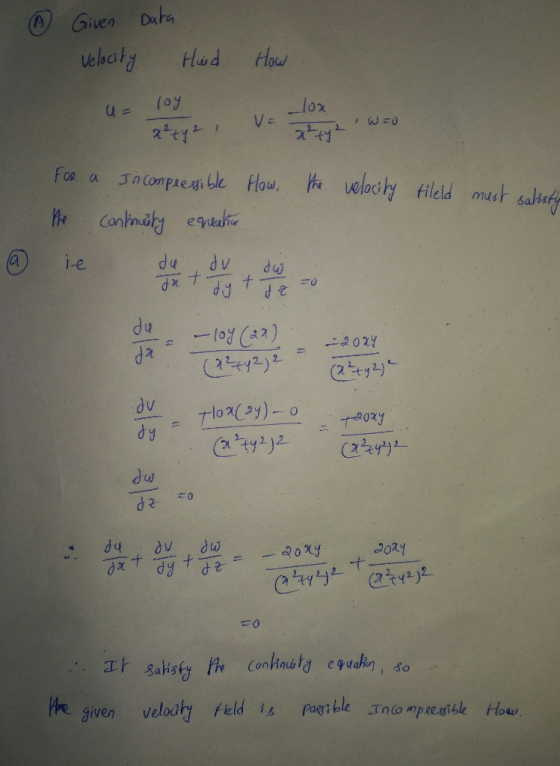
Problem #7 (10 pt). The velocity field of a frictionless, incompressible, and steady-flow is given by...
 Problem #7 (10 pt). The velocity field of a frictionless, incompressible, and steady-flow is given by V = 2xi +x+yj The gravity effect can be neglected. Find an expression for the pressure gradient in the x-direction.
Meng334(fluids mechanics) plz solve it fast in 10 mins please Q2: A steady two-dimensional, incompressible flow of a...
 Meng334(fluids mechanics) plz solve it fast in 10 mins please
Q2: A steady two-dimensional, incompressible flow of a Newtonian fluid with the velocity field: v = y2-x2 u-2 x y and w 0 (a) Does the flow satisfy conservation of mass. (b) Find the total pressure gradient VP) (c) Show that the pressure field is a smooth function of x and y. Don't compute the pressure. (9x 9y 0) =
Q2: A steady two-dimensional, incompressible flow of a Newtonian fluid...
Meng334(fluids mechanics) plz solve it fast in 10 mins please
Q2: A steady two-dimensional, incompressible flow of a Newtonian fluid with the velocity field: v = y2-x2 u-2 x y and w 0 (a) Does the flow satisfy conservation of mass. (b) Find the total pressure gradient VP) (c) Show that the pressure field is a smooth function of x and y. Don't compute the pressure. (9x 9y 0) =
Q2: A steady two-dimensional, incompressible flow of a Newtonian fluid...
The x and y components of the velocity field of a three-dimensional incompressible flow are given...
The x and y components of the velocity field of a three-dimensional incompressible flow are given by U = xv; V = -y-1 Find the expression for the z component of the velocity that vanishes at the origin.
H08.2 (2 points) Given the vector velocity field V(x, y, z, t) = 4t i +...
 H08.2 (2 points) Given the vector velocity field V(x, y, z, t) = 4t i + xz j + 2ty3 k a) Is this a valid incompressible flow field? b) Is this flow field irrotational?
Air flows into the atmosphere from a nozzle and strikes a vertical plate as shown in...
 Air flows into the atmosphere from a nozzle and strikes a
vertical plate as shown in below figure. The reading on the
pressure gage was 1.82 kPa. Determine the horizontal force required
to hold the plate in place. Assume the flow to be incompressible
and frictionless. Also consider the density of air is 1.23 kg/m3
and neglect the air weight.
P= 1.82 kPa F = ?? N A=0.003 m A = 0,01 m²
Air flows into the atmosphere from a nozzle and strikes a
vertical plate as shown in below figure. The reading on the
pressure gage was 1.82 kPa. Determine the horizontal force required
to hold the plate in place. Assume the flow to be incompressible
and frictionless. Also consider the density of air is 1.23 kg/m3
and neglect the air weight.
P= 1.82 kPa F = ?? N A=0.003 m A = 0,01 m²
Given the velocity field V = 101 +(x² + y2); - 2xy k [m/s] a) b)...
 Given the velocity field V = 101 +(x² + y2); - 2xy k [m/s] a) b) c) Is the flow steady or unsteady? Is this motion kinematically possible for an incompressible fluid? Do you think that velocity field can represent a potential flow at specific positions of(x,y)? What is the acceleration of a particle at position (x, y, z) = (3, 1, 0) m? d)
Given the velocity field V =107 +(x + y2)7-2xyk [m/s] Is the flow steady or unsteady?...
 Given the velocity field V =107 +(x + y2)7-2xyk [m/s] Is the flow steady or unsteady? Is this motion kinematically possible for an incompressible fluid? Do you think that velocity field can represent a potential flow at specific positions of (x, y)? What is the acceleration of a particle at position (x, y, z) = (3, 1, 0) m?
Air flow over a cylinder of radius R- 150mm is modelled as a steady, frictionless and incompressible flow. The vector form of the velocity field is 1" The freestream velocity far away from the cy...
 Air flow over a cylinder of radius R- 150mm is modelled as a steady, frictionless and incompressible flow. The vector form of the velocity field is 1" The freestream velocity far away from the cylinder is 75m/s and the static pressure is 101.3kPa. Note that this is similar to worked example 5.1 done during the lecture. However, now you know the Bernoulli equation can be used along a streamline...so: Find a) The stagnation pressure at the leading edge of the...
help 1. A 2D inviscid flow field is represented by the velocity potential function: ° =...
 help
1. A 2D inviscid flow field is represented by the velocity potential function: ° = Ax + Bx2 – By2. Where A = 1m/s, B = 15-7, and the coordinates are measured in meters. The flow density is p = 1.2 kg/m3. (a) (2 points) Calculate the velocity field. (b) (2 points) Verify that the flow is irrotational. (c) (2 points) Verify that the flow is incompressible. (d) (2 points) Obtain the expression of stream function. (e) (2 points)...
help
1. A 2D inviscid flow field is represented by the velocity potential function: ° = Ax + Bx2 – By2. Where A = 1m/s, B = 15-7, and the coordinates are measured in meters. The flow density is p = 1.2 kg/m3. (a) (2 points) Calculate the velocity field. (b) (2 points) Verify that the flow is irrotational. (c) (2 points) Verify that the flow is incompressible. (d) (2 points) Obtain the expression of stream function. (e) (2 points)...
Consider incompressible, steady, inviscid flow at vertical velocity vo though a porous surface into a narrow...
 Consider incompressible, steady, inviscid flow at vertical velocity vo though a porous surface into a narrow gap of height h, as shown. Assume that the flow is 2D planar, so neglect any variations or velocity components in the z direction. Find the x-component of velocity, assuming uniform flow at every x location. Find the y-component of velocity. Find an expression for the pressure variation, assuming that the pressure at the outer edge of the gap is Parm (hint: we can...
 Problem #7 (10 pt). The velocity field of a frictionless, incompressible, and steady-flow is given by V = 2xi +x+yj The gravity effect can be neglected. Find an expression for the pressure gradient in the x-direction.
 Meng334(fluids mechanics) plz solve it fast in 10 mins please
Q2: A steady two-dimensional, incompressible flow of a Newtonian fluid with the velocity field: v = y2-x2 u-2 x y and w 0 (a) Does the flow satisfy conservation of mass. (b) Find the total pressure gradient VP) (c) Show that the pressure field is a smooth function of x and y. Don't compute the pressure. (9x 9y 0) =
Q2: A steady two-dimensional, incompressible flow of a Newtonian fluid...
Meng334(fluids mechanics) plz solve it fast in 10 mins please
Q2: A steady two-dimensional, incompressible flow of a Newtonian fluid with the velocity field: v = y2-x2 u-2 x y and w 0 (a) Does the flow satisfy conservation of mass. (b) Find the total pressure gradient VP) (c) Show that the pressure field is a smooth function of x and y. Don't compute the pressure. (9x 9y 0) =
Q2: A steady two-dimensional, incompressible flow of a Newtonian fluid...
 H08.2 (2 points) Given the vector velocity field V(x, y, z, t) = 4t i + xz j + 2ty3 k a) Is this a valid incompressible flow field? b) Is this flow field irrotational?
 Air flows into the atmosphere from a nozzle and strikes a
vertical plate as shown in below figure. The reading on the
pressure gage was 1.82 kPa. Determine the horizontal force required
to hold the plate in place. Assume the flow to be incompressible
and frictionless. Also consider the density of air is 1.23 kg/m3
and neglect the air weight.
P= 1.82 kPa F = ?? N A=0.003 m A = 0,01 m²
Air flows into the atmosphere from a nozzle and strikes a
vertical plate as shown in below figure. The reading on the
pressure gage was 1.82 kPa. Determine the horizontal force required
to hold the plate in place. Assume the flow to be incompressible
and frictionless. Also consider the density of air is 1.23 kg/m3
and neglect the air weight.
P= 1.82 kPa F = ?? N A=0.003 m A = 0,01 m²
 Given the velocity field V = 101 +(x² + y2); - 2xy k [m/s] a) b) c) Is the flow steady or unsteady? Is this motion kinematically possible for an incompressible fluid? Do you think that velocity field can represent a potential flow at specific positions of(x,y)? What is the acceleration of a particle at position (x, y, z) = (3, 1, 0) m? d)
 Given the velocity field V =107 +(x + y2)7-2xyk [m/s] Is the flow steady or unsteady? Is this motion kinematically possible for an incompressible fluid? Do you think that velocity field can represent a potential flow at specific positions of (x, y)? What is the acceleration of a particle at position (x, y, z) = (3, 1, 0) m?
 Air flow over a cylinder of radius R- 150mm is modelled as a steady, frictionless and incompressible flow. The vector form of the velocity field is 1" The freestream velocity far away from the cylinder is 75m/s and the static pressure is 101.3kPa. Note that this is similar to worked example 5.1 done during the lecture. However, now you know the Bernoulli equation can be used along a streamline...so: Find a) The stagnation pressure at the leading edge of the...
 help
1. A 2D inviscid flow field is represented by the velocity potential function: ° = Ax + Bx2 – By2. Where A = 1m/s, B = 15-7, and the coordinates are measured in meters. The flow density is p = 1.2 kg/m3. (a) (2 points) Calculate the velocity field. (b) (2 points) Verify that the flow is irrotational. (c) (2 points) Verify that the flow is incompressible. (d) (2 points) Obtain the expression of stream function. (e) (2 points)...
help
1. A 2D inviscid flow field is represented by the velocity potential function: ° = Ax + Bx2 – By2. Where A = 1m/s, B = 15-7, and the coordinates are measured in meters. The flow density is p = 1.2 kg/m3. (a) (2 points) Calculate the velocity field. (b) (2 points) Verify that the flow is irrotational. (c) (2 points) Verify that the flow is incompressible. (d) (2 points) Obtain the expression of stream function. (e) (2 points)...
 Consider incompressible, steady, inviscid flow at vertical velocity vo though a porous surface into a narrow gap of height h, as shown. Assume that the flow is 2D planar, so neglect any variations or velocity components in the z direction. Find the x-component of velocity, assuming uniform flow at every x location. Find the y-component of velocity. Find an expression for the pressure variation, assuming that the pressure at the outer edge of the gap is Parm (hint: we can...
Most questions answered within 3 hours.
-
Where is the error in this code sequence?
String s1 = "Hello";
String s2 = "ello";...
asked 11 months ago -
Financial data for Joel de Paris, Inc., for last year
follow:
Joel de Paris, Inc.
Balance...
asked 11 months ago -
Consider this reaction:
Al2(SO4)3 (aq)+ BaCl3
(aq) Al2Cl6 (aq)- +
3BaSO4(s) . What is the...
asked 11 months ago -
Suppose that Savneet is considering increasing her
recent random sample from 20 car rentals to 40...
asked 11 months ago -
Trucks arrive at an unloading terminal at an average rate of 120
per hour.
Trucks arrive...
asked 11 months ago -
Why are methanol and ethanol completely soluble in water while
octanol is not very little soluble....
asked 11 months ago -
A facilities manager at a university reads in a research report
that the mean amount of...
asked 11 months ago -
When the CuSO4 is rehydrated by adding water to the anhydrous
compound, is this an endothermic...
asked 11 months ago -
A ray of sunlight is passing from diamond into crown glass; the
angle of incidence is...
asked 11 months ago -
A block of mass 0.249 kg is placed on top of a light, vertical
spring of...
asked 11 months ago -
how do the kidneys compensate in the presences of acidosis
a) trigger hyperventilate
b) reserve acid...
asked 11 months ago -
Question 501 pts
The rental rate of capital to the firm increases. Which of the
following...
asked 11 months ago