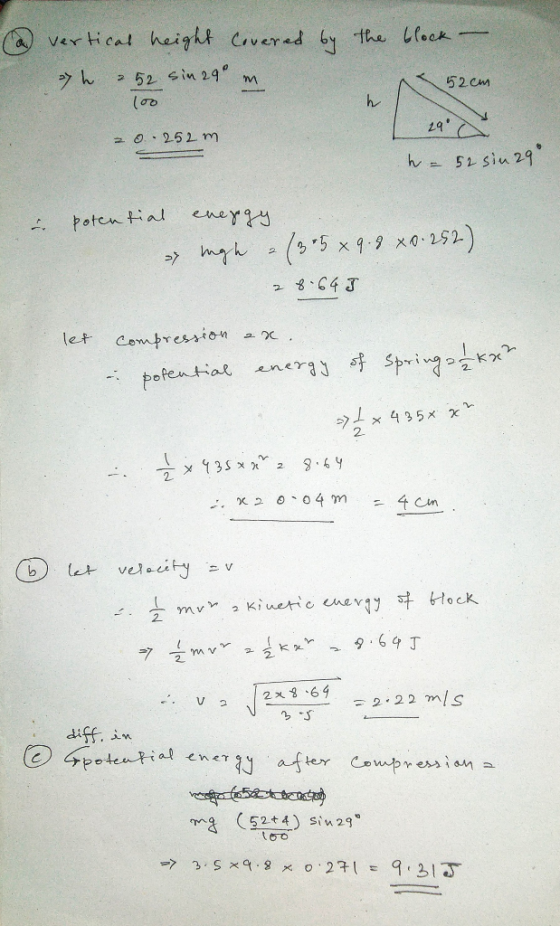
A block of mass 3.5 kg is sitting on a frictionless ramp with a spring at the bottom that has a spring constant of 435 N/m (refer to the figure). The angle of the ramp with respect to the horizontal is 29°. show answer Incorrect Answer 33% Part (a) The block, starting from rest, slides down the ramp a distance 52 cm before hitting the spring. How far, in centimeters, is the spring compressed as the block comes to momentary rest? Δx = 0.028 ✘ Attempts Remain show answer No Attempt 33% Part (b) After the block comes to rest, the spring pushes the block back up the ramp. How fast, in meters per second, is the block moving right after it comes off the spring?
|
|||||||||


Homework Answers
A handwritten solution for this question is given below
Add Answer to:
A block of mass 3.5 kg is sitting on a frictionless ramp with a
spring at...
A block of mass m = 3.5 kg is attached to a spring with spring constant...
A block of mass m = 3.5 kg is attached to a spring with spring constant k = 990 N/m. It is initially at rest on an inclined plane that is at an angle of θ = 22° with respect to the horizontal, and the coefficient of kinetic friction between the block and the plane is μk = 0.12. In the initial position, where the spring is compressed by a distance of d = 0.19 m, the mass is at...
A 0.750 kg block is attached to a spring with spring constant 16.5 N/m. While the...
 A 0.750 kg block is attached to a spring with spring constant 16.5 N/m. While the block is sitting at rest, a student hits it with a hammer and almost instantaneously gives it a speed of 50.0 cm/s. What are We were unable to transcribe this imagePart B The block's speed at the point where 0.650 A? Express your answer with the appropriate units.
A block of mass m = 3.5 kg is on an inclined plane with a coefficient...
 A block of mass m = 3.5 kg is
on an inclined plane with a coefficient of friction
μ1 = 0.31, at an
initial height h = 0.53 m above
the ground. The plane is inclined at an angle θ =
54°. The block is then compressed against
a spring a distance Δx = 0.11 m
from its equilibrium point (the spring has a spring constant of
k1 = 39 N/m) and
released. At the bottom of the inclined plane...
A block of mass m = 3.5 kg is
on an inclined plane with a coefficient of friction
μ1 = 0.31, at an
initial height h = 0.53 m above
the ground. The plane is inclined at an angle θ =
54°. The block is then compressed against
a spring a distance Δx = 0.11 m
from its equilibrium point (the spring has a spring constant of
k1 = 39 N/m) and
released. At the bottom of the inclined plane...
A block of mass m = 3.5 kg is attached to a spring with spring constant...
A block of mass m = 3.5 kg is attached to a spring with spring constant k = 520 N/m. It is initially at rest on an inclined plane that is at an angle of θ = 21° with respect to the horizontal, and the coefficient of kinetic friction between the block and the plane is μk = 0.16. In the initial position, where the spring is compressed by a distance of d = 0.14 m, the mass is at...
A block of mass m = 3.5 kg is attached to a spring with spring constant k = 780 N/m
 A block of mass m = 3.5 kg is attached to a spring with spring constant k = 780 N/m. It is initially at rest on an inclined plane that is at an angle of θ = 28° with respect to the horizontal, and the coefficient of kinetic friction between the block and the plane is μk = 0.19. In the initial position, where the spring is compressed by a distance of d = 0.19 m, the mass is at...
A block of mass m = 4.5 kg is attached to a spring with spring constant k = 710 N/m.
 A block of mass m = 4.5 kg is attached to a spring with spring constant k = 710 N/m. It is initially at rest on an inclined plane that is at an angle of θ = 25° with respect to the horizontal, and the coefficient of kinetic friction between the block and the plane is μk=0.18. In the initial position, where the spring is compressed by a distance of d = 0.12 m, the mass is at its lowest...
A ball of mass M is attached to one end of a spring of stiffness k...
 A ball of mass M is attached to one end of a spring of
stiffness k and relaxed length
L0. The other end of the spring
is attached to the ceiling. When the ball hangs at rest in
equilibrium at the end of the spring it is located at the origin of
the coordinate system shown and the spring’s length is
Leq.
a. The figure shows the ball at position . What are the components of the
vector Li that...
A ball of mass M is attached to one end of a spring of
stiffness k and relaxed length
L0. The other end of the spring
is attached to the ceiling. When the ball hangs at rest in
equilibrium at the end of the spring it is located at the origin of
the coordinate system shown and the spring’s length is
Leq.
a. The figure shows the ball at position . What are the components of the
vector Li that...
3.0 kg block slides down a frictionless ramp of height 3.0 meters starting from rest. it then tra...
 3.0 kg block slides down a frictionless ramp of height 3.0
meters starting from rest. it then traverses a 2.0 metter rough
patch with a coefficient of kinetic friction 0.35 It then gets to a
smooth area where it compresses a horizontal spring of spring
constant 50 n/m.
Please help me Solve the rest of the physics problem
The answers to part A is x= 1.64 meters and part b is 1.58
meters
Problem 1 A 3.0 kg block slides...
3.0 kg block slides down a frictionless ramp of height 3.0
meters starting from rest. it then traverses a 2.0 metter rough
patch with a coefficient of kinetic friction 0.35 It then gets to a
smooth area where it compresses a horizontal spring of spring
constant 50 n/m.
Please help me Solve the rest of the physics problem
The answers to part A is x= 1.64 meters and part b is 1.58
meters
Problem 1 A 3.0 kg block slides...
3. A 1.2 kg block sliding at 6.0 m/s on a frictionless surface runs into and...
 3. A 1.2 kg block sliding at 6.0 m/s on a frictionless surface runs into and sticks to a spring. The spring is compressed 0.10 m before stopping the block and starting its motion back in the opposite direction. a. Calculate the energy of vibration. b. Calculate the force constant of the spring. c. Calculate the period of vibration of the system. d. Write the equation of motion of the block when its oscillating. We were unable to transcribe this...
A block is placed on a frictionless ramp at a height hof 14.5 m above the...
 A block is placed on a frictionless ramp at a height hof 14.5 m above the ground. Starting from rest, the block slides down the ramp. At the bottom of the ramp, the block slides onto a frictionless horizontal track without slowing down. At the end of the horizontal track, the block slides smoothly onto a second frictionless ramp. 0 = 48.3° By = 25.5 How far along the second ramp does the block travel before coming to a momentary...
 A 0.750 kg block is attached to a spring with spring constant 16.5 N/m. While the block is sitting at rest, a student hits it with a hammer and almost instantaneously gives it a speed of 50.0 cm/s. What are We were unable to transcribe this imagePart B The block's speed at the point where 0.650 A? Express your answer with the appropriate units.
 A block of mass m = 3.5 kg is
on an inclined plane with a coefficient of friction
μ1 = 0.31, at an
initial height h = 0.53 m above
the ground. The plane is inclined at an angle θ =
54°. The block is then compressed against
a spring a distance Δx = 0.11 m
from its equilibrium point (the spring has a spring constant of
k1 = 39 N/m) and
released. At the bottom of the inclined plane...
A block of mass m = 3.5 kg is
on an inclined plane with a coefficient of friction
μ1 = 0.31, at an
initial height h = 0.53 m above
the ground. The plane is inclined at an angle θ =
54°. The block is then compressed against
a spring a distance Δx = 0.11 m
from its equilibrium point (the spring has a spring constant of
k1 = 39 N/m) and
released. At the bottom of the inclined plane...
 A ball of mass M is attached to one end of a spring of
stiffness k and relaxed length
L0. The other end of the spring
is attached to the ceiling. When the ball hangs at rest in
equilibrium at the end of the spring it is located at the origin of
the coordinate system shown and the spring’s length is
Leq.
a. The figure shows the ball at position . What are the components of the
vector Li that...
A ball of mass M is attached to one end of a spring of
stiffness k and relaxed length
L0. The other end of the spring
is attached to the ceiling. When the ball hangs at rest in
equilibrium at the end of the spring it is located at the origin of
the coordinate system shown and the spring’s length is
Leq.
a. The figure shows the ball at position . What are the components of the
vector Li that...
 3.0 kg block slides down a frictionless ramp of height 3.0
meters starting from rest. it then traverses a 2.0 metter rough
patch with a coefficient of kinetic friction 0.35 It then gets to a
smooth area where it compresses a horizontal spring of spring
constant 50 n/m.
Please help me Solve the rest of the physics problem
The answers to part A is x= 1.64 meters and part b is 1.58
meters
Problem 1 A 3.0 kg block slides...
3.0 kg block slides down a frictionless ramp of height 3.0
meters starting from rest. it then traverses a 2.0 metter rough
patch with a coefficient of kinetic friction 0.35 It then gets to a
smooth area where it compresses a horizontal spring of spring
constant 50 n/m.
Please help me Solve the rest of the physics problem
The answers to part A is x= 1.64 meters and part b is 1.58
meters
Problem 1 A 3.0 kg block slides...
 3. A 1.2 kg block sliding at 6.0 m/s on a frictionless surface runs into and sticks to a spring. The spring is compressed 0.10 m before stopping the block and starting its motion back in the opposite direction. a. Calculate the energy of vibration. b. Calculate the force constant of the spring. c. Calculate the period of vibration of the system. d. Write the equation of motion of the block when its oscillating. We were unable to transcribe this...
 A block is placed on a frictionless ramp at a height hof 14.5 m above the ground. Starting from rest, the block slides down the ramp. At the bottom of the ramp, the block slides onto a frictionless horizontal track without slowing down. At the end of the horizontal track, the block slides smoothly onto a second frictionless ramp. 0 = 48.3° By = 25.5 How far along the second ramp does the block travel before coming to a momentary...
Most questions answered within 3 hours.
-
Where is the error in this code sequence?
String s1 = "Hello";
String s2 = "ello";...
asked 11 months ago -
Financial data for Joel de Paris, Inc., for last year
follow:
Joel de Paris, Inc.
Balance...
asked 11 months ago -
Consider this reaction:
Al2(SO4)3 (aq)+ BaCl3
(aq) Al2Cl6 (aq)- +
3BaSO4(s) . What is the...
asked 11 months ago -
Suppose that Savneet is considering increasing her
recent random sample from 20 car rentals to 40...
asked 11 months ago -
Trucks arrive at an unloading terminal at an average rate of 120
per hour.
Trucks arrive...
asked 11 months ago -
Why are methanol and ethanol completely soluble in water while
octanol is not very little soluble....
asked 11 months ago -
A facilities manager at a university reads in a research report
that the mean amount of...
asked 11 months ago -
When the CuSO4 is rehydrated by adding water to the anhydrous
compound, is this an endothermic...
asked 11 months ago -
A ray of sunlight is passing from diamond into crown glass; the
angle of incidence is...
asked 11 months ago -
A block of mass 0.249 kg is placed on top of a light, vertical
spring of...
asked 11 months ago -
how do the kidneys compensate in the presences of acidosis
a) trigger hyperventilate
b) reserve acid...
asked 11 months ago -
Question 501 pts
The rental rate of capital to the firm increases. Which of the
following...
asked 11 months ago