
Homework Answers
We want to find 'x' such that 
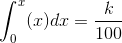
![[\frac{x^2}{2}]_{0}^{x}=\frac{k}{100}\\ \\](http://img.homeworklib.com/questions/fa654bc0-c2ff-11eb-a705-8576cd06f9d0.png?x-oss-process=image/resize,w_560)
![[\frac{x^2}{2}-0]=\frac{k}{100}\\ \\](http://img.homeworklib.com/questions/fac40e10-c2ff-11eb-b579-4701c912cbb0.png?x-oss-process=image/resize,w_560)

which is the kth percentile.
Add Answer to:
Determine the kth percentile of the distribution defined by the following density function. f (x)= x...
The joint probability density function of X and Yis defined by f(, )0 elsewhere What is Pr(X Y K ...
 The joint probability density function of X and Yis defined by f(, )0 elsewhere What is Pr(X Y K z,0 1)?
The joint probability density function of X and Yis defined by f(, )0 elsewhere What is Pr(X Y K z,0 1)?
The joint probability density function of X and Yis defined by f(, )0 elsewhere What is Pr(X Y K z,0 1)?
Random variable x has a uniform distribution defined by the probability density function below. Determine the...
Random variable x has a uniform distribution defined by the probability density function below. Determine the probability that x has a value of at least 220. f(x) = 1/100 for values of x between 200 and 300, and 0 everywhere else a)0.65 b)0.80 c)0.75 d)0.60
Let X be a continuous RV with the following density function: f X ( x )...
Let X be a continuous RV with the following density function: f X ( x ) = { 2(1 − x ) , 0 < x < 1 0 , elsewhere a. Determine the cumulative distribution function for X , F X . b. Compute P ( X ≤ 0 . 5). c. Compute the mean of X , μ X . d. Compute the median of X . e. Compute the variance ( σ 2 X ) and standard...
3. (4 points) A manufacturer's annual losses follow a distribution with density function: 2.5(0.6)2.5 f(x)235x 0 elsewhere To cover its losses, the manufacturer purchases an insurance policy...
 3. (4 points) A manufacturer's annual losses follow a distribution with density function: 2.5(0.6)2.5 f(x)235x 0 elsewhere To cover its losses, the manufacturer purchases an insurance policy with an annual deductible of 3. Let Y be the insu payment. a) What is the difference between the median and the 99th percentile of Y? What is the mean of the manufacturer's annual losses not paid by the insurance policy?
3. (4 points) A manufacturer's annual losses follow a distribution with density...
3. (4 points) A manufacturer's annual losses follow a distribution with density function: 2.5(0.6)2.5 f(x)235x 0 elsewhere To cover its losses, the manufacturer purchases an insurance policy with an annual deductible of 3. Let Y be the insu payment. a) What is the difference between the median and the 99th percentile of Y? What is the mean of the manufacturer's annual losses not paid by the insurance policy?
3. (4 points) A manufacturer's annual losses follow a distribution with density...
Let the joint probability density function of X and Y be defined by f( x, y...
Let the joint probability density function of X and Y be defined by f( x, y ) = (x+4y)/9 , 0 < y < 1, y < x < 3, zero otherwise. Find the probability distribution of U = X/ Y.
Let X have probability density function f(2)= k(1+x) -3 for 0 < x < oo and...
 Let X have probability density function f(2)= k(1+x) -3 for 0 < x < oo and f(x) = 0 elsewhere. a. Find the constant k and Find the c.d.f. of X. b. Find the expected value and the variance of X. Are both well defined? c. Suppose you are required to generate a random variable X with the probability density function f(x). You have available to you a computer program that will generate a random variable U having a U[0,...
7.30 Given the probability density function 20x3 (1- x) for 0< f(x) <1 and 0 elsewhere find the following: The cu...
 7.30 Given the probability density function 20x3 (1- x) for 0< f(x) <1 and 0 elsewhere find the following: The cumulative distribution function F(x) b. Е(X) Find Pr(0.5 <X < 2). a. d. SD(X) с. Е(X?) e.
7.30 Given the probability density function 20x3 (1- x) for 0
7.30 Given the probability density function 20x3 (1- x) for 0< f(x) <1 and 0 elsewhere find the following: The cumulative distribution function F(x) b. Е(X) Find Pr(0.5 <X < 2). a. d. SD(X) с. Е(X?) e.
7.30 Given the probability density function 20x3 (1- x) for 0
*Use the distribution function technique* to find the density function for Y = 2X + 3....
*Use the distribution function technique* to find the density function for Y = 2X + 3. The density function for X is f(x). Your answer should be given as a piecewise function. f(x) = { (1/4)(2x + 1) 1 < x < 2 0 elsewhere
A probability density function f(x) is an important concept in statistical sciences. It gives you the...
 A probability density function f(x) is an important concept in statistical sciences. It gives you the distribution of the random variable x. f(x) usually defined in a certain interval, and vanish in the rest. One can defined the median u and variances o2 as using the probability density function as (you'll see more about this later on in the course of statistic): u=L" xf(x)dx 2= (x – u)? dx For most cases the distribution function is normal or Gaussian. If...
6) If the probability density function of a continuous random variable X is f(x) =x/8 when...
6) If the probability density function of a continuous random variable X is f(x) =x/8 when 3<x < 5, f(x)=0 otherwise a) Find the expected value of this distribution. b) Find the variance of this distribution. c) Find the 25th percentile of this distribution.
 The joint probability density function of X and Yis defined by f(, )0 elsewhere What is Pr(X Y K z,0 1)?
The joint probability density function of X and Yis defined by f(, )0 elsewhere What is Pr(X Y K z,0 1)?
The joint probability density function of X and Yis defined by f(, )0 elsewhere What is Pr(X Y K z,0 1)?
 3. (4 points) A manufacturer's annual losses follow a distribution with density function: 2.5(0.6)2.5 f(x)235x 0 elsewhere To cover its losses, the manufacturer purchases an insurance policy with an annual deductible of 3. Let Y be the insu payment. a) What is the difference between the median and the 99th percentile of Y? What is the mean of the manufacturer's annual losses not paid by the insurance policy?
3. (4 points) A manufacturer's annual losses follow a distribution with density...
3. (4 points) A manufacturer's annual losses follow a distribution with density function: 2.5(0.6)2.5 f(x)235x 0 elsewhere To cover its losses, the manufacturer purchases an insurance policy with an annual deductible of 3. Let Y be the insu payment. a) What is the difference between the median and the 99th percentile of Y? What is the mean of the manufacturer's annual losses not paid by the insurance policy?
3. (4 points) A manufacturer's annual losses follow a distribution with density...
 Let X have probability density function f(2)= k(1+x) -3 for 0 < x < oo and f(x) = 0 elsewhere. a. Find the constant k and Find the c.d.f. of X. b. Find the expected value and the variance of X. Are both well defined? c. Suppose you are required to generate a random variable X with the probability density function f(x). You have available to you a computer program that will generate a random variable U having a U[0,...
 7.30 Given the probability density function 20x3 (1- x) for 0< f(x) <1 and 0 elsewhere find the following: The cumulative distribution function F(x) b. Е(X) Find Pr(0.5 <X < 2). a. d. SD(X) с. Е(X?) e.
7.30 Given the probability density function 20x3 (1- x) for 0
7.30 Given the probability density function 20x3 (1- x) for 0< f(x) <1 and 0 elsewhere find the following: The cumulative distribution function F(x) b. Е(X) Find Pr(0.5 <X < 2). a. d. SD(X) с. Е(X?) e.
7.30 Given the probability density function 20x3 (1- x) for 0
 A probability density function f(x) is an important concept in statistical sciences. It gives you the distribution of the random variable x. f(x) usually defined in a certain interval, and vanish in the rest. One can defined the median u and variances o2 as using the probability density function as (you'll see more about this later on in the course of statistic): u=L" xf(x)dx 2= (x – u)? dx For most cases the distribution function is normal or Gaussian. If...
Most questions answered within 3 hours.
-
Where is the error in this code sequence?
String s1 = "Hello";
String s2 = "ello";...
asked 11 months ago -
Financial data for Joel de Paris, Inc., for last year
follow:
Joel de Paris, Inc.
Balance...
asked 11 months ago -
Consider this reaction:
Al2(SO4)3 (aq)+ BaCl3
(aq) Al2Cl6 (aq)- +
3BaSO4(s) . What is the...
asked 11 months ago -
Suppose that Savneet is considering increasing her
recent random sample from 20 car rentals to 40...
asked 11 months ago -
Trucks arrive at an unloading terminal at an average rate of 120
per hour.
Trucks arrive...
asked 11 months ago -
Why are methanol and ethanol completely soluble in water while
octanol is not very little soluble....
asked 11 months ago -
A facilities manager at a university reads in a research report
that the mean amount of...
asked 11 months ago -
When the CuSO4 is rehydrated by adding water to the anhydrous
compound, is this an endothermic...
asked 11 months ago -
A ray of sunlight is passing from diamond into crown glass; the
angle of incidence is...
asked 11 months ago -
A block of mass 0.249 kg is placed on top of a light, vertical
spring of...
asked 11 months ago -
how do the kidneys compensate in the presences of acidosis
a) trigger hyperventilate
b) reserve acid...
asked 11 months ago -
Question 501 pts
The rental rate of capital to the firm increases. Which of the
following...
asked 11 months ago