
Homework Answers
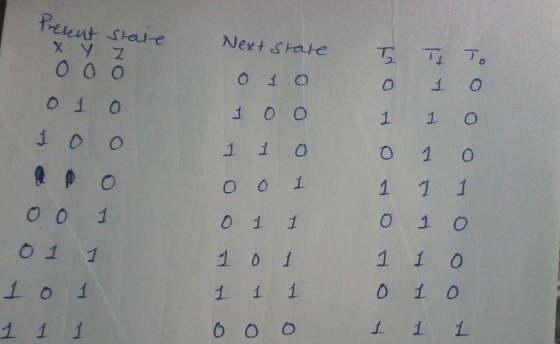
state table:
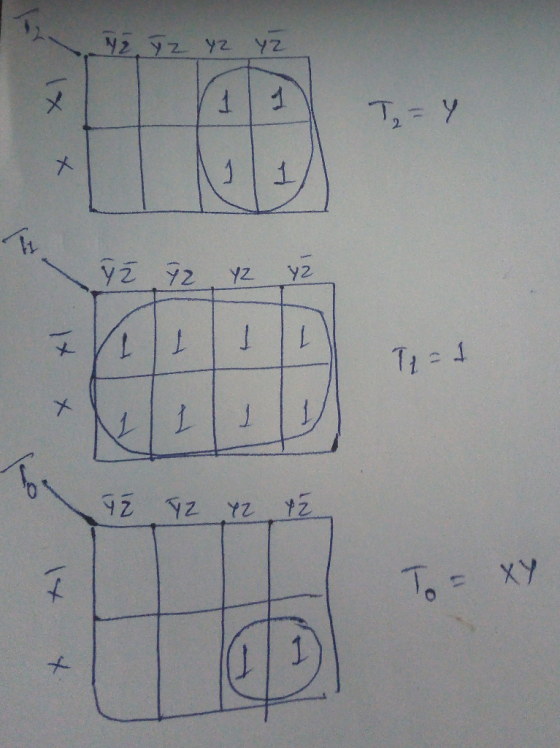
k-maps:
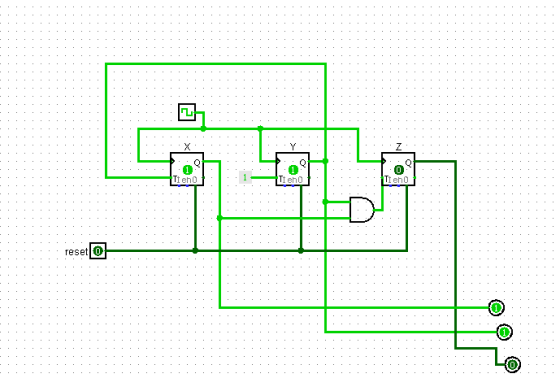
circuit :
Add Answer to:
(b)(i) Using T flip-flop as main components, design a 3-bit synchronous counter that perform counting as...
a) (5 marks) Explain the difference between a latch, a gated latch and a flip flop....
 a) (5 marks) Explain the difference between a latch, a gated latch and a flip flop. b) (5 marks) A gated SR latch has the following schematic diagram CLK a) Draw a timing diagram showing the Q and Q outputs for the following sequence of inputs: CLK R Assume that the initial state of the outputs is Q 0 and Q 1 c) (5 marks) Draw a schematic diagram for a rising edge-triggered master-slave D flip- flop built using two...
1. Design a synchronous 2-bit up-down counter using a T flip flop for the most significant bit an...
 1. Design a synchronous 2-bit up-down counter using a T flip flop for the most significant bit and an SR flip flop for the least significant bit; when the input X-1, it should count down and for X-0, it should count up. Use SOP.
1. Design a synchronous 2-bit up-down counter using a T flip flop for the most significant bit and an SR flip flop for the least significant bit; when the input X-1, it should count down and...
1. Design a synchronous 2-bit up-down counter using a T flip flop for the most significant bit and an SR flip flop for the least significant bit; when the input X-1, it should count down and for X-0, it should count up. Use SOP.
1. Design a synchronous 2-bit up-down counter using a T flip flop for the most significant bit and an SR flip flop for the least significant bit; when the input X-1, it should count down and...
Using S-R flip-flops, design a 3-bit counter (C,B,A) with the repeating binary counting sequence: 1, 3,...
Using S-R flip-flops, design a 3-bit counter (C,B,A) with the repeating binary counting sequence: 1, 3, 2, 6, 7, 5, 4. - Show the circuit's state table with the present-state entries in ascending order, which should have the present state (t), next state (t+1), and flip-flop inputs. - Find the flip-flop input equations for RC, RB, and RA in Product of Sums form.
Design a synchronous 2-bit up-down counter using a SR flip flop for the most significant bit and an T flip flop for the least significant bit;
Design a synchronous 2-bit up-down counter using a SR flip flop for the most significant bit and an T flip flop for the least significant bit; when the input X=0, it should count down and for X=1, it should count up. Use SOP
Design a 5-bit binary counter using JK flip flops. Draw the flip-flop circuit diagram, the state...
Design a 5-bit binary counter using JK flip flops. Draw the flip-flop circuit diagram, the state graph, the timing diagram, the truth table (with clk pulse) and the state table (with present and next states).
3. Construct a modulo-5 parallel (synchronous) down counter using master-slave T flip- flops. The counter should...
 3. Construct a modulo-5 parallel (synchronous) down counter using master-slave T flip- flops. The counter should count in the sequence 0-4-3-2-1-0 and then back to 4, counting continuously. The counter stages are x,y and z, where z is the most significant bit. The Qoutputs are Qx, Qy and Qu. The T-inputs of the three stages are Tx, Ty and Tz. Use Karnaugh map method (truth table for Tinputs followed by K-map) to determine each of the T-inputs (not the short-cut...
1) Design a synchronous 3-bit binary UP/DOWN counter uses the following counting pattern 10.2.3.7.6.40.1.3...) the counter...
 1) Design a synchronous 3-bit binary UP/DOWN counter uses the following counting pattern 10.2.3.7.6.40.1.3...) the counter will count in this pattern indefinitely when the input X is equal to 1. When the input the counter will reverse direction and count in the opposite pattern 0. 4 7310) Complete the state diagram, transition table, New state s and solve for the recitation equations for flipflops that will perform this function. (You do not need to draw the flip-flops Use the state...
b. (i) Draw the circuit diagram of a 4-bit shift register using D-flip-flop. (2 marks) (ii)...
 b. (i) Draw the circuit diagram of a 4-bit shift register using D-flip-flop. (2 marks) (ii) Supposing the 4-bit data 1011 is to be transfer in a 4-stage shift register using D-flip- flop, right-out the corresponding output of each of the flip-flop after the 6th clock pulses. (4 marks) c. Design a synchronous counter that go through the state 3, 4, 5, 7,8, 9, 10 . (13 marks)
Use S-R flip-flops to design a 3-bit counter (C, B, A) with the repeating binary counting...
 Use S-R flip-flops to design a 3-bit counter (C, B, A) with the repeating binary counting sequence: 1, 3, 2, 6, 7, 5, 4. Show clearly the following: (a) The circuit's state table with the present-state entries in ascending order. Present State (t) Next State (t+1) Flip-flop Inputs с B A m с B A Sc Rc SB RE SA RA Required format of the state table in Problem 1(a). Show table grid lines and align all entries per column....
We need to design a four-bit binary synchronous down counter using JK flip-flop. I'd appreciate it...
We need to design a four-bit binary synchronous down counter using JK flip-flop. I'd appreciate it if you could draw the truth and logic.
 a) (5 marks) Explain the difference between a latch, a gated latch and a flip flop. b) (5 marks) A gated SR latch has the following schematic diagram CLK a) Draw a timing diagram showing the Q and Q outputs for the following sequence of inputs: CLK R Assume that the initial state of the outputs is Q 0 and Q 1 c) (5 marks) Draw a schematic diagram for a rising edge-triggered master-slave D flip- flop built using two...
 1. Design a synchronous 2-bit up-down counter using a T flip flop for the most significant bit and an SR flip flop for the least significant bit; when the input X-1, it should count down and for X-0, it should count up. Use SOP.
1. Design a synchronous 2-bit up-down counter using a T flip flop for the most significant bit and an SR flip flop for the least significant bit; when the input X-1, it should count down and...
1. Design a synchronous 2-bit up-down counter using a T flip flop for the most significant bit and an SR flip flop for the least significant bit; when the input X-1, it should count down and for X-0, it should count up. Use SOP.
1. Design a synchronous 2-bit up-down counter using a T flip flop for the most significant bit and an SR flip flop for the least significant bit; when the input X-1, it should count down and...
 3. Construct a modulo-5 parallel (synchronous) down counter using master-slave T flip- flops. The counter should count in the sequence 0-4-3-2-1-0 and then back to 4, counting continuously. The counter stages are x,y and z, where z is the most significant bit. The Qoutputs are Qx, Qy and Qu. The T-inputs of the three stages are Tx, Ty and Tz. Use Karnaugh map method (truth table for Tinputs followed by K-map) to determine each of the T-inputs (not the short-cut...
 1) Design a synchronous 3-bit binary UP/DOWN counter uses the following counting pattern 10.2.3.7.6.40.1.3...) the counter will count in this pattern indefinitely when the input X is equal to 1. When the input the counter will reverse direction and count in the opposite pattern 0. 4 7310) Complete the state diagram, transition table, New state s and solve for the recitation equations for flipflops that will perform this function. (You do not need to draw the flip-flops Use the state...
 b. (i) Draw the circuit diagram of a 4-bit shift register using D-flip-flop. (2 marks) (ii) Supposing the 4-bit data 1011 is to be transfer in a 4-stage shift register using D-flip- flop, right-out the corresponding output of each of the flip-flop after the 6th clock pulses. (4 marks) c. Design a synchronous counter that go through the state 3, 4, 5, 7,8, 9, 10 . (13 marks)
 Use S-R flip-flops to design a 3-bit counter (C, B, A) with the repeating binary counting sequence: 1, 3, 2, 6, 7, 5, 4. Show clearly the following: (a) The circuit's state table with the present-state entries in ascending order. Present State (t) Next State (t+1) Flip-flop Inputs с B A m с B A Sc Rc SB RE SA RA Required format of the state table in Problem 1(a). Show table grid lines and align all entries per column....
Most questions answered within 3 hours.
-
Where is the error in this code sequence?
String s1 = "Hello";
String s2 = "ello";...
asked 11 months ago -
Financial data for Joel de Paris, Inc., for last year
follow:
Joel de Paris, Inc.
Balance...
asked 11 months ago -
Consider this reaction:
Al2(SO4)3 (aq)+ BaCl3
(aq) Al2Cl6 (aq)- +
3BaSO4(s) . What is the...
asked 11 months ago -
Suppose that Savneet is considering increasing her
recent random sample from 20 car rentals to 40...
asked 11 months ago -
Trucks arrive at an unloading terminal at an average rate of 120
per hour.
Trucks arrive...
asked 11 months ago -
Why are methanol and ethanol completely soluble in water while
octanol is not very little soluble....
asked 11 months ago -
A facilities manager at a university reads in a research report
that the mean amount of...
asked 11 months ago -
When the CuSO4 is rehydrated by adding water to the anhydrous
compound, is this an endothermic...
asked 11 months ago -
A ray of sunlight is passing from diamond into crown glass; the
angle of incidence is...
asked 11 months ago -
A block of mass 0.249 kg is placed on top of a light, vertical
spring of...
asked 11 months ago -
how do the kidneys compensate in the presences of acidosis
a) trigger hyperventilate
b) reserve acid...
asked 11 months ago -
Question 501 pts
The rental rate of capital to the firm increases. Which of the
following...
asked 11 months ago