
Homework Answers
Add Answer to:
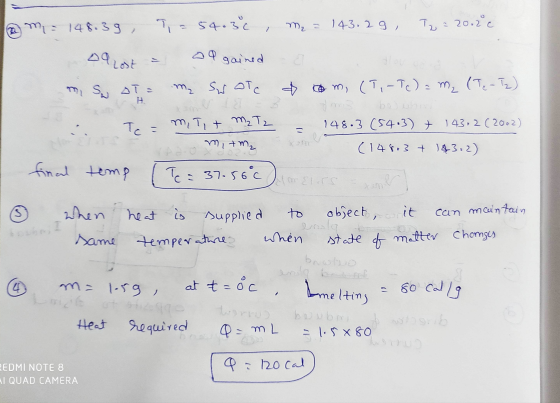
2. A SCEN101 student mixes 148.3 grams of hot water at 54.3°C with 143.2 grams of...
Eighty grams of cold water initially at 20 oC is combined with some amount of hot...
Eighty grams of cold water initially at 20 oC is combined with some amount of hot water having an initial temperature of 80 oC. Afterward, the final temperature of the mixture stabilizes at 40 oC. Assume the heat is exchanged only between the hot and cold water only (so that there is no heat loss to the surroundings). The specific heat capcity of water is 1.0 cal/(g Co). What was ΔT and Q for the hot water? ΔTH = QH...
You cool your cup of hot beverage (250 grams), initially at 100 °C, by dropping in...
You cool your cup of hot beverage (250 grams), initially at 100 °C, by dropping in an ice cube (30 grams), initially at -15 °C. The ice melts and mixes with the beverage. What is the final temperature of the mixture?
a shower mixes 1.2 kg/s of cool water at 20c with 0.9 kg/s of hot water...
a shower mixes 1.2 kg/s of cool water at 20c with 0.9 kg/s of hot water at 65C .during mixing heat is lost to the surrounding at the rate of 28 kj/s. what is the temperature of the warm water stream?
o prase Ul Water to 2. What is the heat, q, required to melt 10 grams...
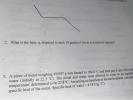 o prase Ul Water to 2. What is the heat, q, required to melt 10 grams of ice in a) Joules b) calories? 122.3 °C). The goC. Assuming -4.18 /(8°C) 3. A piece of metal weighing 49.047 g was heated to 100.0 °C and then put it into 100.0 m water initially at 22.3 °C). The metal and water were allowed to come to an equilibu temperature, determined to be 27.8 °C. Assuming no heat lost to the environment, calculat...
How many grams of ice at -15°C must be added to 705 grams of water that...
How many grams of ice at -15°C must be added to 705 grams of water that is initially at a temperature of 88°C to produce water at a final temperature of 11°C. Assume that no heat is lost to the surroundings and that the container has negligible mass. The specific heat of liquid water is 4190 J/kg·C° and of ice is 2050 J/kg·C°. For water the normal melting point is 0.00°C and the heat of fusion is 334 × 103...
Introduction If a cup of cold water is mixed with a cup of hot water, the...
Introduction If a cup of cold water is mixed with a cup of hot water, the final temperature of the mixture will be between the two initial temperatures. Using information on the temperature and volume of the hot and the cold water, the final temperature of the mixture could be predicted. This virtual experiment involves mixing of equal volume of cold and hot water and prediction of the final temperature of the mixture. Procedure Step 1 To get equal volume...
The recovery time of a hot water heater is the time required to heat all the...
The recovery time of a hot water heater is the time required to heat all the water in the unit to the desired temperature. Suppose that a 47-gal (1.00 gal = 3.79 x 10⁻³ m3) unit starts with cold water at 11 °C and delivers hot water at 53 °C. The unit is electric and utilizes a resistance heater (120 V ac, 3.9 Ω) to heat the water. Assuming that no heat is lost to the environment, determine the recovery...
A student heats 84.17 mL of water to 95.27°C using a hot plate. The heated water...
 A student heats 84.17 mL of water to 95.27°C using a hot plate. The heated water is added to a calorimeter containing 73.92 mL of cold water. The water temperature in the calorimeter rises from J 2.15°C to 40.70°C. The specific heat capacity of water is 4.184 and the density of water is g. °C 1.00 mL Assuming that heat was transferred from the hot water to the cold water and the calorimeter, determine the heat capacity of the calorimeter....
A student heats 84.17 mL of water to 95.27°C using a hot plate. The heated water...
 A student heats 84.17 mL of water to 95.27°C using a hot plate. The heated water is added to a calorimeter containing 73.92 mL of cold water. The water temperature in the calorimeter rises from J 2.15°C to 39.32°C. The specific heat capacity of water is 4.184 and the density of water is g•°C 1.00 mL Assuming that heat was transferred from the hot water to the cold water and the calorimeter, determine the heat capacity of the calorimeter. Heat...
Useful equations and constants: heat lost/gained = (Volume (Density)(AT)(specific heat capacity) (heat lost by hot...
 Useful equations and constants: heat lost/gained = (Volume (Density)(AT)(specific heat capacity) (heat lost by hot water) - Cheat gained by cold water) calorimeter constant = Density co = 1.00 g/mL Specific heat capacity (water) - 4.184 J/g °C 1. What is thermochemistry? (2 pts) 2. A student adds 5.00 mL of cold water to 5.00 mL of hot water in a test tube surrounded by a Styrofoam installation (ie, calorimeter). The initial temperature of the cold water was 15.26 °C,...
 o prase Ul Water to 2. What is the heat, q, required to melt 10 grams of ice in a) Joules b) calories? 122.3 °C). The goC. Assuming -4.18 /(8°C) 3. A piece of metal weighing 49.047 g was heated to 100.0 °C and then put it into 100.0 m water initially at 22.3 °C). The metal and water were allowed to come to an equilibu temperature, determined to be 27.8 °C. Assuming no heat lost to the environment, calculat...
 A student heats 84.17 mL of water to 95.27°C using a hot plate. The heated water is added to a calorimeter containing 73.92 mL of cold water. The water temperature in the calorimeter rises from J 2.15°C to 40.70°C. The specific heat capacity of water is 4.184 and the density of water is g. °C 1.00 mL Assuming that heat was transferred from the hot water to the cold water and the calorimeter, determine the heat capacity of the calorimeter....
 A student heats 84.17 mL of water to 95.27°C using a hot plate. The heated water is added to a calorimeter containing 73.92 mL of cold water. The water temperature in the calorimeter rises from J 2.15°C to 39.32°C. The specific heat capacity of water is 4.184 and the density of water is g•°C 1.00 mL Assuming that heat was transferred from the hot water to the cold water and the calorimeter, determine the heat capacity of the calorimeter. Heat...
 Useful equations and constants: heat lost/gained = (Volume (Density)(AT)(specific heat capacity) (heat lost by hot water) - Cheat gained by cold water) calorimeter constant = Density co = 1.00 g/mL Specific heat capacity (water) - 4.184 J/g °C 1. What is thermochemistry? (2 pts) 2. A student adds 5.00 mL of cold water to 5.00 mL of hot water in a test tube surrounded by a Styrofoam installation (ie, calorimeter). The initial temperature of the cold water was 15.26 °C,...
Most questions answered within 3 hours.
-
Where is the error in this code sequence?
String s1 = "Hello";
String s2 = "ello";...
asked 11 months ago -
Financial data for Joel de Paris, Inc., for last year
follow:
Joel de Paris, Inc.
Balance...
asked 11 months ago -
Consider this reaction:
Al2(SO4)3 (aq)+ BaCl3
(aq) Al2Cl6 (aq)- +
3BaSO4(s) . What is the...
asked 11 months ago -
Suppose that Savneet is considering increasing her
recent random sample from 20 car rentals to 40...
asked 11 months ago -
Trucks arrive at an unloading terminal at an average rate of 120
per hour.
Trucks arrive...
asked 11 months ago -
Why are methanol and ethanol completely soluble in water while
octanol is not very little soluble....
asked 11 months ago -
A facilities manager at a university reads in a research report
that the mean amount of...
asked 11 months ago -
When the CuSO4 is rehydrated by adding water to the anhydrous
compound, is this an endothermic...
asked 11 months ago -
A ray of sunlight is passing from diamond into crown glass; the
angle of incidence is...
asked 11 months ago -
A block of mass 0.249 kg is placed on top of a light, vertical
spring of...
asked 11 months ago -
how do the kidneys compensate in the presences of acidosis
a) trigger hyperventilate
b) reserve acid...
asked 11 months ago -
Question 501 pts
The rental rate of capital to the firm increases. Which of the
following...
asked 11 months ago