
Homework Answers
Let the required probability be p. So, the probability of the stock falling to $26 will be 1-p. So, the expected stock price today will be the weighted average according to the probabilities in the future. Hence,
36 x p + 26 x (1-p) = 30.
10p = 4
p = 0.4.
Let the required probability be p. So, the probability of the stock falling to $26 will be 1-p. So, the expected stock price today will be the weighted average according to the probabilities in the future. Hence,
36 x p + 26 x (1-p) = 30.
10p = 4
p = 0.4.
Add Answer to:
The current price of a non-dividend-paying stock is $30. Over the next six months it is...
The current price of a non-dividend-paying stock is $30. Over the next six months it is...
The current price of a non-dividend-paying stock is $30. Over the next six months it is expected to rise to $36 or fall to $26. Assume that the risk-free rate is 10%. What, to the nearest cent, is the value of a 6-month European call option on the stock with a strike price of $33?
The current price of a non-dividend-paying stock is $30. Over the next six months it is...
The current price of a non-dividend-paying stock is $30. Over the next six months it is expected to rise to $36 or fall to $28. Assume the risk-free rate is 10%. What, to the nearest cent, is the price of a European put option with a strike price of $33?
The current price of a non-dividend-paying stock is $160. Over the next year it is expected...
The current price of a non-dividend-paying stock is $160. Over the next year it is expected to rise to $176 or fall to $154. Assume the risk free rate is 5% per year. An investor buys a European call option with a strike price of $162 per share. Assume that the option is written on 100 shares of stock. What stock position should the investor take today so that she would hold a riskless portfolio if it was combined with...
Q8-Part I (6 marks) The current price of a non-dividend-paying stock is $42. Over the next...
 Q8-Part I (6 marks) The current price of a non-dividend-paying stock is $42. Over the next year it is expected to rise to-$44. or fall to $39. An investor buys put options with a strike price of $43. To hedge the position, should (and by how many) the investor buy or sell the underlying share (s) for each put option purchased? (6 marks) 08-Part II (9 marks) The current price of a non-dividend paying stock is $49. Use a two-step...
The current price of a non-dividend-paying stock is $100. Over the next year the stock is...
The current price of a non-dividend-paying stock is $100. Over the next year the stock is expected either to rise to $110 or to fall to $90. An investor buys two put options with a strike price of $105. Which of the following is necessary to delta-hedge the position? A. Buy 0.5 shares of the stock. B. Sell 0.5 shares of the stock. C. Buy 0.25 shares of the stock. D. Sell 0.25 shares of the stock. E. None of...
A long forward on a non-dividend-paying stock has six months to maturity. The risk free rate...
 A long forward on a non-dividend-paying stock has six months to maturity. The risk free rate is 10% annually, the current stock price is $25, and the delivery price is $24. What is the value of forward contract today?
A long forward on a non-dividend-paying stock has six months to maturity. The risk free rate...
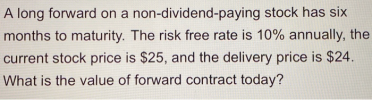 A long forward on a non-dividend-paying stock has six months to maturity. The risk free rate is 10% annually, the current stock price is $25, and the delivery price is $24. What is the value of forward contract today?
The current price of a non-dividend-paying stock is 30. The volatility of the stock is 0.3...
The current price of a non-dividend-paying stock is 30. The volatility of the stock is 0.3 per annum. The risk free rate is 0.05 for all maturities. Using the Cox-Ross-Rubinstein binomial tree model with two time steps to do the valuation, what is the value of a European call option with a strike price of 32 that expires in 6 months?
Problem 1. 1. Calculate the price of a six-month European put option on a non-dividend-paying stock...
Problem 1. 1. Calculate the price of a six-month European put option on a non-dividend-paying stock with an exercise price of $90 when the current stock price is $100, the annualized riskless rate of interest is 3%, and the volatility is 40% per year. 2. Calculate the price of a six-month European call option with an exercise price on this same stock a non-dividend-paying stock with an exercise price of $90. Problem 2. Re-calculate the put and call option prices...
The current stock price of a non-dividend-paying stock is $50, the risk-free interest rate is 10%...
 The current stock price of a non-dividend-paying stock is $50, the risk-free interest rate is 10% per annum, and the volatility is 30% per annum. a) According to the BSM model what is the price of a three-month European put option with a 2. strike of $50? What would be the price of this option if the stock is expected to pay a dividend of $1.50 in two months? b)
 Q8-Part I (6 marks) The current price of a non-dividend-paying stock is $42. Over the next year it is expected to rise to-$44. or fall to $39. An investor buys put options with a strike price of $43. To hedge the position, should (and by how many) the investor buy or sell the underlying share (s) for each put option purchased? (6 marks) 08-Part II (9 marks) The current price of a non-dividend paying stock is $49. Use a two-step...
 A long forward on a non-dividend-paying stock has six months to maturity. The risk free rate is 10% annually, the current stock price is $25, and the delivery price is $24. What is the value of forward contract today?
 A long forward on a non-dividend-paying stock has six months to maturity. The risk free rate is 10% annually, the current stock price is $25, and the delivery price is $24. What is the value of forward contract today?
 The current stock price of a non-dividend-paying stock is $50, the risk-free interest rate is 10% per annum, and the volatility is 30% per annum. a) According to the BSM model what is the price of a three-month European put option with a 2. strike of $50? What would be the price of this option if the stock is expected to pay a dividend of $1.50 in two months? b)
Most questions answered within 3 hours.
-
Where is the error in this code sequence?
String s1 = "Hello";
String s2 = "ello";...
asked 11 months ago -
Financial data for Joel de Paris, Inc., for last year
follow:
Joel de Paris, Inc.
Balance...
asked 11 months ago -
Consider this reaction:
Al2(SO4)3 (aq)+ BaCl3
(aq) Al2Cl6 (aq)- +
3BaSO4(s) . What is the...
asked 11 months ago -
Suppose that Savneet is considering increasing her
recent random sample from 20 car rentals to 40...
asked 11 months ago -
Trucks arrive at an unloading terminal at an average rate of 120
per hour.
Trucks arrive...
asked 11 months ago -
Why are methanol and ethanol completely soluble in water while
octanol is not very little soluble....
asked 11 months ago -
A facilities manager at a university reads in a research report
that the mean amount of...
asked 11 months ago -
When the CuSO4 is rehydrated by adding water to the anhydrous
compound, is this an endothermic...
asked 11 months ago -
A ray of sunlight is passing from diamond into crown glass; the
angle of incidence is...
asked 11 months ago -
A block of mass 0.249 kg is placed on top of a light, vertical
spring of...
asked 11 months ago -
how do the kidneys compensate in the presences of acidosis
a) trigger hyperventilate
b) reserve acid...
asked 11 months ago -
Question 501 pts
The rental rate of capital to the firm increases. Which of the
following...
asked 11 months ago