
Homework Answers

Add Answer to:
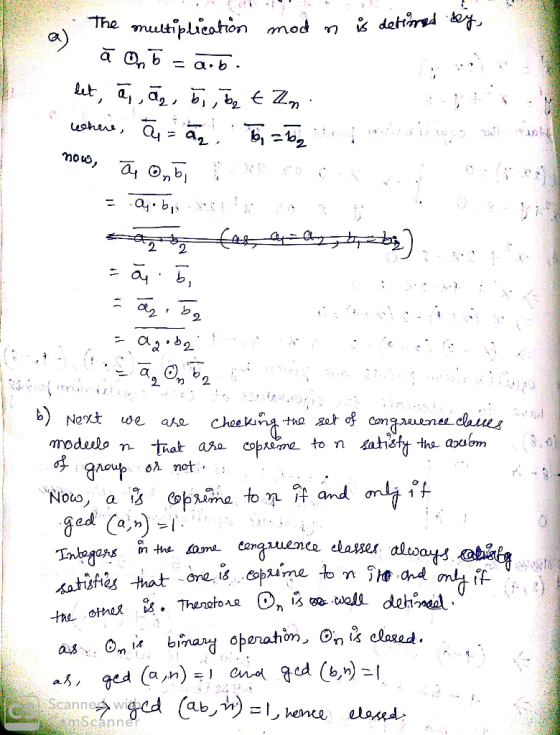
4. (a) For n eZ, define multiplication mod n by ao b-a b (where indicates regular...
Let G = {1, 3, 5, 9, 11, 13} and let represent the binary operation of multiplication modulo 14. (a) Prove that (G, ) is a group. (You may assume that multiplication is associative.) (b) List the cycl...
Let G = {1, 3, 5, 9, 11, 13} and let represent the binary operation of multiplication modulo 14. (a) Prove that (G, ) is a group. (You may assume that multiplication is associative.) (b) List the cyclic subgroups of (G, ). (c) Explain why (G, ) is not isomorphic to the symmetric group S3. (d) State an isomorphism between (G, ) and (Z6, +).
Problem 68. Define for any 2 n є N, the set U(n)-(x| 1 x n and...
 Problem 68. Define for any 2 n є N, the set U(n)-(x| 1 x n and gcd(z, n-1} For example U(12) 1,5,7,11 Further, define n to be multiplication modulo n. For example 9 10 90 (mod 8) 2. i. Show that o is a binary operation on U/). Hint: Use the lemma from Problem 3 on your take-home exam.) ii. Pick a є N. Prove that a: 1 (mod n) has a solution (some number z є U(n)) if and...
* (9) Let n be a positive integer. Define : Z → Zn by (k) =...
 * (9) Let n be a positive integer. Define : Z → Zn by (k) = [k]. (a) Show that is a homomorphism. (b) Find Ker(6) and Im(). yrcises (c) To what familiar group is the quotient group Z/nZ isomorphic? Explain.
5. Let Zli_ {a + bi l a,b E Z. i2--1} be the Gaussian integers. Define a function for all a bi E Zi]. We call N the norm (a) Prove that N is multiplicative. This is, prove that for all a bi, c+di E Z...
 5. Let Zli_ {a + bi l a,b E Z. i2--1} be the Gaussian integers. Define a function for all a bi E Zi]. We call N the norm (a) Prove that N is multiplicative. This is, prove that for all a bi, c+di E Z[i] (b) Prove that if a + r є z[i] is a unit of Zli], then Ma + bi)-1. (c) Find all of the units in Zli
5. Let Zli_ {a + bi l a,b...
5. Let Zli_ {a + bi l a,b E Z. i2--1} be the Gaussian integers. Define a function for all a bi E Zi]. We call N the norm (a) Prove that N is multiplicative. This is, prove that for all a bi, c+di E Z[i] (b) Prove that if a + r є z[i] is a unit of Zli], then Ma + bi)-1. (c) Find all of the units in Zli
5. Let Zli_ {a + bi l a,b...
I need to answer #3 could be done in only one way, we see that if...
 I need to answer #3
could be done in only one way, we see that if we take the table for G and rename the identity e, the next element listed a, and the last element b, the resulting table for G must be the same as the one we had for G. As explained in Section 3, this renaming gives an isomorphism of the group G' with the group G. Definition 3.7 defined the notion of isomorphism and of...
I need to answer #3
could be done in only one way, we see that if we take the table for G and rename the identity e, the next element listed a, and the last element b, the resulting table for G must be the same as the one we had for G. As explained in Section 3, this renaming gives an isomorphism of the group G' with the group G. Definition 3.7 defined the notion of isomorphism and of...
Let po, P1, ...,Pn be boolean variables. Define ak = (Pk + (ak-1)), where ao =...
 Let po, P1, ...,Pn be boolean variables. Define ak = (Pk + (ak-1)), where ao = po. Prove the following boolean-algebra identity using proof by induction and the rules of boolean algebra (given below). Poan = po, for all n > 1. Equivalently this can be written out as: po · (Pn + (Pn-1 +...+(p2 + (p1 + po)...)) = po, for all n > 1. (p')=P (a) Commutative p.q=qp p+q = 9+p (b) Associative (p. 9).r=p.(q.r) (p+q) +r=p+(q +...
1 1 point Consider the following algorithm for factoring an integer N provided as input (in...
 1 1 point Consider the following algorithm for factoring an integer N provided as input (in binary): For i = 2 to [VN.17 i divides N, then output (i, N/). Which of the following statements is true? This algorithm is correct, but it runs in exponential time. This algorithm is not correct, because it will sometimes fail to find a factorization of Neven if N is composite This algorithm runs in sub-linear time, and always factors N it Nis composite...
Let R be a commutative ring with no nonzero zero divisor and elements r1,r2,.. . ,Tn where n is a...
 Let R be a commutative ring with no nonzero zero divisor and elements r1,r2,.. . ,Tn where n is a positive integer and n 2. In this problem you will sketch a proof that R is a field (a) We first show that R has a multiplicative identity. Sinee the additive identity of R is, there is a nonzero a E R. Consider the elements ari, ar2, ..., arn. These are distinct. To see O. Since R conelude that0, which...
 Problem 68. Define for any 2 n є N, the set U(n)-(x| 1 x n and gcd(z, n-1} For example U(12) 1,5,7,11 Further, define n to be multiplication modulo n. For example 9 10 90 (mod 8) 2. i. Show that o is a binary operation on U/). Hint: Use the lemma from Problem 3 on your take-home exam.) ii. Pick a є N. Prove that a: 1 (mod n) has a solution (some number z є U(n)) if and...
 * (9) Let n be a positive integer. Define : Z → Zn by (k) = [k]. (a) Show that is a homomorphism. (b) Find Ker(6) and Im(). yrcises (c) To what familiar group is the quotient group Z/nZ isomorphic? Explain.
 5. Let Zli_ {a + bi l a,b E Z. i2--1} be the Gaussian integers. Define a function for all a bi E Zi]. We call N the norm (a) Prove that N is multiplicative. This is, prove that for all a bi, c+di E Z[i] (b) Prove that if a + r є z[i] is a unit of Zli], then Ma + bi)-1. (c) Find all of the units in Zli
5. Let Zli_ {a + bi l a,b...
5. Let Zli_ {a + bi l a,b E Z. i2--1} be the Gaussian integers. Define a function for all a bi E Zi]. We call N the norm (a) Prove that N is multiplicative. This is, prove that for all a bi, c+di E Z[i] (b) Prove that if a + r є z[i] is a unit of Zli], then Ma + bi)-1. (c) Find all of the units in Zli
5. Let Zli_ {a + bi l a,b...
 I need to answer #3
could be done in only one way, we see that if we take the table for G and rename the identity e, the next element listed a, and the last element b, the resulting table for G must be the same as the one we had for G. As explained in Section 3, this renaming gives an isomorphism of the group G' with the group G. Definition 3.7 defined the notion of isomorphism and of...
I need to answer #3
could be done in only one way, we see that if we take the table for G and rename the identity e, the next element listed a, and the last element b, the resulting table for G must be the same as the one we had for G. As explained in Section 3, this renaming gives an isomorphism of the group G' with the group G. Definition 3.7 defined the notion of isomorphism and of...
 Let po, P1, ...,Pn be boolean variables. Define ak = (Pk + (ak-1)), where ao = po. Prove the following boolean-algebra identity using proof by induction and the rules of boolean algebra (given below). Poan = po, for all n > 1. Equivalently this can be written out as: po · (Pn + (Pn-1 +...+(p2 + (p1 + po)...)) = po, for all n > 1. (p')=P (a) Commutative p.q=qp p+q = 9+p (b) Associative (p. 9).r=p.(q.r) (p+q) +r=p+(q +...
 1 1 point Consider the following algorithm for factoring an integer N provided as input (in binary): For i = 2 to [VN.17 i divides N, then output (i, N/). Which of the following statements is true? This algorithm is correct, but it runs in exponential time. This algorithm is not correct, because it will sometimes fail to find a factorization of Neven if N is composite This algorithm runs in sub-linear time, and always factors N it Nis composite...
 Let R be a commutative ring with no nonzero zero divisor and elements r1,r2,.. . ,Tn where n is a positive integer and n 2. In this problem you will sketch a proof that R is a field (a) We first show that R has a multiplicative identity. Sinee the additive identity of R is, there is a nonzero a E R. Consider the elements ari, ar2, ..., arn. These are distinct. To see O. Since R conelude that0, which...
Most questions answered within 3 hours.
-
Where is the error in this code sequence?
String s1 = "Hello";
String s2 = "ello";...
asked 11 months ago -
Financial data for Joel de Paris, Inc., for last year
follow:
Joel de Paris, Inc.
Balance...
asked 11 months ago -
Consider this reaction:
Al2(SO4)3 (aq)+ BaCl3
(aq) Al2Cl6 (aq)- +
3BaSO4(s) . What is the...
asked 11 months ago -
Suppose that Savneet is considering increasing her
recent random sample from 20 car rentals to 40...
asked 11 months ago -
Trucks arrive at an unloading terminal at an average rate of 120
per hour.
Trucks arrive...
asked 11 months ago -
Why are methanol and ethanol completely soluble in water while
octanol is not very little soluble....
asked 11 months ago -
A facilities manager at a university reads in a research report
that the mean amount of...
asked 11 months ago -
When the CuSO4 is rehydrated by adding water to the anhydrous
compound, is this an endothermic...
asked 11 months ago -
A ray of sunlight is passing from diamond into crown glass; the
angle of incidence is...
asked 11 months ago -
A block of mass 0.249 kg is placed on top of a light, vertical
spring of...
asked 11 months ago -
how do the kidneys compensate in the presences of acidosis
a) trigger hyperventilate
b) reserve acid...
asked 11 months ago -
Question 501 pts
The rental rate of capital to the firm increases. Which of the
following...
asked 11 months ago