 Please show all work and
steps! Would like to learn how!
Please show all work and
steps! Would like to learn how!
Homework Answers

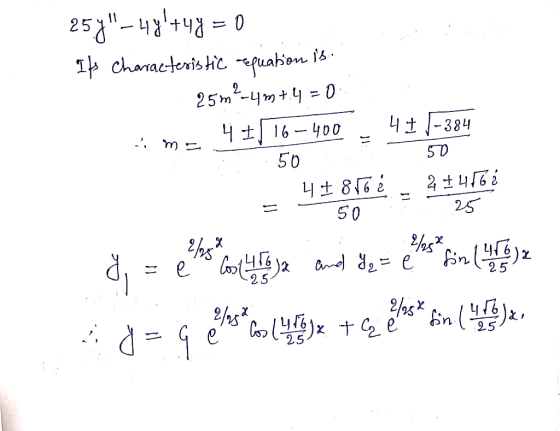
Add Answer to:
Please show all work and
steps! Would like to learn how!
Given a second order linear...
Given a second order linear homogeneous differential equation a2(x)” + a (x2y + a)(x2y = 0...
 Given a second order linear homogeneous differential equation a2(x)” + a (x2y + a)(x2y = 0 we know that a fundamental set for this ODE consists of a pair linearly independent solutions yı, y. But there are times when only one function, call it yi, is available and we would like to find a second linearly independent solution. We can find y2 using the method of reduction of order. First, under the necessary assumption the az(x) + 0 we rewrite...
Given a second order linear homogeneous differential equation а2(х)у" + а (х)У + аo(х)у — 0...
 Given a second order linear homogeneous differential equation а2(х)у" + а (х)У + аo(х)у — 0 we know that a fundamental set for this ODE consists of a pair linearly independent solutions yı, V2. But there are times when only one function, call it y, is available and we would like to find a second linearly independent solution. We can find y2 using the method of reduction of order. First, under the necessary assumption the a2(x) F 0 we rewrite...
HW3.2: Problem 1 Previous Problem Problem List Next Problem (1 point) Given a second order linear...
 HW3.2: Problem 1 Previous Problem Problem List Next Problem (1 point) Given a second order linear homogeneous differential equation a2(x)y" + ai (x)y' + ao (x)y0 we know that a fundamental set for this ODE consists of a pair linearly independent solutions yi, y2. But there are times when only one function, call it y, is available and we would like to find a second linearly independent solution. We can find 2 using the method of reduction of order. First,...
(1 point) Given a second order inear homogeneous differential equation az(x) + we know that a...
 (1 point) Given a second order inear homogeneous differential equation az(x) + we know that a fundamental set for this ODE consists of a pair nearly ndependent solutions . linearly independent solution We can find using the method et reduction of (2) + Golly=0 But there are times when only one functional and we would e nd a con First under the necessary assumption the a, (2) we rewrite the equation as * +++ (2) - Plz) - ) Then...
The indicated function yı() is a solution of the given differential equation. Use reduction of order...
 The indicated function yı() is a solution of the given differential equation. Use reduction of order or formula (5) in Section 4.2, Y2 = vy() / e-SP(x) dx dx (5) y?(x) as instructed, to find a second solution y2(x). x?y" + 2xy' – 6y = 0; Y1 = x2 Y2 The indicated function yı(x) is a solution of the given differential equation. 6y" + y' - y = 0; Y1 Fet/3 Use reduction of order or formula (5) in Section...
2. (3+4+4+4 pts) In this problem, we discuss a method of solving SOL equations known as...
 2. (3+4+4+4 pts) In this problem, we discuss a method of solving SOL equations known as Reduction of Order. Given an equation y" +p(a)y' +9(2)y = 0, and assuming yi is a solution, Reduction of Order asks: does there exist a second, linearly-independent solution y2 of the form y2 = u(x)41 for some function u(x)? See Section 3.2, Exercise 36 for reference). We'll now use this to solve the following problem. (a) Consider the SOL differential equation sin(x)y" — 2...
Part A Part B Kindly show the detailed solution for reviewer. Thanks! I'll rate it The...
 Part A
Part B
Kindly show the detailed solution for reviewer.
Thanks! I'll rate it
The indicated function y(x) is a solution of the associated homogeneous equation. Use the method of reduction of order to find a second solution 72(x) of the homogeneous equation and a particular solution Yp(x) of the given nonhomogeneous equation. y" - 3y + 2y = 11e3x, Yu = ex Y2(X) Yo(x) = The indicated function yı(x) is a solution of the given differential equation. Use...
Part A
Part B
Kindly show the detailed solution for reviewer.
Thanks! I'll rate it
The indicated function y(x) is a solution of the associated homogeneous equation. Use the method of reduction of order to find a second solution 72(x) of the homogeneous equation and a particular solution Yp(x) of the given nonhomogeneous equation. y" - 3y + 2y = 11e3x, Yu = ex Y2(X) Yo(x) = The indicated function yı(x) is a solution of the given differential equation. Use...
One of the solutions to the following differential equation (1 – 2x – 2y + 2(1+x)y...
 One of the solutions to the following differential equation (1 – 2x – 2y + 2(1+x)y – 2y = 0 is known to be yı (x) = 1 +1 Find the second linearly independent solution y2 (2) using the method of Reduction of Order.
1- Use the Reduction of Order method to find a second solution of the equation 4x2y"...
 1- Use the Reduction of Order method to find a second solution of the equation 4x2y" + y = 0 Given that yı = xì Inx 2- Solve the differential equation y" + 4y + 4y = 0 3- Solve the differential equation y" + 2y + 10y = 0 y” + 5y + 4y = cosx + 2e*
part A part B part C Kindly show the detailed solution for reviewer! I'll rate it...
 part A
part B
part C
Kindly show the detailed solution for reviewer! I'll
rate it for sure thanks!
The indicated function y(x) is a solution of the given differential equation. Use reduction of order or formula (5) in Section 4.2, e-SP(x) dx Y2 = Y1(x) dx (5) as instructed, to find a second solution 72(x). xy" + y' = 0; Y1 = In x Y2 = The indicated function yı(x) is a solution of the given differential equation. Use...
part A
part B
part C
Kindly show the detailed solution for reviewer! I'll
rate it for sure thanks!
The indicated function y(x) is a solution of the given differential equation. Use reduction of order or formula (5) in Section 4.2, e-SP(x) dx Y2 = Y1(x) dx (5) as instructed, to find a second solution 72(x). xy" + y' = 0; Y1 = In x Y2 = The indicated function yı(x) is a solution of the given differential equation. Use...
 Given a second order linear homogeneous differential equation a2(x)” + a (x2y + a)(x2y = 0 we know that a fundamental set for this ODE consists of a pair linearly independent solutions yı, y. But there are times when only one function, call it yi, is available and we would like to find a second linearly independent solution. We can find y2 using the method of reduction of order. First, under the necessary assumption the az(x) + 0 we rewrite...
 Given a second order linear homogeneous differential equation а2(х)у" + а (х)У + аo(х)у — 0 we know that a fundamental set for this ODE consists of a pair linearly independent solutions yı, V2. But there are times when only one function, call it y, is available and we would like to find a second linearly independent solution. We can find y2 using the method of reduction of order. First, under the necessary assumption the a2(x) F 0 we rewrite...
 HW3.2: Problem 1 Previous Problem Problem List Next Problem (1 point) Given a second order linear homogeneous differential equation a2(x)y" + ai (x)y' + ao (x)y0 we know that a fundamental set for this ODE consists of a pair linearly independent solutions yi, y2. But there are times when only one function, call it y, is available and we would like to find a second linearly independent solution. We can find 2 using the method of reduction of order. First,...
 (1 point) Given a second order inear homogeneous differential equation az(x) + we know that a fundamental set for this ODE consists of a pair nearly ndependent solutions . linearly independent solution We can find using the method et reduction of (2) + Golly=0 But there are times when only one functional and we would e nd a con First under the necessary assumption the a, (2) we rewrite the equation as * +++ (2) - Plz) - ) Then...
 The indicated function yı() is a solution of the given differential equation. Use reduction of order or formula (5) in Section 4.2, Y2 = vy() / e-SP(x) dx dx (5) y?(x) as instructed, to find a second solution y2(x). x?y" + 2xy' – 6y = 0; Y1 = x2 Y2 The indicated function yı(x) is a solution of the given differential equation. 6y" + y' - y = 0; Y1 Fet/3 Use reduction of order or formula (5) in Section...
 2. (3+4+4+4 pts) In this problem, we discuss a method of solving SOL equations known as Reduction of Order. Given an equation y" +p(a)y' +9(2)y = 0, and assuming yi is a solution, Reduction of Order asks: does there exist a second, linearly-independent solution y2 of the form y2 = u(x)41 for some function u(x)? See Section 3.2, Exercise 36 for reference). We'll now use this to solve the following problem. (a) Consider the SOL differential equation sin(x)y" — 2...
 Part A
Part B
Kindly show the detailed solution for reviewer.
Thanks! I'll rate it
The indicated function y(x) is a solution of the associated homogeneous equation. Use the method of reduction of order to find a second solution 72(x) of the homogeneous equation and a particular solution Yp(x) of the given nonhomogeneous equation. y" - 3y + 2y = 11e3x, Yu = ex Y2(X) Yo(x) = The indicated function yı(x) is a solution of the given differential equation. Use...
Part A
Part B
Kindly show the detailed solution for reviewer.
Thanks! I'll rate it
The indicated function y(x) is a solution of the associated homogeneous equation. Use the method of reduction of order to find a second solution 72(x) of the homogeneous equation and a particular solution Yp(x) of the given nonhomogeneous equation. y" - 3y + 2y = 11e3x, Yu = ex Y2(X) Yo(x) = The indicated function yı(x) is a solution of the given differential equation. Use...
 One of the solutions to the following differential equation (1 – 2x – 2y + 2(1+x)y – 2y = 0 is known to be yı (x) = 1 +1 Find the second linearly independent solution y2 (2) using the method of Reduction of Order.
 1- Use the Reduction of Order method to find a second solution of the equation 4x2y" + y = 0 Given that yı = xì Inx 2- Solve the differential equation y" + 4y + 4y = 0 3- Solve the differential equation y" + 2y + 10y = 0 y” + 5y + 4y = cosx + 2e*
 part A
part B
part C
Kindly show the detailed solution for reviewer! I'll
rate it for sure thanks!
The indicated function y(x) is a solution of the given differential equation. Use reduction of order or formula (5) in Section 4.2, e-SP(x) dx Y2 = Y1(x) dx (5) as instructed, to find a second solution 72(x). xy" + y' = 0; Y1 = In x Y2 = The indicated function yı(x) is a solution of the given differential equation. Use...
part A
part B
part C
Kindly show the detailed solution for reviewer! I'll
rate it for sure thanks!
The indicated function y(x) is a solution of the given differential equation. Use reduction of order or formula (5) in Section 4.2, e-SP(x) dx Y2 = Y1(x) dx (5) as instructed, to find a second solution 72(x). xy" + y' = 0; Y1 = In x Y2 = The indicated function yı(x) is a solution of the given differential equation. Use...
Most questions answered within 3 hours.
-
Where is the error in this code sequence?
String s1 = "Hello";
String s2 = "ello";...
asked 10 months ago -
Financial data for Joel de Paris, Inc., for last year
follow:
Joel de Paris, Inc.
Balance...
asked 10 months ago -
Consider this reaction:
Al2(SO4)3 (aq)+ BaCl3
(aq) Al2Cl6 (aq)- +
3BaSO4(s) . What is the...
asked 10 months ago -
Suppose that Savneet is considering increasing her
recent random sample from 20 car rentals to 40...
asked 10 months ago -
Trucks arrive at an unloading terminal at an average rate of 120
per hour.
Trucks arrive...
asked 10 months ago -
Why are methanol and ethanol completely soluble in water while
octanol is not very little soluble....
asked 10 months ago -
A facilities manager at a university reads in a research report
that the mean amount of...
asked 10 months ago -
When the CuSO4 is rehydrated by adding water to the anhydrous
compound, is this an endothermic...
asked 10 months ago -
A ray of sunlight is passing from diamond into crown glass; the
angle of incidence is...
asked 10 months ago -
A block of mass 0.249 kg is placed on top of a light, vertical
spring of...
asked 10 months ago -
how do the kidneys compensate in the presences of acidosis
a) trigger hyperventilate
b) reserve acid...
asked 10 months ago -
Question 501 pts
The rental rate of capital to the firm increases. Which of the
following...
asked 10 months ago