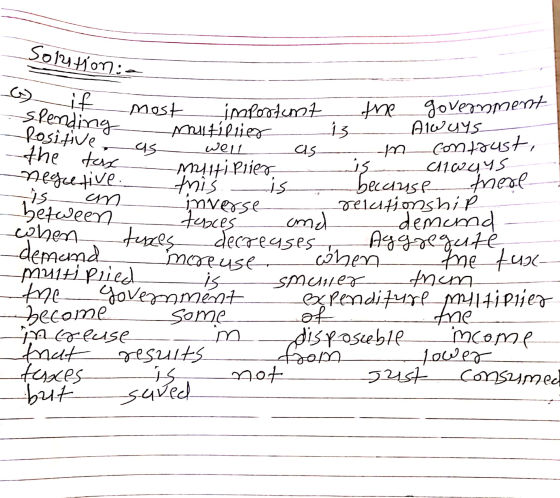
Why, as we introduce taxes into the model, does the value of the multiplier decrease?
Why, as we introduce taxes into the model, does the value of the multiplier decrease?
Homework Answers
Add Answer to:
Why, as we introduce taxes into the model, does the value of the
multiplier decrease?
Now we introduce the role of income taxes into the Keynesian system. U.S. taxes consist of...
Now we introduce the role of income taxes into the Keynesian system. U.S. taxes consist of autonomous taxes and income taxes. Autonomous taxes such as sales taxes and property taxes do not depend on income, whereas income taxes such as personal income taxes and corporate income taxes depend on the level of income. When we introduce income taxes into the model, the multipliers are modified as follows: Assuming that the U.S. MPC is 0.9, and the average income tax rate...
Now we introduce the role of income taxes into the Keynesian system. U.S. taxes consist of...
Now we introduce the role of income taxes into the Keynesian system. U.S. taxes consist of autonomous taxes and income taxes. Autonomous taxes such as sales taxes and property taxes do not depend on income, whereas income taxes such as personal income taxes and corporate income taxes depend on the level of income. When we introduce income taxes into the model, the multipliers are modified as follows: Assuming that the U.S. MPC is 0.9, and the average income tax rate...
A decrease in autonomous consumption in a general IS-LM macroeconomic model where consumption, investments, taxes, and...
A decrease in autonomous consumption in a general IS-LM macroeconomic model where consumption, investments, taxes, and money demand are given by the following general functional forms. ?(?, ?), ?(?, ?), ?(?), ??(?, ?) . a. Is there a multiplier effect on output if we hold the interest rate fixed? Explain what would happen to equilibirum
The Multiplier in the Simple Model with No Income Taxes The simple government purchase multiplier is...
The Multiplier in the Simple Model with No Income Taxes The simple government purchase multiplier is given by 1/(1 - MPC). Suppose that the U.S. MPC is 0.9. Calculate the government purchase multiplier. If the U.S. government increases its spending by $100 billion to stimulate the economy devastated by the Coronavirus crisis, how much will U.S. GDP increase in the simple model?
Why is the multiplier for a change in taxes smaller than for a change in spending?...
 Why is the multiplier for a change in taxes smaller than for a change in spending? a. A change in taxes has no effect on aggregate demand, only on aggregate supply. b. A change in taxes directly affects government spending as well, lowering the multiplier. c. A change in taxes affects spending directly, but at a slower rate than spending does. d. A change in taxes affects disposable income and then consumption rather than spending directly. e. All of the...
22. Why is the multiplier for a change in taxes smaller than for a change in spendi...
22. Why is the multiplier for a change in taxes smaller than for a change in spending? a. A change in taxes has no effect on aggregate demand, only on aggregate supply. b. A change in taxes directly affects government spending as well, lowering the multiplier. c. A change in taxes affects spending directly, but at a slower rate than spending does. d. A change in taxes affects disposable income and then consumption rather than spending directly....
The major contribution of the Miller model is that it demonstrates that a. personal taxes decrease...
The major contribution of the Miller model is that it demonstrates that a. personal taxes decrease the value of using corporate debt. b. financial distress and agency costs reduce the value of using corporate debt. c. equity costs increase with financial leverage. d. debt costs increase with financial leverage. e. personal taxes increase the value of using corporate debt.
35. Death and Taxes. The basic Keynesian Cross model from 11-1 in the textbook assumes taxes are exogenous and inde...
 35. Death and Taxes. The basic Keynesian Cross model from 11-1 in the textbook assumes taxes are exogenous and independent of income, but that is not realistic so let's modify the model. i. Here are two options for modeling taxes as a function of income: a) T(Y) = 2 + 0.2Y or b) T(Y) = 2-0.2Y Which choice is more realistic? Briefly explain your choice to yourself. Suppose I = 6, C = 10 +0.5(Y-T) and G is unknown. Set...
If the government increases taxes to address the budget deficit, then according to the multiplier effect...
If the government increases taxes to address the budget deficit, then according to the multiplier effect A.AD will increase by more than the change in taxes B.AD will increase by less than the change in taxes C.AD will decrease by more than the change in taxes D.AD will decrease by less than the change in taxes
Explain in words why we need to introduce the stress tensor for fluid mechanics.
Explain in words why we need to introduce the stress tensor for fluid mechanics.
 Why is the multiplier for a change in taxes smaller than for a change in spending? a. A change in taxes has no effect on aggregate demand, only on aggregate supply. b. A change in taxes directly affects government spending as well, lowering the multiplier. c. A change in taxes affects spending directly, but at a slower rate than spending does. d. A change in taxes affects disposable income and then consumption rather than spending directly. e. All of the...
 35. Death and Taxes. The basic Keynesian Cross model from 11-1 in the textbook assumes taxes are exogenous and independent of income, but that is not realistic so let's modify the model. i. Here are two options for modeling taxes as a function of income: a) T(Y) = 2 + 0.2Y or b) T(Y) = 2-0.2Y Which choice is more realistic? Briefly explain your choice to yourself. Suppose I = 6, C = 10 +0.5(Y-T) and G is unknown. Set...
Most questions answered within 3 hours.
-
Where is the error in this code sequence?
String s1 = "Hello";
String s2 = "ello";...
asked 10 months ago -
Financial data for Joel de Paris, Inc., for last year
follow:
Joel de Paris, Inc.
Balance...
asked 10 months ago -
Consider this reaction:
Al2(SO4)3 (aq)+ BaCl3
(aq) Al2Cl6 (aq)- +
3BaSO4(s) . What is the...
asked 10 months ago -
Suppose that Savneet is considering increasing her
recent random sample from 20 car rentals to 40...
asked 10 months ago -
Trucks arrive at an unloading terminal at an average rate of 120
per hour.
Trucks arrive...
asked 10 months ago -
Why are methanol and ethanol completely soluble in water while
octanol is not very little soluble....
asked 10 months ago -
A facilities manager at a university reads in a research report
that the mean amount of...
asked 10 months ago -
When the CuSO4 is rehydrated by adding water to the anhydrous
compound, is this an endothermic...
asked 10 months ago -
A ray of sunlight is passing from diamond into crown glass; the
angle of incidence is...
asked 10 months ago -
A block of mass 0.249 kg is placed on top of a light, vertical
spring of...
asked 10 months ago -
how do the kidneys compensate in the presences of acidosis
a) trigger hyperventilate
b) reserve acid...
asked 10 months ago -
Question 501 pts
The rental rate of capital to the firm increases. Which of the
following...
asked 10 months ago