
Homework Answers
Ans:
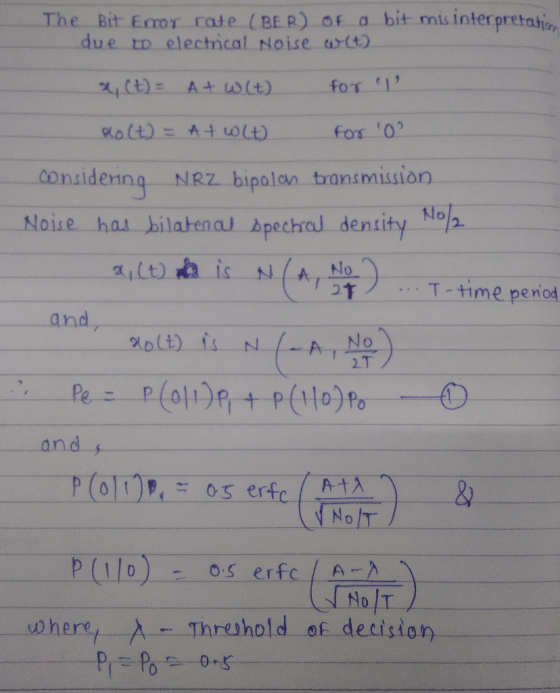
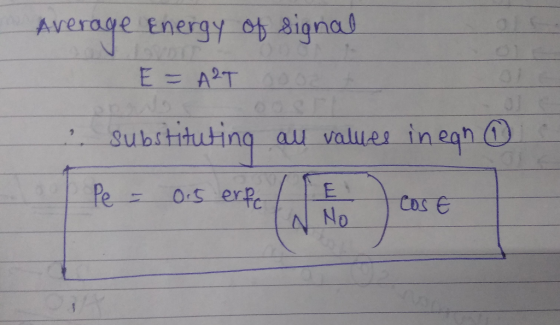
The bit error rate (BER) is the number of bit errors per unit time.The bit error probability pe is the expectation value of the bit error ratio.In a noisy channel, the Bit Error Rate is often expressed as a function of the normalized carrier-to-noise ratio measure denoted Eb/N0, (energy per bit to noise power spectral density ratio), or Es/N0 (energy per modulation symbol to noise spectral density).
Add Answer to:
A binary PSK signal in the presence of additive white Gaussian noise (AWGN) is detected by...
An 8-ary PSK (phase shift keying) signal is transmitted over an additive, zero mean, band-limited Gaussian noise channe...
 An 8-ary PSK (phase shift keying) signal is transmitted over an additive, zero mean, band-limited Gaussian noise channel.The channel output is r(t)-s(t)+n(t), st<T, where s(tAcos 2rft+0) for ie 10,123,4,5,6,7) were,+8 16 8 The noise n(t) is narrowband, zero mean, bandpass Gaussian noise with power spectral density Sn (f) is shown in Figure 3, where B is the bandwidth of the noise S, (f) (Watts/Hz) 2 cf (Hz) Figure 3 T herefore, 2 2 2 0 elsewhere (i) What is the...
Consider a noisy AWGN (Additive White Gaussian Noise) communication channel with a bandwidth of 12 KHz....
Consider a noisy AWGN (Additive White Gaussian Noise) communication channel with a bandwidth of 12 KHz. Is it possible to transmit reliably over this channel at a bit rate of 150 Kbps with an SNR (Signal to Noise Ratio) of 35 dB? Justify your answer
A BPSK signal is detected coherently in the presence of AWGN with double-sided power spectral density....
 A BPSK signal is detected coherently in the presence of AWGN with double-sided power spectral density. The BPSK signal is given by; Signal: FE cos(wet), probability Pų for binary“1 ( - )" and Po for binary “O (+)”. Derive the overall average bit error probability in terms of Ep and y, where Ep is the average bit energy and y is the threshold value. (Show all steps and reasons)
Consider additive white Gaussian noise with a double-sided noise power spectral density (PSD) 12-90 dBm/Hz 1E-12 W/Hz....
 Consider additive white Gaussian noise with a double-sided noise power spectral density (PSD) 12-90 dBm/Hz 1E-12 W/Hz. This noise corrupts a baseband polar NRZ signal with rectangular pulses, like that 1 mV and the pulse duration is Tb such that the symbol rate is Rb 1/Tb. Since this is binary signaling, the symbol rate equals the bit rate of the incoming baseband pulse train: B Rt. The signal is then sampled at the center of the noisy shown in the...
A bipolar binary signal, si(t), is a +1- or -1- V pulse during the interval (0, T). AWGN having two-sided power spectra...
 A bipolar binary signal, si(t), is a +1- or -1- V pulse during the interval (0, T). AWGN having two-sided power spectral density of 0.005 W/Hz is added to the signal. If the received signal is detected with a matched filter, determine the maximum bit rate that can be sent with a bit error probability ofPB< 10
A bipolar binary signal, si(t), is a +1- or -1- V pulse during the interval (0, T). AWGN having two-sided power spectral density...
A bipolar binary signal, si(t), is a +1- or -1- V pulse during the interval (0, T). AWGN having two-sided power spectral density of 0.005 W/Hz is added to the signal. If the received signal is detected with a matched filter, determine the maximum bit rate that can be sent with a bit error probability ofPB< 10
A bipolar binary signal, si(t), is a +1- or -1- V pulse during the interval (0, T). AWGN having two-sided power spectral density...
Question 1 The noise floor, also known as additive white Gaussian noise (AWGN), is a continuous...
Question 1 The noise floor, also known as additive white Gaussian noise (AWGN), is a continuous noise level that appears over a wide spectrum when viewed in the frequency domain. True False 10 points Question 2 When considering the impact of impulse noise, we find that it is more devastating to a digital communications link, than an analog one. Therefore, error control methods should be used on all digital links. True False 10 points Question 3 When two transmitters operate...
Exercise 12: An ASK system employs the following signals in the presence of Additive white noise with a PSD of n/2, t)A c 2f t) for binary 1 So(t)-BA cos(2πfet), for binary 0 where 0< B<1. Deri...
 Exercise 12: An ASK system employs the following signals in the presence of Additive white noise with a PSD of n/2, t)A c 2f t) for binary 1 So(t)-BA cos(2πfet), for binary 0 where 0< B<1. Derive the probability of error Pe assuming that the binary signals for 1 and 0 occur with equal probability. Hint: Find the average energy per bit Eb
Exercise 12: An ASK system employs the following signals in the presence of Additive white noise with...
Exercise 12: An ASK system employs the following signals in the presence of Additive white noise with a PSD of n/2, t)A c 2f t) for binary 1 So(t)-BA cos(2πfet), for binary 0 where 0< B<1. Derive the probability of error Pe assuming that the binary signals for 1 and 0 occur with equal probability. Hint: Find the average energy per bit Eb
Exercise 12: An ASK system employs the following signals in the presence of Additive white noise with...
A bipolar baseband binary signal has rectangular pulse level of +2 V or -2 V and...
 A bipolar baseband binary signal has rectangular pulse level of +2 V or -2 V and bit duration of T. Additive white Gaussian noise with power spectral density No/2-10" Watts/z is added to it. Find the maximum bit rate that can be transmitted with a bit error probability of P 1?? using the following table of the Q function. Note: pa o 2E 2.33.1 374.2 0.01 0.0010.0001 0.00001 Q(x)
Let us consider the binary digital communication system in which bit 1 is represented by the...
Let us consider the binary digital communication system in which bit 1 is represented by the waveform Acos(ωt) of bit duration T, where ω is the carrier radial frequency and A is the constant amplitude. On the hand, the bit 0 is represented by the following waveform instead (A/10)cos(ωt). During the transmission the channel has introduced the uniform random phase shift Φ and transmitted waveform is affected by zero-mean white Gaussian noise of variance σ2. To demodulate, we perform the...
The input r(t) to a DSBSC receiver is a DSB signal s(t) = A m(t)cos (21fet)...
 The input r(t) to a DSBSC receiver is a DSB signal s(t) = A m(t)cos (21fet) corrupted by additive white Gaussian noise with two-sided power spectral density N,/2, where No = 10-12 W/Hz, m(t) is a message signal bandlimited to 10 kHz. Average power of m(t) is Pm = 4 W and Ac = 2 mV. The block diagram of the receiver is shown below. Note that the receiver has filters which have slightly larger bandwidths than a typical DSB...
 An 8-ary PSK (phase shift keying) signal is transmitted over an additive, zero mean, band-limited Gaussian noise channel.The channel output is r(t)-s(t)+n(t), st<T, where s(tAcos 2rft+0) for ie 10,123,4,5,6,7) were,+8 16 8 The noise n(t) is narrowband, zero mean, bandpass Gaussian noise with power spectral density Sn (f) is shown in Figure 3, where B is the bandwidth of the noise S, (f) (Watts/Hz) 2 cf (Hz) Figure 3 T herefore, 2 2 2 0 elsewhere (i) What is the...
 A BPSK signal is detected coherently in the presence of AWGN with double-sided power spectral density. The BPSK signal is given by; Signal: FE cos(wet), probability Pų for binary“1 ( - )" and Po for binary “O (+)”. Derive the overall average bit error probability in terms of Ep and y, where Ep is the average bit energy and y is the threshold value. (Show all steps and reasons)
 Consider additive white Gaussian noise with a double-sided noise power spectral density (PSD) 12-90 dBm/Hz 1E-12 W/Hz. This noise corrupts a baseband polar NRZ signal with rectangular pulses, like that 1 mV and the pulse duration is Tb such that the symbol rate is Rb 1/Tb. Since this is binary signaling, the symbol rate equals the bit rate of the incoming baseband pulse train: B Rt. The signal is then sampled at the center of the noisy shown in the...
 A bipolar binary signal, si(t), is a +1- or -1- V pulse during the interval (0, T). AWGN having two-sided power spectral density of 0.005 W/Hz is added to the signal. If the received signal is detected with a matched filter, determine the maximum bit rate that can be sent with a bit error probability ofPB< 10
A bipolar binary signal, si(t), is a +1- or -1- V pulse during the interval (0, T). AWGN having two-sided power spectral density...
A bipolar binary signal, si(t), is a +1- or -1- V pulse during the interval (0, T). AWGN having two-sided power spectral density of 0.005 W/Hz is added to the signal. If the received signal is detected with a matched filter, determine the maximum bit rate that can be sent with a bit error probability ofPB< 10
A bipolar binary signal, si(t), is a +1- or -1- V pulse during the interval (0, T). AWGN having two-sided power spectral density...
 Exercise 12: An ASK system employs the following signals in the presence of Additive white noise with a PSD of n/2, t)A c 2f t) for binary 1 So(t)-BA cos(2πfet), for binary 0 where 0< B<1. Derive the probability of error Pe assuming that the binary signals for 1 and 0 occur with equal probability. Hint: Find the average energy per bit Eb
Exercise 12: An ASK system employs the following signals in the presence of Additive white noise with...
Exercise 12: An ASK system employs the following signals in the presence of Additive white noise with a PSD of n/2, t)A c 2f t) for binary 1 So(t)-BA cos(2πfet), for binary 0 where 0< B<1. Derive the probability of error Pe assuming that the binary signals for 1 and 0 occur with equal probability. Hint: Find the average energy per bit Eb
Exercise 12: An ASK system employs the following signals in the presence of Additive white noise with...
 A bipolar baseband binary signal has rectangular pulse level of +2 V or -2 V and bit duration of T. Additive white Gaussian noise with power spectral density No/2-10" Watts/z is added to it. Find the maximum bit rate that can be transmitted with a bit error probability of P 1?? using the following table of the Q function. Note: pa o 2E 2.33.1 374.2 0.01 0.0010.0001 0.00001 Q(x)
 The input r(t) to a DSBSC receiver is a DSB signal s(t) = A m(t)cos (21fet) corrupted by additive white Gaussian noise with two-sided power spectral density N,/2, where No = 10-12 W/Hz, m(t) is a message signal bandlimited to 10 kHz. Average power of m(t) is Pm = 4 W and Ac = 2 mV. The block diagram of the receiver is shown below. Note that the receiver has filters which have slightly larger bandwidths than a typical DSB...
Most questions answered within 3 hours.
-
Where is the error in this code sequence?
String s1 = "Hello";
String s2 = "ello";...
asked 11 months ago -
Financial data for Joel de Paris, Inc., for last year
follow:
Joel de Paris, Inc.
Balance...
asked 11 months ago -
Consider this reaction:
Al2(SO4)3 (aq)+ BaCl3
(aq) Al2Cl6 (aq)- +
3BaSO4(s) . What is the...
asked 11 months ago -
Suppose that Savneet is considering increasing her
recent random sample from 20 car rentals to 40...
asked 11 months ago -
Trucks arrive at an unloading terminal at an average rate of 120
per hour.
Trucks arrive...
asked 11 months ago -
Why are methanol and ethanol completely soluble in water while
octanol is not very little soluble....
asked 11 months ago -
A facilities manager at a university reads in a research report
that the mean amount of...
asked 11 months ago -
When the CuSO4 is rehydrated by adding water to the anhydrous
compound, is this an endothermic...
asked 11 months ago -
A ray of sunlight is passing from diamond into crown glass; the
angle of incidence is...
asked 11 months ago -
A block of mass 0.249 kg is placed on top of a light, vertical
spring of...
asked 11 months ago -
how do the kidneys compensate in the presences of acidosis
a) trigger hyperventilate
b) reserve acid...
asked 11 months ago -
Question 501 pts
The rental rate of capital to the firm increases. Which of the
following...
asked 11 months ago