
Homework Answers
Add Answer to:
1. (a) Write the following two functions in terms of , and say where they are...
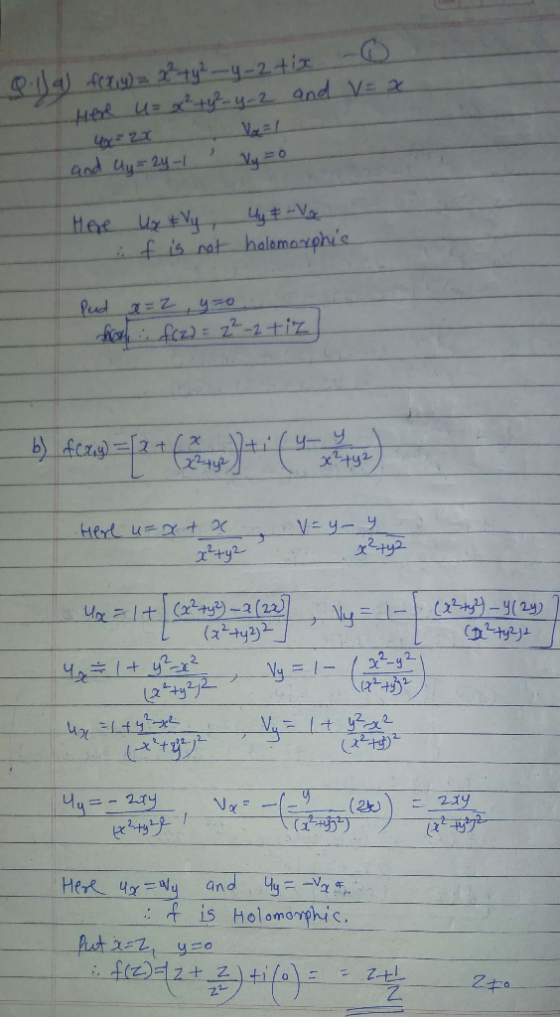
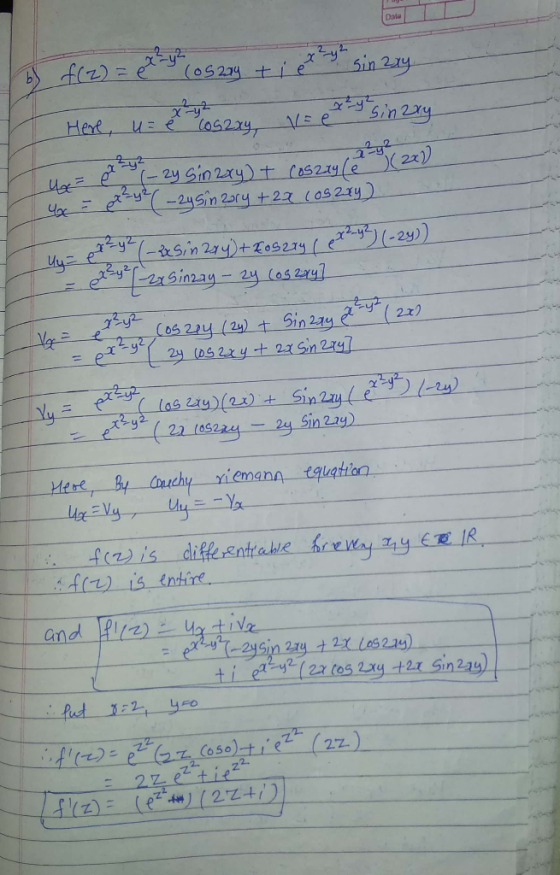
1. Write f(z) in the form f(x) = u(x, y) +iv(x, y). (a) f(x) = 23+2+1...
 1. Write f(z) in the form f(x) = u(x, y) +iv(x, y). (a) f(x) = 23+2+1 (b) f(3) = 2,270. Suppose f(z) = x2 - y2 - 2y +i (2x - 2xy), where z = x + iy, and express () in terms of .
*PLEASE SHOW ALL WORK AND STEP BY STEP SOLUTION* 7.+-/3 points MarsVectorCalc6 2.6.011. For the functions below, what is the direction of fastest increase at (1, 1, 1)? 8 (a) f(x, y 2) -2+ y2 +2 x2 +...
 *PLEASE SHOW ALL WORK AND STEP BY STEP SOLUTION*
7.+-/3 points MarsVectorCalc6 2.6.011. For the functions below, what is the direction of fastest increase at (1, 1, 1)? 8 (a) f(x, y 2) -2+ y2 +2 x2 + y2 + z2 (b) f(x, y, z)-2xy + 2yz + 2xz 8 (cx,2x2 + y2+ 2 2 + z2
7.+-/3 points MarsVectorCalc6 2.6.011. For the functions below, what is the direction of fastest increase at (1, 1, 1)? 8 (a) f(x, y...
*PLEASE SHOW ALL WORK AND STEP BY STEP SOLUTION*
7.+-/3 points MarsVectorCalc6 2.6.011. For the functions below, what is the direction of fastest increase at (1, 1, 1)? 8 (a) f(x, y 2) -2+ y2 +2 x2 + y2 + z2 (b) f(x, y, z)-2xy + 2yz + 2xz 8 (cx,2x2 + y2+ 2 2 + z2
7.+-/3 points MarsVectorCalc6 2.6.011. For the functions below, what is the direction of fastest increase at (1, 1, 1)? 8 (a) f(x, y...
Question 1. Consider these real-valued functions of two variables: T In (x2 + y2) (a) () What is ...
 Question 1. Consider these real-valued functions of two variables: T In (x2 + y2) (a) () What is the maximal domain, D, for the functions f and g? Write D in set notation. (ii) What is the range of f and g? Is either function onto? ii) Show that f is not one-to-one. (iv) Find and sketch the level sets of g with heights: z00, 2, 04 (Note: Use set notation, and draw a single contour diagram.) (v) Without finding...
Hw2 Q1 Show that the function f(z) = z2 + z is analytic. Also find its...
 Hw2 Q1 Show that the function f(z) = z2 + z is analytic. Also find its derivative. (Hint: check CR Equations for Analyticity, and then proceed finding the derivative as shown in video 8 by any of the two rules shown in video 7] Q2 Verify that the following functions are harmonic i. u = x2 - y2 + 2x - y. ii. v=e* cos y. Q3 Verify that the given function is harmonic, and find the harmonic conjugate function...
(4) Evaluate the line integral F dr where C is the epicycloid with parametrization given by r(t) 5 cos t - gradient of...
 (4) Evaluate the line integral F dr where C is the epicycloid with parametrization given by r(t) 5 cos t - gradient of the function f(x, y) = 3 sin(ry) + cos(y2) cos 5t and y(t) = 5 sin t - sin 5t for 0 < t < 2« and F is the (5) EvaluateF dr where F(x, y) with counterclockwise orientation (2y, xy2and C is the ellipse 4r2 9y2 36 _ F dr where F(r, y) = (x2 -...
Problem 2. Write the Taylor series expansion for the following functions up to quadratic terms a....
 Problem 2. Write the Taylor series expansion for the following functions up to quadratic terms a. cos (x) about the point x*-pi/4. b. f(xx) 10x1 20x^x2 +10x3 +x 2x 5 about the point (1,1). Compare the approximate and exact values of the function at the point (1.2, 0.8)
Would like help solving this problem. This can be left in terms of r and theta...
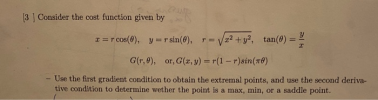 Would like help solving this problem. This can be left in terms of
r and theta or converted to x and y. Using MATLAB (the computer
program) may be helpful.
[3 ] Consider the cost function given by * = r cos(o), y = r sin(e), r = V22 + y2, tan(0) = G(ro), or, G(x, y) =r(1-r)sin(70) - Use the first gradient condition to obtain the extremal points, and use the second deriva- tive condition to determine wether the...
Would like help solving this problem. This can be left in terms of
r and theta or converted to x and y. Using MATLAB (the computer
program) may be helpful.
[3 ] Consider the cost function given by * = r cos(o), y = r sin(e), r = V22 + y2, tan(0) = G(ro), or, G(x, y) =r(1-r)sin(70) - Use the first gradient condition to obtain the extremal points, and use the second deriva- tive condition to determine wether the...
PLEASE WRITE NEATLY. Given the following two utility functions (the superscripts on the utility functions merely...
 PLEASE WRITE NEATLY.
Given the following two utility functions (the superscripts on the utility functions merely denote which utility function we are talking about): U" (x, y)-V x2 + y2 Demonstrate that the MRSxy is the same for the two utility functions U (x)y and
PLEASE WRITE NEATLY.
Given the following two utility functions (the superscripts on the utility functions merely denote which utility function we are talking about): U" (x, y)-V x2 + y2 Demonstrate that the MRSxy is the same for the two utility functions U (x)y and
6. Express solutions of the following in terms of the special functions defined in lectures [do n...
 6. Express solutions of the following in terms of the special functions defined in lectures [do not derive these solutions): (a) (1-x2)y"-2xy' + n (n + 1 )y = 0. conditions g(-1)-(1)", (1)1 -1-x < 1, write down the solution that satisfies the boundary )sine de sin de+n(n+1)7-0,0T, write down the general solution and then the solution and 27-periodic with respect to θ. that is bounded for YAc
6. Express solutions of the following in terms of the special functions...
6. Express solutions of the following in terms of the special functions defined in lectures [do not derive these solutions): (a) (1-x2)y"-2xy' + n (n + 1 )y = 0. conditions g(-1)-(1)", (1)1 -1-x < 1, write down the solution that satisfies the boundary )sine de sin de+n(n+1)7-0,0T, write down the general solution and then the solution and 27-periodic with respect to θ. that is bounded for YAc
6. Express solutions of the following in terms of the special functions...
5 For the functions f(x) = (2,2 – 2x)e- and g(x) = 2.5 – 3.23 +...
 5 For the functions f(x) = (2,2 – 2x)e- and g(x) = 2.5 – 3.23 + 22:2 (1) dentify and classify any stationary points using the second derivative test. (1) Identify and classify any points of inflection using the sign diagram of the second deriva- tive, (i) Determine the intervals where the function is concave up and concave down.
 1. Write f(z) in the form f(x) = u(x, y) +iv(x, y). (a) f(x) = 23+2+1 (b) f(3) = 2,270. Suppose f(z) = x2 - y2 - 2y +i (2x - 2xy), where z = x + iy, and express () in terms of .
 *PLEASE SHOW ALL WORK AND STEP BY STEP SOLUTION*
7.+-/3 points MarsVectorCalc6 2.6.011. For the functions below, what is the direction of fastest increase at (1, 1, 1)? 8 (a) f(x, y 2) -2+ y2 +2 x2 + y2 + z2 (b) f(x, y, z)-2xy + 2yz + 2xz 8 (cx,2x2 + y2+ 2 2 + z2
7.+-/3 points MarsVectorCalc6 2.6.011. For the functions below, what is the direction of fastest increase at (1, 1, 1)? 8 (a) f(x, y...
*PLEASE SHOW ALL WORK AND STEP BY STEP SOLUTION*
7.+-/3 points MarsVectorCalc6 2.6.011. For the functions below, what is the direction of fastest increase at (1, 1, 1)? 8 (a) f(x, y 2) -2+ y2 +2 x2 + y2 + z2 (b) f(x, y, z)-2xy + 2yz + 2xz 8 (cx,2x2 + y2+ 2 2 + z2
7.+-/3 points MarsVectorCalc6 2.6.011. For the functions below, what is the direction of fastest increase at (1, 1, 1)? 8 (a) f(x, y...
 Question 1. Consider these real-valued functions of two variables: T In (x2 + y2) (a) () What is the maximal domain, D, for the functions f and g? Write D in set notation. (ii) What is the range of f and g? Is either function onto? ii) Show that f is not one-to-one. (iv) Find and sketch the level sets of g with heights: z00, 2, 04 (Note: Use set notation, and draw a single contour diagram.) (v) Without finding...
 Hw2 Q1 Show that the function f(z) = z2 + z is analytic. Also find its derivative. (Hint: check CR Equations for Analyticity, and then proceed finding the derivative as shown in video 8 by any of the two rules shown in video 7] Q2 Verify that the following functions are harmonic i. u = x2 - y2 + 2x - y. ii. v=e* cos y. Q3 Verify that the given function is harmonic, and find the harmonic conjugate function...
 (4) Evaluate the line integral F dr where C is the epicycloid with parametrization given by r(t) 5 cos t - gradient of the function f(x, y) = 3 sin(ry) + cos(y2) cos 5t and y(t) = 5 sin t - sin 5t for 0 < t < 2« and F is the (5) EvaluateF dr where F(x, y) with counterclockwise orientation (2y, xy2and C is the ellipse 4r2 9y2 36 _ F dr where F(r, y) = (x2 -...
 Problem 2. Write the Taylor series expansion for the following functions up to quadratic terms a. cos (x) about the point x*-pi/4. b. f(xx) 10x1 20x^x2 +10x3 +x 2x 5 about the point (1,1). Compare the approximate and exact values of the function at the point (1.2, 0.8)
 Would like help solving this problem. This can be left in terms of
r and theta or converted to x and y. Using MATLAB (the computer
program) may be helpful.
[3 ] Consider the cost function given by * = r cos(o), y = r sin(e), r = V22 + y2, tan(0) = G(ro), or, G(x, y) =r(1-r)sin(70) - Use the first gradient condition to obtain the extremal points, and use the second deriva- tive condition to determine wether the...
Would like help solving this problem. This can be left in terms of
r and theta or converted to x and y. Using MATLAB (the computer
program) may be helpful.
[3 ] Consider the cost function given by * = r cos(o), y = r sin(e), r = V22 + y2, tan(0) = G(ro), or, G(x, y) =r(1-r)sin(70) - Use the first gradient condition to obtain the extremal points, and use the second deriva- tive condition to determine wether the...
 PLEASE WRITE NEATLY.
Given the following two utility functions (the superscripts on the utility functions merely denote which utility function we are talking about): U" (x, y)-V x2 + y2 Demonstrate that the MRSxy is the same for the two utility functions U (x)y and
PLEASE WRITE NEATLY.
Given the following two utility functions (the superscripts on the utility functions merely denote which utility function we are talking about): U" (x, y)-V x2 + y2 Demonstrate that the MRSxy is the same for the two utility functions U (x)y and
 6. Express solutions of the following in terms of the special functions defined in lectures [do not derive these solutions): (a) (1-x2)y"-2xy' + n (n + 1 )y = 0. conditions g(-1)-(1)", (1)1 -1-x < 1, write down the solution that satisfies the boundary )sine de sin de+n(n+1)7-0,0T, write down the general solution and then the solution and 27-periodic with respect to θ. that is bounded for YAc
6. Express solutions of the following in terms of the special functions...
6. Express solutions of the following in terms of the special functions defined in lectures [do not derive these solutions): (a) (1-x2)y"-2xy' + n (n + 1 )y = 0. conditions g(-1)-(1)", (1)1 -1-x < 1, write down the solution that satisfies the boundary )sine de sin de+n(n+1)7-0,0T, write down the general solution and then the solution and 27-periodic with respect to θ. that is bounded for YAc
6. Express solutions of the following in terms of the special functions...
 5 For the functions f(x) = (2,2 – 2x)e- and g(x) = 2.5 – 3.23 + 22:2 (1) dentify and classify any stationary points using the second derivative test. (1) Identify and classify any points of inflection using the sign diagram of the second deriva- tive, (i) Determine the intervals where the function is concave up and concave down.
Most questions answered within 3 hours.
-
Where is the error in this code sequence?
String s1 = "Hello";
String s2 = "ello";...
asked 10 months ago -
Financial data for Joel de Paris, Inc., for last year
follow:
Joel de Paris, Inc.
Balance...
asked 10 months ago -
Consider this reaction:
Al2(SO4)3 (aq)+ BaCl3
(aq) Al2Cl6 (aq)- +
3BaSO4(s) . What is the...
asked 10 months ago -
Suppose that Savneet is considering increasing her
recent random sample from 20 car rentals to 40...
asked 10 months ago -
Trucks arrive at an unloading terminal at an average rate of 120
per hour.
Trucks arrive...
asked 10 months ago -
Why are methanol and ethanol completely soluble in water while
octanol is not very little soluble....
asked 10 months ago -
A facilities manager at a university reads in a research report
that the mean amount of...
asked 10 months ago -
When the CuSO4 is rehydrated by adding water to the anhydrous
compound, is this an endothermic...
asked 10 months ago -
A ray of sunlight is passing from diamond into crown glass; the
angle of incidence is...
asked 10 months ago -
A block of mass 0.249 kg is placed on top of a light, vertical
spring of...
asked 10 months ago -
how do the kidneys compensate in the presences of acidosis
a) trigger hyperventilate
b) reserve acid...
asked 10 months ago -
Question 501 pts
The rental rate of capital to the firm increases. Which of the
following...
asked 10 months ago