1. Given the grammar: \(\rightarrow+\langle\) expr \(\rangle\) \(|*
1. Given the grammar:
\(|*
\(\mid(\)
|
\(\langle\mathrm{id}>\rightarrow \mathrm{A}|\mathrm{B}| \mathrm{C}\)
(a) Show the parse tree of expression: \(A+C^{*} B\)
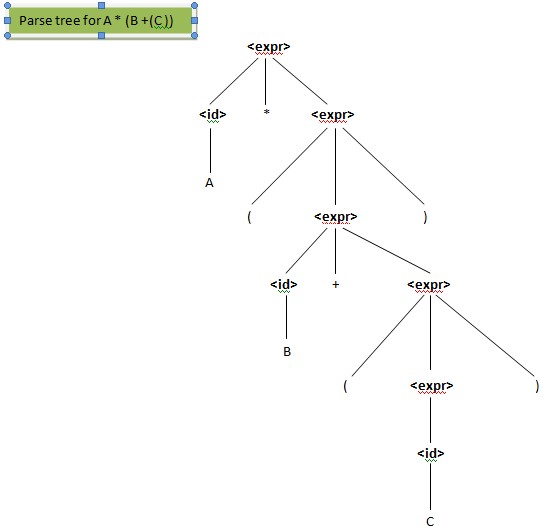
(b) Show the parse tree of expression: \(A^{*}(B+(C))\)
Homework Answers
Derivation for A+C*B :
->
->
-> A + C * B
Derivation for A * (B+(C)) :
->
->
->
->
-> A * (B + (C))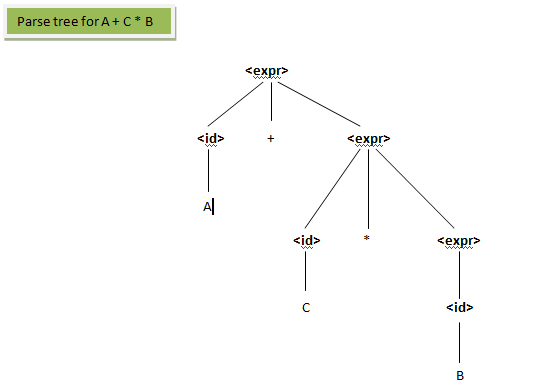
2. Consider the following grammar: <assign> à <id> = <expr>
2. Consider the following grammar: <assign> à <id> = <expr> <id> à A | B | C <expr> à <id> + <expr> | <id> * <expr> | ( <expr> ) | <id> Show a parse tree and leftmost derivation for the following statements: (a) A = ( A + B ) * C (b) A = A * ( B + C ) 3. [10 Points] Show that the following grammar is...
Question 3: Given the following grammar: assign → id := expr expr → expr + term \ term term -term *factor lfactor factor-(expr) id Using the above grammar, show a leftmost derivation (first five step...
 Question 3: Given the following grammar: assign → id := expr expr → expr + term \ term term -term *factor lfactor factor-(expr) id Using the above grammar, show a leftmost derivation (first five steps) for the following assignment statement: A ((A B)+ C) a. [3 marks] b. Using the above grammar, show a rightmost derivation (first five steps) for the following assignment statement: A:-A+B+C)+A [3 marks] Draw the abstract syntax tree for each of the above statements [4 marks]...
The questions in this section are based on the grammar given as the following: prog ->...
The questions in this section are based on the grammar given as the following: prog -> assign | expr assign -> id = expr expr -> expr + term | expr - term | term term -> factor | factor * term factor -> ( expr ) | id | num id -> A | B | C num -> 0 | 1 | 2 | 3 (2a) What is the associativity of the * operator? (5 points) (2b) What...
Using the following grammar: Expr -> Expr + Term I Expr * Term I Term Term->...
Using the following grammar: Expr -> Expr + Term I Expr * Term I Term Term-> 0 I ... I 9 I (Expr) Draw a parse tree for each of the following: (a) 5 + 4 * 3 (b) 5 * 4 + 3 using the following grammar: Expr -> Term+ Expr I Term * Expr I Term Term -> 0 I …. 9 I (Expr) Draw a parse tree for each of the following: (a) 5 + 4 *...
Question Set 2 1. Given the following grammar dactor>-> ( <expr> ) a) What is the...
 Question Set 2 1. Given the following grammar dactor>-> ( <expr> ) a) What is the associativity of each of the operators? What is precedence of the operators? Show a leftmost derivation and parse tree for the following sentence: b) c) A-A(B(C A)) d) Rewrite the BNF grammar above to give precedence over and force to be right associative.
Question Set 2 1. Given the following grammar dactor>-> ( <expr> ) a) What is the...
 Question Set 2 1. Given the following grammar dactor>-> ( <expr> ) a) What is the associativity of each of the operators? What is precedence of the operators? Show a leftmost derivation and parse tree for the following sentence: b) c) A-A(B(C A)) d) Rewrite the BNF grammar above to give precedence over and force to be right associative.
The questions in this section are based on the grammar given as the following: prog ->...
The questions in this section are based on the grammar given as the following: prog -> assign | expr assign -> id = expr expr -> expr + term | expr - term | term term -> factor | factor * term factor -> ( expr ) | id | num id -> A | B | C num -> 0 | 1 | 2 | 3 (2a) What is the associativity of the * operator? (5 points) (2b) What...
Use the grammar given below and show a parse tree and a leftmost derivation for each...
 Use the grammar given below and show a parse tree and a leftmost
derivation for each of
the following statements.
1. A = A * (B + (C * A))
2. B = C * (A * C + B)
3. A = A * (B + (C))
<assign> → <id> <expr> = <expr> → <id> + <expr> kid<expr> <expr>) ids
Use the grammar given below and show a parse tree and a leftmost
derivation for each of
the following statements.
1. A = A * (B + (C * A))
2. B = C * (A * C + B)
3. A = A * (B + (C))
<assign> → <id> <expr> = <expr> → <id> + <expr> kid<expr> <expr>) ids
9. Using the following grammar: Expr -> Term + Expr | Term * Expr | Term...
9. Using the following grammar: Expr -> Term + Expr | Term * Expr | Term Term -> 0| ... | 9 | ( Expr ) draw a parse tree for each of the following (a) 5 + 4 * 3 (b) 5 * 4 + 3
1) Using the grammar in Example 3.2, show a completed parse tree for each of the...
 1) Using the grammar in Example 3.2, show a completed
parse tree for each of the following statements: a) A = A * (B + (C
* A)) b) A = A * (B + (C))
2) Using the original grammar in Example 3.4, show a
completed parse tree for the statement: A = B + C + A
A Grammar for Simple Assignment Statements PLE 3.2 cassign><id> <expr> cidA BIC «ехpг» — sid + <ехpг» id cexpr> ( <expr>)...
1) Using the grammar in Example 3.2, show a completed
parse tree for each of the following statements: a) A = A * (B + (C
* A)) b) A = A * (B + (C))
2) Using the original grammar in Example 3.4, show a
completed parse tree for the statement: A = B + C + A
A Grammar for Simple Assignment Statements PLE 3.2 cassign><id> <expr> cidA BIC «ехpг» — sid + <ехpг» id cexpr> ( <expr>)...
 Question 3: Given the following grammar: assign → id := expr expr → expr + term \ term term -term *factor lfactor factor-(expr) id Using the above grammar, show a leftmost derivation (first five steps) for the following assignment statement: A ((A B)+ C) a. [3 marks] b. Using the above grammar, show a rightmost derivation (first five steps) for the following assignment statement: A:-A+B+C)+A [3 marks] Draw the abstract syntax tree for each of the above statements [4 marks]...
 Question Set 2 1. Given the following grammar dactor>-> ( <expr> ) a) What is the associativity of each of the operators? What is precedence of the operators? Show a leftmost derivation and parse tree for the following sentence: b) c) A-A(B(C A)) d) Rewrite the BNF grammar above to give precedence over and force to be right associative.
 Question Set 2 1. Given the following grammar dactor>-> ( <expr> ) a) What is the associativity of each of the operators? What is precedence of the operators? Show a leftmost derivation and parse tree for the following sentence: b) c) A-A(B(C A)) d) Rewrite the BNF grammar above to give precedence over and force to be right associative.
 Use the grammar given below and show a parse tree and a leftmost
derivation for each of
the following statements.
1. A = A * (B + (C * A))
2. B = C * (A * C + B)
3. A = A * (B + (C))
<assign> → <id> <expr> = <expr> → <id> + <expr> kid<expr> <expr>) ids
Use the grammar given below and show a parse tree and a leftmost
derivation for each of
the following statements.
1. A = A * (B + (C * A))
2. B = C * (A * C + B)
3. A = A * (B + (C))
<assign> → <id> <expr> = <expr> → <id> + <expr> kid<expr> <expr>) ids
 1) Using the grammar in Example 3.2, show a completed
parse tree for each of the following statements: a) A = A * (B + (C
* A)) b) A = A * (B + (C))
2) Using the original grammar in Example 3.4, show a
completed parse tree for the statement: A = B + C + A
A Grammar for Simple Assignment Statements PLE 3.2 cassign><id> <expr> cidA BIC «ехpг» — sid + <ехpг» id cexpr> ( <expr>)...
1) Using the grammar in Example 3.2, show a completed
parse tree for each of the following statements: a) A = A * (B + (C
* A)) b) A = A * (B + (C))
2) Using the original grammar in Example 3.4, show a
completed parse tree for the statement: A = B + C + A
A Grammar for Simple Assignment Statements PLE 3.2 cassign><id> <expr> cidA BIC «ехpг» — sid + <ехpг» id cexpr> ( <expr>)...
Most questions answered within 3 hours.
-
Where is the error in this code sequence?
String s1 = "Hello";
String s2 = "ello";...
asked 10 months ago -
Financial data for Joel de Paris, Inc., for last year
follow:
Joel de Paris, Inc.
Balance...
asked 10 months ago -
Consider this reaction:
Al2(SO4)3 (aq)+ BaCl3
(aq) Al2Cl6 (aq)- +
3BaSO4(s) . What is the...
asked 10 months ago -
Suppose that Savneet is considering increasing her
recent random sample from 20 car rentals to 40...
asked 10 months ago -
Trucks arrive at an unloading terminal at an average rate of 120
per hour.
Trucks arrive...
asked 10 months ago -
Why are methanol and ethanol completely soluble in water while
octanol is not very little soluble....
asked 10 months ago -
A facilities manager at a university reads in a research report
that the mean amount of...
asked 10 months ago -
When the CuSO4 is rehydrated by adding water to the anhydrous
compound, is this an endothermic...
asked 10 months ago -
A ray of sunlight is passing from diamond into crown glass; the
angle of incidence is...
asked 10 months ago -
A block of mass 0.249 kg is placed on top of a light, vertical
spring of...
asked 10 months ago -
how do the kidneys compensate in the presences of acidosis
a) trigger hyperventilate
b) reserve acid...
asked 10 months ago -
Question 501 pts
The rental rate of capital to the firm increases. Which of the
following...
asked 10 months ago