
Homework Answers
Request Answer!
We need at least 10 more requests to produce the answer.
0 / 10 have requested this problem solution
The more requests, the faster the answer.
2 9 11 and b (1 point) Let A -6 The QR factorization of the matrix...
 2 9 11 and b (1 point) Let A -6 The QR factorization of the matrix A is given by: 2 1 6 17 äv2 3 1 1 0 3 2 3 21 V2 3 áva (a) Applying the QR factorization to solving the least squares problem Ax b gives the system: X = 0 2 3 (b) Use backsubstitution to solve the system in part (a) and find the least squares solution. x=
== 2 1 3 (1 point) Let A 1 and b -3 2 6 The QR...
 == 2 1 3 (1 point) Let A 1 and b -3 2 6 The QR factorization of the matrix A is given by: 1 2 = ſ v2 ŠV2 0 V2 3 2 3 (a) Applying the QR factorization to solving the least squares problem Ax b gives the system: 3 wls, wie X = (b) Use backsubstitution to system in part (a) and find the least squares solution. =
Section 5.6 QR Factorization: Problem 6 Previous Problem Problem List Next Problem 2 9 (1 point)...
 Section 5.6 QR Factorization: Problem 6 Previous Problem Problem List Next Problem 2 9 (1 point) Let A = 1 1 and b = 6 The QR factorization of the matrix A is given by: 2 6 1 3 1 1 -ŠV2 V2 *V2 ܝܙܚܐܝ 0 (a) Applying the QR factorization to solving the least squares problem Ax = b gives the system: 3 X= 0 3 (b) Use backsubstitution to solve the system in part (a) and find the...
T67 [21] (1 point) Let A = 1 1 and b = [21] -6 .The QR...
 T67 [21] (1 point) Let A = 1 1 and b = [21] -6 .The QR factorization of the matrix A is given by: 1-3] [21] [ 11 = [2 1 112] 2 -V2 ماده و V2 (a) Applying the QR factorization to solving the least squares problem Ax = b gives the system: (b) Use backsubstitution to solve the system in part (a) and find the least squares solution. 5/3 -3
Let A1 1 and b = {12, 6, 18)T (a) Use the Gram-Schmidt process to find...
 Let A1 1 and b = {12, 6, 18)T (a) Use the Gram-Schmidt process to find an orthonormal basis for the column basis for the column space of A; (b) Factor A into a product QR, where Q has an orthonormal set of column vectors and R is upper triangular; (c) Solve the least squares problem Ax = b. Use the results from problem! (c) to find the least square solution of Ax = b
7. Consider the following matrix (a) Find the QR decomposition of A using the Gram Schmidt process. (b) Use the QR deco...
 7. Consider the following matrix (a) Find the QR decomposition of A using the Gram Schmidt process. (b) Use the QR decomposition from (a) to find the least-squares solution to Ax = b where -3
7. Consider the following matrix (a) Find the QR decomposition of A using the Gram Schmidt process. (b) Use the QR decomposition from (a) to find the least-squares solution to Ax = b where -3
7. Consider the following matrix (a) Find the QR decomposition of A using the Gram Schmidt process. (b) Use the QR decomposition from (a) to find the least-squares solution to Ax = b where -3
linear algebra question 0. Given 1 3-5 1 1 -2 1-3 1 and b If the Gram-Schmidt process is applied to determine an orthonormal basis for R(A), and a QR factoriza- tion of A then, after the first two or...
 linear algebra question
0. Given 1 3-5 1 1 -2 1-3 1 and b If the Gram-Schmidt process is applied to determine an orthonormal basis for R(A), and a QR factoriza- tion of A then, after the first two orthonormal vectors qi and q are computed, we have 2 -2 2 2 2 2 2 (a) Finish the process. Determine q3 and fill in the third columns of Q and R (b) Use the QR factorization to find the least...
linear algebra question
0. Given 1 3-5 1 1 -2 1-3 1 and b If the Gram-Schmidt process is applied to determine an orthonormal basis for R(A), and a QR factoriza- tion of A then, after the first two orthonormal vectors qi and q are computed, we have 2 -2 2 2 2 2 2 (a) Finish the process. Determine q3 and fill in the third columns of Q and R (b) Use the QR factorization to find the least...
Exercise 18 Compute the Gram-Schmidt QR factorization of the matrix A 1 1 = 0 1...
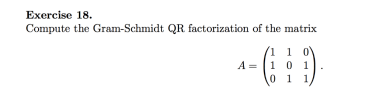 Exercise 18 Compute the Gram-Schmidt QR factorization of the matrix A 1 1 = 0 1 1
ce of least squates solutions. Problem III.3 (5 points), Consider matrix B (as in the right)....
 ce of least squates solutions. Problem III.3 (5 points), Consider matrix B (as in the right). Find the QR factorization of B. That is, find a matrix Q whose columns are orthonormal and an upper triangular square mnatrix R with positive diagonal entries such that B QR. -2 1 24-1 B 3= 243 -2 1 Hìnt. Apply the Gram-Schmidt process. Keep track of the relevant linear combinationas
(4.2) Let 4 7 A= 4 7 -2 1 (a) Find the QR decomposition of A....
 (4.2) Let 4 7 A= 4 7 -2 1 (a) Find the QR decomposition of A. It has to be of the form A QR where Q is a 3 x 3 orthogonal matrix, and R is 3 x 2 upper-triangular. (b) Use part (a) to find the least squares solution to the -6 Ax -4 -2
 2 9 11 and b (1 point) Let A -6 The QR factorization of the matrix A is given by: 2 1 6 17 äv2 3 1 1 0 3 2 3 21 V2 3 áva (a) Applying the QR factorization to solving the least squares problem Ax b gives the system: X = 0 2 3 (b) Use backsubstitution to solve the system in part (a) and find the least squares solution. x=
 == 2 1 3 (1 point) Let A 1 and b -3 2 6 The QR factorization of the matrix A is given by: 1 2 = ſ v2 ŠV2 0 V2 3 2 3 (a) Applying the QR factorization to solving the least squares problem Ax b gives the system: 3 wls, wie X = (b) Use backsubstitution to system in part (a) and find the least squares solution. =
 Section 5.6 QR Factorization: Problem 6 Previous Problem Problem List Next Problem 2 9 (1 point) Let A = 1 1 and b = 6 The QR factorization of the matrix A is given by: 2 6 1 3 1 1 -ŠV2 V2 *V2 ܝܙܚܐܝ 0 (a) Applying the QR factorization to solving the least squares problem Ax = b gives the system: 3 X= 0 3 (b) Use backsubstitution to solve the system in part (a) and find the...
 T67 [21] (1 point) Let A = 1 1 and b = [21] -6 .The QR factorization of the matrix A is given by: 1-3] [21] [ 11 = [2 1 112] 2 -V2 ماده و V2 (a) Applying the QR factorization to solving the least squares problem Ax = b gives the system: (b) Use backsubstitution to solve the system in part (a) and find the least squares solution. 5/3 -3
 Let A1 1 and b = {12, 6, 18)T (a) Use the Gram-Schmidt process to find an orthonormal basis for the column basis for the column space of A; (b) Factor A into a product QR, where Q has an orthonormal set of column vectors and R is upper triangular; (c) Solve the least squares problem Ax = b. Use the results from problem! (c) to find the least square solution of Ax = b
 7. Consider the following matrix (a) Find the QR decomposition of A using the Gram Schmidt process. (b) Use the QR decomposition from (a) to find the least-squares solution to Ax = b where -3
7. Consider the following matrix (a) Find the QR decomposition of A using the Gram Schmidt process. (b) Use the QR decomposition from (a) to find the least-squares solution to Ax = b where -3
7. Consider the following matrix (a) Find the QR decomposition of A using the Gram Schmidt process. (b) Use the QR decomposition from (a) to find the least-squares solution to Ax = b where -3
 linear algebra question
0. Given 1 3-5 1 1 -2 1-3 1 and b If the Gram-Schmidt process is applied to determine an orthonormal basis for R(A), and a QR factoriza- tion of A then, after the first two orthonormal vectors qi and q are computed, we have 2 -2 2 2 2 2 2 (a) Finish the process. Determine q3 and fill in the third columns of Q and R (b) Use the QR factorization to find the least...
linear algebra question
0. Given 1 3-5 1 1 -2 1-3 1 and b If the Gram-Schmidt process is applied to determine an orthonormal basis for R(A), and a QR factoriza- tion of A then, after the first two orthonormal vectors qi and q are computed, we have 2 -2 2 2 2 2 2 (a) Finish the process. Determine q3 and fill in the third columns of Q and R (b) Use the QR factorization to find the least...
 Exercise 18 Compute the Gram-Schmidt QR factorization of the matrix A 1 1 = 0 1 1
 ce of least squates solutions. Problem III.3 (5 points), Consider matrix B (as in the right). Find the QR factorization of B. That is, find a matrix Q whose columns are orthonormal and an upper triangular square mnatrix R with positive diagonal entries such that B QR. -2 1 24-1 B 3= 243 -2 1 Hìnt. Apply the Gram-Schmidt process. Keep track of the relevant linear combinationas
 (4.2) Let 4 7 A= 4 7 -2 1 (a) Find the QR decomposition of A. It has to be of the form A QR where Q is a 3 x 3 orthogonal matrix, and R is 3 x 2 upper-triangular. (b) Use part (a) to find the least squares solution to the -6 Ax -4 -2
Most questions answered within 3 hours.
-
Where is the error in this code sequence?
String s1 = "Hello";
String s2 = "ello";...
asked 10 months ago -
Financial data for Joel de Paris, Inc., for last year
follow:
Joel de Paris, Inc.
Balance...
asked 10 months ago -
Consider this reaction:
Al2(SO4)3 (aq)+ BaCl3
(aq) Al2Cl6 (aq)- +
3BaSO4(s) . What is the...
asked 10 months ago -
Suppose that Savneet is considering increasing her
recent random sample from 20 car rentals to 40...
asked 10 months ago -
Trucks arrive at an unloading terminal at an average rate of 120
per hour.
Trucks arrive...
asked 10 months ago -
Why are methanol and ethanol completely soluble in water while
octanol is not very little soluble....
asked 10 months ago -
A facilities manager at a university reads in a research report
that the mean amount of...
asked 10 months ago -
When the CuSO4 is rehydrated by adding water to the anhydrous
compound, is this an endothermic...
asked 10 months ago -
A ray of sunlight is passing from diamond into crown glass; the
angle of incidence is...
asked 10 months ago -
A block of mass 0.249 kg is placed on top of a light, vertical
spring of...
asked 10 months ago -
how do the kidneys compensate in the presences of acidosis
a) trigger hyperventilate
b) reserve acid...
asked 10 months ago -
Question 501 pts
The rental rate of capital to the firm increases. Which of the
following...
asked 10 months ago