You left the hose on! Water is coming out of the hose at a volume flow...
You left the hose on! Water is coming out of the hose at a volume flow rate of f. (The SI units of f are m3/s, if that helps).
You measure the radius of the hose to be r.
1. Determine the speed vhose that water is coming out of the hose.
Homework Answers
Request Answer!
We need at least 10 more requests to produce the answer.
0 / 10 have requested this problem solution
The more requests, the faster the answer.
Add Answer to:
You left the hose on! Water is coming out of the hose at a
volume flow...
The water is leaving the nozzle of a hose with a volume flow rate of 0.65...
 The water is leaving the nozzle of a hose with a volume flow rate of 0.65 m3/s. Assume there are no leaks and the nozzle has a circular opening with diameter of 6.0 mm. 1) How fast is the water leaving the nozzle of a hose? (Express your answer to two significant figures.) m Submit You currently have 0 submissions for this question. Only 10 submission are allowed. You can make 10 more submissions for this question.
You have a hose with a radius of 0.05 m. Calculate the volume flow rate of...
 You have a hose with a radius of 0.05 m. Calculate the volume flow rate of the fluid moving at a velocity of 3.00 m/s. A. 0.942 m/s B. 0.00750 m3/s OC. 0.471 m3/s OD.0.0236 m3/s
A garden hose has a radius of 1 cm. Water flows out of the hose at...
A garden hose has a radius of 1 cm. Water flows out of the hose at a velocity of 2.4 m/s. A child is playing with the hose, and covers half of the opening with his thumb. What is the velocity of the water coming out of the hose now? Use units of m/s and round to one decimal place.
A garden hose with a diameter of 2.3 cm is used to fill a bucket, which...
 A garden hose with a diameter of 2.3 cm is used to fill a bucket, which has a volume of 0.11 cubic meters. It takes 1.8 minutes to fill. An adjustable nozzle is attached to the hose to decrease the diameter of the opening, which increases the speed of the water. The hose is held level to the ground at a height of 1.0 meters, and the diameter of the nozzle is decreased until a flower bed 2.6 meters away...
Find the velocity of the water coming out of a hose with a radius of 5...
Find the velocity of the water coming out of a hose with a radius of 5 cm if it is used to fill a 200 cm^3 bucket in 40 s
The water coming from a fire hose produces a tremendous amount of force. If not careful,...
The water coming from a fire hose produces a tremendous amount of force. If not careful, a firefighter may not be able to hold the fire hose and hurt himself or somebody. Consider a fire hose having an inner diameter of 75 mm. Water is coming out with a speed of 17.0 m/s and at a rate of 1500 kg/min . How much force does it take to hold the fire hose in place?
Suppose that you are filling an aquarium with a hose of radius 2 cm. You measure the volume flow rate and find that it is 5 L per minute. If all other factors remain constant, what would the flow rate...
Suppose that you are filling an aquarium with a hose of radius 2 cm. You measure the volume flow rate and find that it is 5 L per minute. If all other factors remain constant, what would the flow rate be if you switched to a hose with a radius of 5 cm? Show the steps taken to find your answer.
33. Water is sprayed out of a water hose. The radius of the hose is 1.0...
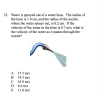 33. Water is sprayed out of a water hose. The radius of the hose is 1.0 cm, and the radius of the nozzle, where the water sprays out, is 0.2 cm. If the velocity of the water in the hose is 0.7 m/s, what is the velocity of the water as it passes through the nozzle? A B C D E 17.5 m/s 14.3 m/s 16.0 m/s 9.4 m/s 11.0 m/s
The question concerns water flowing in or from a hose. The cross section of the hose...
The question concerns water flowing in or from a hose. The cross section of the hose is circular. The circumference of a circle is 2πR and the area of a circle is πR2, where R is the radius of the circle. 1 milliliter = 1 cm3. If the inner diameter of the hose is 1.2 cm, but you partially cover the opening of the hose leaving an open area of 0.3 cm<sup>2 </sup>at the end of the hose. The water...
The questions concern water flowing in or from a hose. The cross section of the hose...
The questions concern water flowing in or from a hose. The cross section of the hose is circular. The circumference of a circle is 2πR and the area of a circle is πR2, where R is the radius of the circle. 1 milliliter = 1 cm3. A. If the inner diameter of the hose is 1.13 cm, and the water flows in the hose with a speed of 0.89 m/s, what is the volumetric current Q of the water flowing...
 The water is leaving the nozzle of a hose with a volume flow rate of 0.65 m3/s. Assume there are no leaks and the nozzle has a circular opening with diameter of 6.0 mm. 1) How fast is the water leaving the nozzle of a hose? (Express your answer to two significant figures.) m Submit You currently have 0 submissions for this question. Only 10 submission are allowed. You can make 10 more submissions for this question.
 You have a hose with a radius of 0.05 m. Calculate the volume flow rate of the fluid moving at a velocity of 3.00 m/s. A. 0.942 m/s B. 0.00750 m3/s OC. 0.471 m3/s OD.0.0236 m3/s
 A garden hose with a diameter of 2.3 cm is used to fill a bucket, which has a volume of 0.11 cubic meters. It takes 1.8 minutes to fill. An adjustable nozzle is attached to the hose to decrease the diameter of the opening, which increases the speed of the water. The hose is held level to the ground at a height of 1.0 meters, and the diameter of the nozzle is decreased until a flower bed 2.6 meters away...
 33. Water is sprayed out of a water hose. The radius of the hose is 1.0 cm, and the radius of the nozzle, where the water sprays out, is 0.2 cm. If the velocity of the water in the hose is 0.7 m/s, what is the velocity of the water as it passes through the nozzle? A B C D E 17.5 m/s 14.3 m/s 16.0 m/s 9.4 m/s 11.0 m/s
Most questions answered within 3 hours.
-
Where is the error in this code sequence?
String s1 = "Hello";
String s2 = "ello";...
asked 11 months ago -
Financial data for Joel de Paris, Inc., for last year
follow:
Joel de Paris, Inc.
Balance...
asked 11 months ago -
Consider this reaction:
Al2(SO4)3 (aq)+ BaCl3
(aq) Al2Cl6 (aq)- +
3BaSO4(s) . What is the...
asked 11 months ago -
Suppose that Savneet is considering increasing her
recent random sample from 20 car rentals to 40...
asked 11 months ago -
Trucks arrive at an unloading terminal at an average rate of 120
per hour.
Trucks arrive...
asked 11 months ago -
Why are methanol and ethanol completely soluble in water while
octanol is not very little soluble....
asked 11 months ago -
A facilities manager at a university reads in a research report
that the mean amount of...
asked 11 months ago -
When the CuSO4 is rehydrated by adding water to the anhydrous
compound, is this an endothermic...
asked 11 months ago -
A ray of sunlight is passing from diamond into crown glass; the
angle of incidence is...
asked 11 months ago -
A block of mass 0.249 kg is placed on top of a light, vertical
spring of...
asked 11 months ago -
how do the kidneys compensate in the presences of acidosis
a) trigger hyperventilate
b) reserve acid...
asked 11 months ago -
Question 501 pts
The rental rate of capital to the firm increases. Which of the
following...
asked 11 months ago