participates in regional economic integration. The firm needs to understand what is nappening in that trade Dioc and the erect It WIII have on the firm's strategy and operations.
The creation of a single market through regional economic integration offers significant opportunities because markets that were formerly protected from foreign competition are increasingly open. Opportunities arise from the inherently lower costs of doing business in a single market. Even after the removal of barriers to trade and investment, differences in culture and competitive practices often limit the ability of companies to centralize production. A major threat to businesses is that with lowered trade barriers, the business environment can become even more competitive. Firms can also be shut out of markets if they do not have a local presence.
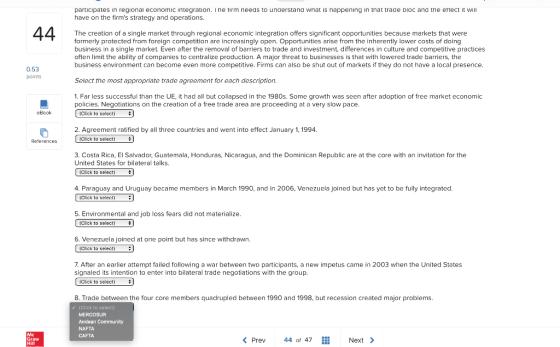
Select the most appropriate trade agreement for each description.
1. Far less successful than the UE, it had all but collapsed in the 1980s. Some growth was seen after adoption of free market economic policies. Negotiations on the creation of a free trade area are proceeding at a very slow pace. (Click to select) ) eBook
2. Agreement ratified by all three countries and went into effect January 1, 1994. Click to select) ) References
3. Costa Rica, El Salvador, Guatemala, Honduras, Nicaragua, and the Dominican Republic are at the core with an invitation for the United States for bilateral talks. Click to select) )
4. Paraguay and Uruguay became members in March 1990, and in 2006, Venezuela joined but has yet to be fully integrated. Click to select) )
5. Environmental and job loss fears did not materialize. (Click to select) =)
6. Venezuela joined at one point but has since withdrawn. Click to select)
7. After an earlier attempt failed following a war between two participants, a new impetus came in 2003 when the United States signaled its intention to enter into bilateral trade negotiations with the group. Click to select) )
8. Trade between the four core members quadrupled between 1990 and 1998, but recession created major problems.
Homework Answers
Ans 1: Andean Community
Explanation: The Andean community is free trades are created to establish a customs union comprising of the South American countries. It includes Bolivia, Ecuador, Columbia, Chile and Peru. It was formed in 1969 by the Cartagena Agreement. Venezuela joined in 1973 but withdrew in 2006. Chile withdrew in 1977. Peru decided to suspend its membership in 1992 but resumed it in 1997.
Ans 2: NAFTA
Explanation: The North American free-trade agreement signed by Canada, Mexico and the United States. It created three-country trade bloc in North America. The agreement came into force on January 1, 1984 superseding all other agreements. From 1993 to 2004, the NAFTA’s partners grew by 250 percent. Today Canada and Mexico are the number one and two partners of the USA.
Ans 3: CAFTA
Explanation: Central American free trade agreement signed in 2004 continued to eliminate most tariffs, customs duties and trade barriers between the countries of Costa Rica, the Dominican Republic, El Salvador, Guatemala, Honduras, Nicaragua, and the united states. It was the first free trade agreement between the USA and developing countries.
Ans 4: Mercosur
Explanation: Mercosur is an economic and political bloc comprising Argentina, Brazil, Paraguay, Uruguay, and Venezuela. It was created with the intention to improve trade relations. It realized some initial success when trade increased by 10 fold within the group in the 1990s. Mercosur has failed to match the expectations of integrating the bloc. It is primarily because of dictatorships and military rule in Argentina and Brazil. Mercosur’s one-year suspension of Paraguay in 2012 and indefinite suspension of Venezuela in 2016 revealed fractures in the group.
Add Answer to:
participates in regional economic integration. The firm needs to understand what is nappening in that trade...
Regional economic integration is an agreement among countries in a geographic area to reduce tariff and...
 Regional economic integration is an agreement among countries in a geographic area to reduce tariff and nontariff barriers to the lice flow of goods, services, and factors of production between each other There are costs and benefits associated with regional economic integration. According to economists, the amount of benefits versus COSIS can be measured by whether the integration leads to trade creation versus trade diversion .Row over each product listed and after reviewing the related hint, click and drop them under...
The European Union stands alone in terms of boldness and potential implications
 Roll-over the items on the left and determine which
describes the regional agreement and the appropriate members, then
drag the item to the correct location.Regional Economic Integration The European Union stands alone in terms of boldness and potential implications, but regional economic integration is on the rise in the Americas. NAFTA is significant but several other trade blocs are in the offing, and these have practical and managerial implications for any firm doing business in the Western Hemisphere. When a business is...
Roll-over the items on the left and determine which
describes the regional agreement and the appropriate members, then
drag the item to the correct location.Regional Economic Integration The European Union stands alone in terms of boldness and potential implications, but regional economic integration is on the rise in the Americas. NAFTA is significant but several other trade blocs are in the offing, and these have practical and managerial implications for any firm doing business in the Western Hemisphere. When a business is...
19 and 24 please 19. Two main threats to regional economic integration are A. the within-group...
 19 and 24 please
19. Two main threats to regional economic integration are A. the within-group business environment will become more competitive; firms outside the trading bloc are effectively locked-out of the single market. B. the costs of doing business outweigh benefits; concerns over sabotage exist. C. the growth of mergers within the single market; concerns over national sovereignty D. MNEs are exerting huge power, concerns over the Euro currency 20. The least integrated or shallowest form of economic integration...
19 and 24 please
19. Two main threats to regional economic integration are A. the within-group business environment will become more competitive; firms outside the trading bloc are effectively locked-out of the single market. B. the costs of doing business outweigh benefits; concerns over sabotage exist. C. the growth of mergers within the single market; concerns over national sovereignty D. MNEs are exerting huge power, concerns over the Euro currency 20. The least integrated or shallowest form of economic integration...
Just solve question number 19 & 25 please 19. Two main threats to regional economic integration...
 Just solve question number 19 & 25 please
19. Two main threats to regional economic integration are A. the within-group business environment will become more competitive; firms outside the trading bloc are effectively locked-out of the single market. B. the costs of doing business outweigh benefits; concerns over sabotage exist. C. the growth of mergers within the single market; concerns over national sovereignty D. MNEs are exerting huge power, concerns over the Euro currency 20. The least integrated or shallowest...
Just solve question number 19 & 25 please
19. Two main threats to regional economic integration are A. the within-group business environment will become more competitive; firms outside the trading bloc are effectively locked-out of the single market. B. the costs of doing business outweigh benefits; concerns over sabotage exist. C. the growth of mergers within the single market; concerns over national sovereignty D. MNEs are exerting huge power, concerns over the Euro currency 20. The least integrated or shallowest...
Chapter overview 1. Reasons for international trade Resources reasons Economic reasons Other reasons 2. Difference between...
Chapter overview 1. Reasons for international trade Resources reasons Economic reasons Other reasons 2. Difference between international trade and domestic trade More complex context More difficult and risky Higher management skills required 3. Basic concept s relating to international trade Visible trade & invisible trade Favorable trade & unfavorable trade General trade system & special trade system Volume of international trade & quantum of international trade Commodity composition of international trade Geographical composition of international trade Degree / ratio of...
CASE DISCUSSION QUESTIONS: 1. What are the costs and benefits of FDI inflows for a host...
CASE DISCUSSION QUESTIONS: 1. What are the costs and benefits of FDI inflows for a host country such as Brazil and Mexico? 2. If you were an executive working for an emerging automaker from China or India, assuming your firm only has the ability to enter one Latin American country for the time being, which country would you recommend: Brazil or Mexico? 3. The automobile industry in both Brazil and Mexico is thriving. If you were a government official from...
Which two phrases represent the views of globalization? Choose two answers. A pendulum that swings from...
Which two phrases represent the views of globalization? Choose two answers. A pendulum that swings from one extreme to another A competition among key financial centers and markets A continuing force sweeping through the world An unplanned result of corporate responses to a variety of opportunities A trading of goods and services between the most and least regulated countries What are two trade barriers? Choose two answers. Nontariffs Foreign languages The ocean Tariffs Shipping What is the effect of tariff...
CEMEX a. Did CEMEX use a multidomestic strategy? Justify your answer. b. Did CEMEX use a...
CEMEX a. Did CEMEX use a multidomestic strategy? Justify your answer. b. Did CEMEX use a global strategy? Justify your answer. c. Did CEMEX use a transnational strategy? Justify your answer. On June 7, 2007 Mexico-based CEMEX won a majority stake in Australia’s Rinker Group. The $15.3 billion takeover, which came on top of the major acquisition in 2005 of the RMC Corporation – then the world’s largest ready-mix concrete company and the single largest purchaser of cement – made...
Read the Article posted below, then answer the following questions: Mergers & acquisitions are a major...
 Read the Article posted below, then answer the following
questions:
Mergers & acquisitions are a major form of
corporate diversification strategy, identify and discuss the top
three reasons why most (50-60%) of acquisitions fail to create
shareholder value.
What are the five major components of “CEMEX
Way” and why has this approach been so successful in
post-acquisition integration?
In your opinion, what can other companies learn from
the “CEMEX Way” as a benchmark for acquisition
management?
Article:
CEMEX: Globalization "The...
Read the Article posted below, then answer the following
questions:
Mergers & acquisitions are a major form of
corporate diversification strategy, identify and discuss the top
three reasons why most (50-60%) of acquisitions fail to create
shareholder value.
What are the five major components of “CEMEX
Way” and why has this approach been so successful in
post-acquisition integration?
In your opinion, what can other companies learn from
the “CEMEX Way” as a benchmark for acquisition
management?
Article:
CEMEX: Globalization "The...
Carlsberg in Emerging Markets A breeze of optimism blew through the office of Carlsberg A/S’s CEO,...
Carlsberg in Emerging Markets A breeze of optimism blew through the office of Carlsberg A/S’s CEO, Jørgen Buhl Rasmussen. After finally gaining 100 percent control over the giant Russian brewery Baltic Beverages Holding (BBH), and with the investments in Western China beginning to bear fruit, the newly appointed CEO was confident that the Danish brewing company’s intensified focus on emerging markets would pay off. The company was counting on tapping the massive potential in emerging markets in order to achieve...
 Regional economic integration is an agreement among countries in a geographic area to reduce tariff and nontariff barriers to the lice flow of goods, services, and factors of production between each other There are costs and benefits associated with regional economic integration. According to economists, the amount of benefits versus COSIS can be measured by whether the integration leads to trade creation versus trade diversion .Row over each product listed and after reviewing the related hint, click and drop them under...
 Roll-over the items on the left and determine which
describes the regional agreement and the appropriate members, then
drag the item to the correct location.Regional Economic Integration The European Union stands alone in terms of boldness and potential implications, but regional economic integration is on the rise in the Americas. NAFTA is significant but several other trade blocs are in the offing, and these have practical and managerial implications for any firm doing business in the Western Hemisphere. When a business is...
Roll-over the items on the left and determine which
describes the regional agreement and the appropriate members, then
drag the item to the correct location.Regional Economic Integration The European Union stands alone in terms of boldness and potential implications, but regional economic integration is on the rise in the Americas. NAFTA is significant but several other trade blocs are in the offing, and these have practical and managerial implications for any firm doing business in the Western Hemisphere. When a business is...
 19 and 24 please
19. Two main threats to regional economic integration are A. the within-group business environment will become more competitive; firms outside the trading bloc are effectively locked-out of the single market. B. the costs of doing business outweigh benefits; concerns over sabotage exist. C. the growth of mergers within the single market; concerns over national sovereignty D. MNEs are exerting huge power, concerns over the Euro currency 20. The least integrated or shallowest form of economic integration...
19 and 24 please
19. Two main threats to regional economic integration are A. the within-group business environment will become more competitive; firms outside the trading bloc are effectively locked-out of the single market. B. the costs of doing business outweigh benefits; concerns over sabotage exist. C. the growth of mergers within the single market; concerns over national sovereignty D. MNEs are exerting huge power, concerns over the Euro currency 20. The least integrated or shallowest form of economic integration...
 Just solve question number 19 & 25 please
19. Two main threats to regional economic integration are A. the within-group business environment will become more competitive; firms outside the trading bloc are effectively locked-out of the single market. B. the costs of doing business outweigh benefits; concerns over sabotage exist. C. the growth of mergers within the single market; concerns over national sovereignty D. MNEs are exerting huge power, concerns over the Euro currency 20. The least integrated or shallowest...
Just solve question number 19 & 25 please
19. Two main threats to regional economic integration are A. the within-group business environment will become more competitive; firms outside the trading bloc are effectively locked-out of the single market. B. the costs of doing business outweigh benefits; concerns over sabotage exist. C. the growth of mergers within the single market; concerns over national sovereignty D. MNEs are exerting huge power, concerns over the Euro currency 20. The least integrated or shallowest...
 Read the Article posted below, then answer the following
questions:
Mergers & acquisitions are a major form of
corporate diversification strategy, identify and discuss the top
three reasons why most (50-60%) of acquisitions fail to create
shareholder value.
What are the five major components of “CEMEX
Way” and why has this approach been so successful in
post-acquisition integration?
In your opinion, what can other companies learn from
the “CEMEX Way” as a benchmark for acquisition
management?
Article:
CEMEX: Globalization "The...
Read the Article posted below, then answer the following
questions:
Mergers & acquisitions are a major form of
corporate diversification strategy, identify and discuss the top
three reasons why most (50-60%) of acquisitions fail to create
shareholder value.
What are the five major components of “CEMEX
Way” and why has this approach been so successful in
post-acquisition integration?
In your opinion, what can other companies learn from
the “CEMEX Way” as a benchmark for acquisition
management?
Article:
CEMEX: Globalization "The...
Most questions answered within 3 hours.
-
Where is the error in this code sequence?
String s1 = "Hello";
String s2 = "ello";...
asked 10 months ago -
Financial data for Joel de Paris, Inc., for last year
follow:
Joel de Paris, Inc.
Balance...
asked 10 months ago -
Consider this reaction:
Al2(SO4)3 (aq)+ BaCl3
(aq) Al2Cl6 (aq)- +
3BaSO4(s) . What is the...
asked 10 months ago -
Suppose that Savneet is considering increasing her
recent random sample from 20 car rentals to 40...
asked 10 months ago -
Trucks arrive at an unloading terminal at an average rate of 120
per hour.
Trucks arrive...
asked 10 months ago -
Why are methanol and ethanol completely soluble in water while
octanol is not very little soluble....
asked 10 months ago -
A facilities manager at a university reads in a research report
that the mean amount of...
asked 10 months ago -
When the CuSO4 is rehydrated by adding water to the anhydrous
compound, is this an endothermic...
asked 10 months ago -
A ray of sunlight is passing from diamond into crown glass; the
angle of incidence is...
asked 10 months ago -
A block of mass 0.249 kg is placed on top of a light, vertical
spring of...
asked 10 months ago -
how do the kidneys compensate in the presences of acidosis
a) trigger hyperventilate
b) reserve acid...
asked 10 months ago -
Question 501 pts
The rental rate of capital to the firm increases. Which of the
following...
asked 10 months ago