
Homework Answers
Add Answer to:
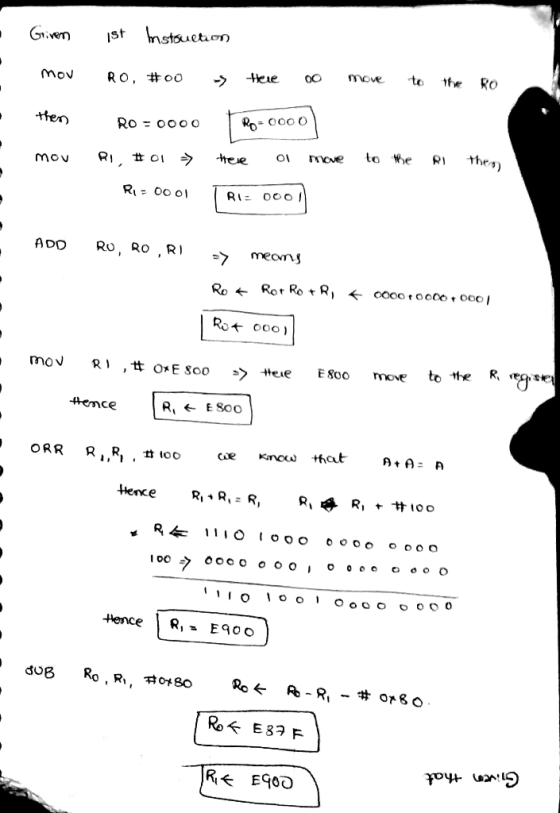
show, the values of RO and R1 (4 bytes, in hexadecimal), after each of the instructions...
4. What will r0 and r1 contain after each of the following instructions? Consider the instructions...
4. What will r0 and r1 contain after each of the following instructions? Consider the instructions in sequence. Give your answers in decimal format. mov r0,#1 @ r0 =_____________ mov r1,#0x30 @ r0= _____________ r1= _____________ orr r1,r1,r0 @ r0= _____________ r1= _____________ lsl r1,#0x2 @ r0= _____________ r1= _____________ orr r1,r1,r0 @ r0= _____________ r1= _____________ eor r0,r0,r1 @ r0= _____________ r1= _____________ lsr r1,r0,#3 @ r0= _____________ r1= ______________
Assignment 4: Answer the following questions with reference to the assembly program below. Before the code...
 Assignment 4: Answer the following questions with reference to the assembly program below. Before the code is executed, the initial content of memory and registers is shown in the figure below memory 0x01 0x02 0x03 0x04 0x05 0x06 0x07 0x08 address Use BIG ENDIAN, and 0x2000.0000 0x2000.0001 0x2000.0002 show all steps register 0x2000.0000RO Ox2000.0003 0x2000.0004 0x2000.0005 0xFFFF.FFFF R2 ox2000.0006 0x1234.5678 R3 0x2000.0007 Ox0000.0000 R1 LDRH R1, [R0 , #2]! LDRH R2 , [R0 , #2)! ADD R3, R1, R2 STR...
8. (8 pt) After executing each group of instructions, write down if the branch is taken...
 8. (8 pt) After executing each group of instructions, write down if the branch is taken or not-taken (i.e., write down if the branch condition is true (taken branch) or false (not-taken branch). Each group of instructions is independent of each other and each group uses the register values given below. Show your work. R1 = FFFF FFFF16 R2 = 0000 0000116 slt R3, R1, R2 beq R3, RO, target Branch outcome = sltu R3, R1, R2 beq R3, RO,...
Write a C program which will display the contents of a file in base-16 (hexadecimal) and...
Write a C program which will display the contents of a file in base-16 (hexadecimal) and in ASCII. Complete the following tasks: Obtain the name of the input file from the command line. If the command-line is “./hexdump xxx.bin” then argv[1] will contain “xxx.bin”. Open the file for binary input Print the entire file, 16-bytes per line. Each line should begin with an 8-digit hexadecimal offset into the file. This is the count of the bytes that you have already...
Implement the following statements using MS430 assembly instructions. You may use more than one, ...
 Implement the following statements using MS430 assembly instructions. You may use more than one, but you should minimize the number of instructions required. You can use both native and emulated instructions. Use hex notation for all numbers 1. (a) Move the word located in register R14 to R15 (b) Increment the word in R6 by 2. (c) Perform a bitwise ANDing of the word located at address 0x0240 with the datum in R15, placing the results in R15. (d) Rotate...
1. Assume that you are given values in eax, ebx, ecx. Write an assembly code that...
1. Assume that you are given values in eax, ebx, ecx. Write an assembly code that does the following: eax = (ecx + edx ) - (eax + ebx) 2. Write a piece of code that copies the number inside al to ch. Example: Assume that Initially eax = 0x15DBCB19. At the end of your code ecx = 0x00001900. Your code must be as efficient as possible. 3. You are given eax = 0x5. Write one line of code in...
4. (3 pts. each) Write the hexadecimal representation of each MIPS assembly instruction: (4.1) sub $s3,...
 4. (3 pts. each) Write the hexadecimal representation of each MIPS assembly instruction: (4.1) sub $s3, $t1, $s2 (4.2) bne $t3, $t4, 18 (4.3) sll $s0, $t5, 2 5. (20 pts.) Consider the following C (or java) code: else f=f+2; By storing the value of j in Ss0, write a sequence of MIPS assembly instructions that will execute these lines of code for the following two cases: (5.1) assuming that the values of f, g and h are stored in...
Problem 5 (15pts): Describe what the following program is doing (Do not need to explain each line of instruction....
 Problem 5 (15pts): Describe what the following program is doing (Do not need to explain each line of instruction. Just show me the purpose of this code). .equ LEDS, Ox100000 10 # define LEDS Ox10000010 .text global start #base address of LEDS on DEO-Nano start: movia r2, LEDS movi r3, 0b00000001 movi r4, OX7FFF slli r4, r4, 3 add r4, r4, r4 load: movi r5, 0b10000000 loop: stw rs, o(r2) mov r6, ro count: addi r6, r6, 1 bne r6,...
int c = 75; int d = 100; int& r1 = c; int& r2 = d;...
int c = 75; int d = 100; int& r1 = c; int& r2 = d; c++; r2++; Use the code above. Suppose the variable c lives at memory address 512, and d lives at the memory address 1024. The size of an integer is 4 bytes. After execution of the above code, draw labelled boxes for each of the 4 variables c, d, r1 and r2, and show their integer values. For r1 and r2, draw an additional arrow...
3.8) Convert the hexadecimal number 0x15 to a decimal number. 3.9) Convert the hexadecimal number 0x19...
3.8) Convert the hexadecimal number 0x15 to a decimal number. 3.9) Convert the hexadecimal number 0x19 to a decimal number. 3.10) Convert the decimal number -35 to an 8-bit two’s complement binary number. 3.11) Convert the decimal number -32 to an 8-bit two’s complement binary number. 3.12) Assuming the use of the two’s complement number system find the equivalent decimal values for the following 8-bit binary numbers: a)10000001 b)11111111 c)01010000 d)11100000 e)10000011 3.13) Convert the base 8 number 204 to...
 Assignment 4: Answer the following questions with reference to the assembly program below. Before the code is executed, the initial content of memory and registers is shown in the figure below memory 0x01 0x02 0x03 0x04 0x05 0x06 0x07 0x08 address Use BIG ENDIAN, and 0x2000.0000 0x2000.0001 0x2000.0002 show all steps register 0x2000.0000RO Ox2000.0003 0x2000.0004 0x2000.0005 0xFFFF.FFFF R2 ox2000.0006 0x1234.5678 R3 0x2000.0007 Ox0000.0000 R1 LDRH R1, [R0 , #2]! LDRH R2 , [R0 , #2)! ADD R3, R1, R2 STR...
 8. (8 pt) After executing each group of instructions, write down if the branch is taken or not-taken (i.e., write down if the branch condition is true (taken branch) or false (not-taken branch). Each group of instructions is independent of each other and each group uses the register values given below. Show your work. R1 = FFFF FFFF16 R2 = 0000 0000116 slt R3, R1, R2 beq R3, RO, target Branch outcome = sltu R3, R1, R2 beq R3, RO,...
 Implement the following statements using MS430 assembly instructions. You may use more than one, but you should minimize the number of instructions required. You can use both native and emulated instructions. Use hex notation for all numbers 1. (a) Move the word located in register R14 to R15 (b) Increment the word in R6 by 2. (c) Perform a bitwise ANDing of the word located at address 0x0240 with the datum in R15, placing the results in R15. (d) Rotate...
 4. (3 pts. each) Write the hexadecimal representation of each MIPS assembly instruction: (4.1) sub $s3, $t1, $s2 (4.2) bne $t3, $t4, 18 (4.3) sll $s0, $t5, 2 5. (20 pts.) Consider the following C (or java) code: else f=f+2; By storing the value of j in Ss0, write a sequence of MIPS assembly instructions that will execute these lines of code for the following two cases: (5.1) assuming that the values of f, g and h are stored in...
 Problem 5 (15pts): Describe what the following program is doing (Do not need to explain each line of instruction. Just show me the purpose of this code). .equ LEDS, Ox100000 10 # define LEDS Ox10000010 .text global start #base address of LEDS on DEO-Nano start: movia r2, LEDS movi r3, 0b00000001 movi r4, OX7FFF slli r4, r4, 3 add r4, r4, r4 load: movi r5, 0b10000000 loop: stw rs, o(r2) mov r6, ro count: addi r6, r6, 1 bne r6,...
Most questions answered within 3 hours.
-
Where is the error in this code sequence?
String s1 = "Hello";
String s2 = "ello";...
asked 11 months ago -
Financial data for Joel de Paris, Inc., for last year
follow:
Joel de Paris, Inc.
Balance...
asked 11 months ago -
Consider this reaction:
Al2(SO4)3 (aq)+ BaCl3
(aq) Al2Cl6 (aq)- +
3BaSO4(s) . What is the...
asked 11 months ago -
Suppose that Savneet is considering increasing her
recent random sample from 20 car rentals to 40...
asked 11 months ago -
Trucks arrive at an unloading terminal at an average rate of 120
per hour.
Trucks arrive...
asked 11 months ago -
Why are methanol and ethanol completely soluble in water while
octanol is not very little soluble....
asked 11 months ago -
A facilities manager at a university reads in a research report
that the mean amount of...
asked 11 months ago -
When the CuSO4 is rehydrated by adding water to the anhydrous
compound, is this an endothermic...
asked 11 months ago -
A ray of sunlight is passing from diamond into crown glass; the
angle of incidence is...
asked 11 months ago -
A block of mass 0.249 kg is placed on top of a light, vertical
spring of...
asked 11 months ago -
how do the kidneys compensate in the presences of acidosis
a) trigger hyperventilate
b) reserve acid...
asked 11 months ago -
Question 501 pts
The rental rate of capital to the firm increases. Which of the
following...
asked 11 months ago