

Homework Answers
Add Answer to:
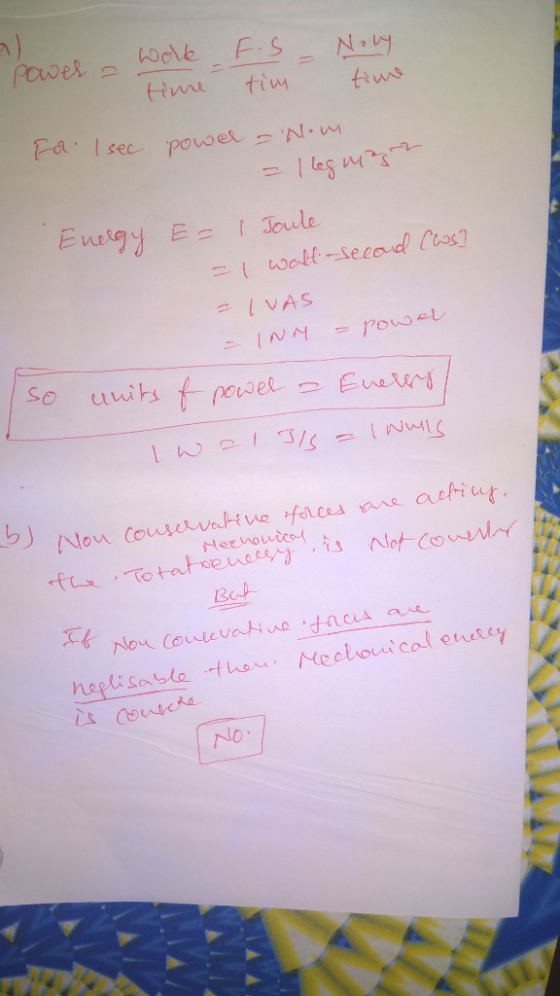
a Question 1 (10 points) Power is the same as: energy work done - rate of...
1/ When a net amount of Work is done on an object (by a non-conservative force),...
1/ When a net amount of Work is done on an object (by a non-conservative force), what is the significance of the sign of the net Work to the change in that object’s Mechanical Energy? 2 /Explain why friction is not a conservative force but the force of gravity is.
Work Done by the Govtational Force bute the gravitational force G m./r into the integral equation...
 Work Done by the Govtational Force bute the gravitational force G m./r into the integral equation on the previous genith Y replacing and find the work done by this force df w is the work done by the gravitational for moves away from t he gravitational force positive, negative, or zero when an object in the Earth? When it moves toward the Earth? When it orbits the Earth in a circle? Part B: Conservative and Non-conservative Forces welop and understorence...
Power in the rate at which work is done or energy is transformed. That is, Power=...
Power in the rate at which work is done or energy is transformed. That is, Power= Energy/Time Use the energy found above and the time measured during the demonstration to calculate the power developed in the eruption. Starting Mass 4.6 lbs Max height 41 inches Time of Eruption 3.35 sec Final Mass after Eruption: 1.7 lbs Amount of Mass that left the bottle during Eruption 2.9lbs Please help me answer the above question with the results from the experiment.
Calculate the work WAB done by the electrostatic force on a particle of charge q as...
 Calculate the work WAB done by the electrostatic force on a
particle of charge q as it moves from A to B. Express your answer
in terms of some or all the variables E, q, L, and ?.
Constants Learning Goal: To review the concept of conservative forces and to understand that electrostatic forces are, in fact, conservative. Calculate the work WAB done by the electrostatic force on a particle of charge q as it moves from A to B....
Calculate the work WAB done by the electrostatic force on a
particle of charge q as it moves from A to B. Express your answer
in terms of some or all the variables E, q, L, and ?.
Constants Learning Goal: To review the concept of conservative forces and to understand that electrostatic forces are, in fact, conservative. Calculate the work WAB done by the electrostatic force on a particle of charge q as it moves from A to B....
A conservative force is one for which Select one: 1. the work done is independent of...
A conservative force is one for which Select one: 1. the work done is independent of path. 2. the work done is dependent on path. 3. frictional forces are involved. 4. potential energy stored can not be recovered as kinetic energy. Question 2 Hooke's law relates the distance a spring stretches or compresses to Select one: 1. the energy stored in the spring. 2. the velocity of the spring. 3. the force exerted on the spring. 4. the work done...
Question 1 The change in electric potential energy is the negative of the work done by...
Question 1 The change in electric potential energy is the negative of the work done by the electric force. the work done by the electric force. the negative of the electric force. the electric force. . Question 2 The electric potential difference is . the same as the change in the electric potential energy. the change in the electric potential energy times the charge. the charge divided by the change in the electric potential energy. the change in the electric...
The object below, with mass M is pulled in the horizontal direction over a flat surface...
 The object below, with mass M is pulled in the horizontal
direction over a flat surface for a distance d, whose coefficient
of friction is uk.
2. The object below, with mass Mis pulled in the horizontal direction over a flat surface for a distance d, whose coefficient offriction is HK a. (5 points What is the total work done by friction? b. (5 points What is the change in thermal energy? 3. (5 points If both conservative forces and...
The object below, with mass M is pulled in the horizontal
direction over a flat surface for a distance d, whose coefficient
of friction is uk.
2. The object below, with mass Mis pulled in the horizontal direction over a flat surface for a distance d, whose coefficient offriction is HK a. (5 points What is the total work done by friction? b. (5 points What is the change in thermal energy? 3. (5 points If both conservative forces and...
А D z Problem 3. Work done by gravity and change in gravitational potential energy In...
 А D z Problem 3. Work done by gravity and change in gravitational potential energy In problem the box was moving in a horizontal direction, and therefore no work was done by gravity. Here, we will analyze a situation where the force of gravity has some component that points along the direction of the displacement, and therefore there is non-zero work done by gravity on the system of interest Consider a box of mass 10 kg, initially at rest, which...
QUESTION 10 Power, P, is defined as the rate at which work, W, is done, or...
QUESTION 10 Power, P, is defined as the rate at which work, W, is done, or the work divided by the time, t, over which that work occurs: P = W / t. Starting from rest, at the bottom of a flight of stairs, what is the power output for a person of mass 55 kg who runs up a flight of stairs of height 3.0 m and reaches the top of the stairs, in a time of 3.0 s,...
11. For the following be aware that work has the same units as energy (In fact...
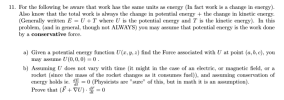 11. For the following be aware that work has the same units as energy (In fact work is a change in energy). Also know that the total work is always the change in potential energy + the change in kinetic energy. (Generally written E = U+T where U is the potential energy and T is the kinetic energy). In this problem, (and in general, though not ALWAYS) you may assume that potential energy is the work done by a conservative...
 Work Done by the Govtational Force bute the gravitational force G m./r into the integral equation on the previous genith Y replacing and find the work done by this force df w is the work done by the gravitational for moves away from t he gravitational force positive, negative, or zero when an object in the Earth? When it moves toward the Earth? When it orbits the Earth in a circle? Part B: Conservative and Non-conservative Forces welop and understorence...
 Calculate the work WAB done by the electrostatic force on a
particle of charge q as it moves from A to B. Express your answer
in terms of some or all the variables E, q, L, and ?.
Constants Learning Goal: To review the concept of conservative forces and to understand that electrostatic forces are, in fact, conservative. Calculate the work WAB done by the electrostatic force on a particle of charge q as it moves from A to B....
Calculate the work WAB done by the electrostatic force on a
particle of charge q as it moves from A to B. Express your answer
in terms of some or all the variables E, q, L, and ?.
Constants Learning Goal: To review the concept of conservative forces and to understand that electrostatic forces are, in fact, conservative. Calculate the work WAB done by the electrostatic force on a particle of charge q as it moves from A to B....
 The object below, with mass M is pulled in the horizontal
direction over a flat surface for a distance d, whose coefficient
of friction is uk.
2. The object below, with mass Mis pulled in the horizontal direction over a flat surface for a distance d, whose coefficient offriction is HK a. (5 points What is the total work done by friction? b. (5 points What is the change in thermal energy? 3. (5 points If both conservative forces and...
The object below, with mass M is pulled in the horizontal
direction over a flat surface for a distance d, whose coefficient
of friction is uk.
2. The object below, with mass Mis pulled in the horizontal direction over a flat surface for a distance d, whose coefficient offriction is HK a. (5 points What is the total work done by friction? b. (5 points What is the change in thermal energy? 3. (5 points If both conservative forces and...
 А D z Problem 3. Work done by gravity and change in gravitational potential energy In problem the box was moving in a horizontal direction, and therefore no work was done by gravity. Here, we will analyze a situation where the force of gravity has some component that points along the direction of the displacement, and therefore there is non-zero work done by gravity on the system of interest Consider a box of mass 10 kg, initially at rest, which...
 11. For the following be aware that work has the same units as energy (In fact work is a change in energy). Also know that the total work is always the change in potential energy + the change in kinetic energy. (Generally written E = U+T where U is the potential energy and T is the kinetic energy). In this problem, (and in general, though not ALWAYS) you may assume that potential energy is the work done by a conservative...
Most questions answered within 3 hours.
-
Where is the error in this code sequence?
String s1 = "Hello";
String s2 = "ello";...
asked 10 months ago -
Financial data for Joel de Paris, Inc., for last year
follow:
Joel de Paris, Inc.
Balance...
asked 10 months ago -
Consider this reaction:
Al2(SO4)3 (aq)+ BaCl3
(aq) Al2Cl6 (aq)- +
3BaSO4(s) . What is the...
asked 10 months ago -
Suppose that Savneet is considering increasing her
recent random sample from 20 car rentals to 40...
asked 10 months ago -
Trucks arrive at an unloading terminal at an average rate of 120
per hour.
Trucks arrive...
asked 10 months ago -
Why are methanol and ethanol completely soluble in water while
octanol is not very little soluble....
asked 10 months ago -
A facilities manager at a university reads in a research report
that the mean amount of...
asked 10 months ago -
When the CuSO4 is rehydrated by adding water to the anhydrous
compound, is this an endothermic...
asked 10 months ago -
A ray of sunlight is passing from diamond into crown glass; the
angle of incidence is...
asked 10 months ago -
A block of mass 0.249 kg is placed on top of a light, vertical
spring of...
asked 10 months ago -
how do the kidneys compensate in the presences of acidosis
a) trigger hyperventilate
b) reserve acid...
asked 10 months ago -
Question 501 pts
The rental rate of capital to the firm increases. Which of the
following...
asked 10 months ago