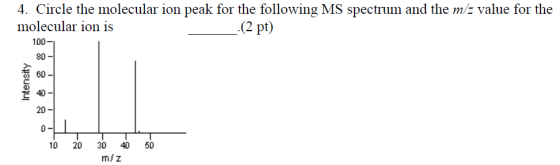
Circle the molecular ion peak for the following MS spectrum and the m/z value for the molecular ion is _____________
Homework Answers

Add Answer to:
Circle the molecular ion peak for the following MS spectrum and
the m/z value for the...
I am not understanding this assignment at all. Any assistance is very much appreciated. Mass Spectrum: Molecular Ion m/z value and structure of the Molecular Ion. Base Peak m/z value and structure of...
 I am not understanding this assignment at all. Any assistance is
very much appreciated.
Mass Spectrum:
Molecular Ion m/z value and structure of the Molecular Ion.
Base Peak m/z value and structure of that ion
One other significant peak m/z value and structure of that
ion
C13 NMR Spectrum-- Draw Structure of Compound
on the C13 NMR spectrum and identify each signal with the
appropriate Carbon.
Proton NMR Spectrum-- Draw Structure of
Compound on the Proton NMR spectrum and identify...
I am not understanding this assignment at all. Any assistance is
very much appreciated.
Mass Spectrum:
Molecular Ion m/z value and structure of the Molecular Ion.
Base Peak m/z value and structure of that ion
One other significant peak m/z value and structure of that
ion
C13 NMR Spectrum-- Draw Structure of Compound
on the C13 NMR spectrum and identify each signal with the
appropriate Carbon.
Proton NMR Spectrum-- Draw Structure of
Compound on the Proton NMR spectrum and identify...
Problem A.1 Label the molecular ion, the base peak, and the M + 1 peak in...
 Problem A.1 Label the molecular ion, the base peak, and the M + 1 peak in the mass spectrum of pentane (CHO). 100 Relative abundance 50 06 0 10 20 30 40 60 70 80 50 m/z 90 100
assign the base peak, molecular ion peak (with m/z) and identify the structure? please? :,) MS-NU-5499...
 assign the base peak, molecular ion peak (with m/z) and identify
the structure?
please? :,)
MS-NU-5499 Relative Intensity 10 15 20 25 30 50 55 60 65 70 75 35 1 40 45 m/z
assign the base peak, molecular ion peak (with m/z) and identify
the structure?
please? :,)
MS-NU-5499 Relative Intensity 10 15 20 25 30 50 55 60 65 70 75 35 1 40 45 m/z
15. The mass spectrum of a compound appears below. The molecular ion, M+1, and M+2 peaks...
 15. The mass spectrum of a compound appears below. The molecular ion, M+1, and M+2 peaks have intensities of 100, 6.8, and 31.8 respectively. Use the information provided to determine the formula of the compound 100 MS-NW-5495 80 60 40 20 шшшl 110 10 20 30 40 50 60 70 80 90 100 m/z Relative Intensity
15. The mass spectrum of a compound appears below. The molecular ion, M+1, and M+2 peaks have intensities of 100, 6.8, and 31.8 respectively....
15. The mass spectrum of a compound appears below. The molecular ion, M+1, and M+2 peaks have intensities of 100, 6.8, and 31.8 respectively. Use the information provided to determine the formula of the compound 100 MS-NW-5495 80 60 40 20 шшшl 110 10 20 30 40 50 60 70 80 90 100 m/z Relative Intensity
15. The mass spectrum of a compound appears below. The molecular ion, M+1, and M+2 peaks have intensities of 100, 6.8, and 31.8 respectively....
2. Below is the MS of 1-methoxypropane. Account for the peak at 45 m/z. Start with...
 2. Below is the MS of 1-methoxypropane. Account for the peak at 45 m/z. Start with the molecular ion. Use curved arrows to show movement of electrons. 4 pts Relative Intensity 0- 10 20 T 30 40 50 60 80 90 100 110 120 70 m/z
Description: Shown below is an EI-MS spectrum for t-butyl chloride. 1) Clearly label the base peak...
 Description: Shown below is an EI-MS spectrum for t-butyl chloride. 1) Clearly label the base peak in the spectrum. Draw the structure of the fragment the base peak corresponds to. 2) Is there a molecular ion present in the spectrum? If so, label the peak that corresponds to the molecular ion. 3) Is there any evidence that the following EI-MS spectrum represents a chlorine containing compound? If so, label the necessary peaks and explain briefly why there is sufficient evidence...
a) Describe the difference between the base peak and the parent ion (or molecular ion) peak....
 a) Describe the difference between the base peak and the parent
ion (or molecular ion) peak.
b) Identify the base peak and the parent ion (or molecular ion)
peak (if any) according to the mass spectrum.
c) Identify the mass fragments which correspond to m/z = 77,
105, 111, and 139.
d) Identify and give explanations for the magnitude (or
intensity) of the peaks at m/z = 113, 141, and 218.
Mass Spectrum ofp-C hlorobenzophenone 105 100 80 139 CI...
a) Describe the difference between the base peak and the parent
ion (or molecular ion) peak.
b) Identify the base peak and the parent ion (or molecular ion)
peak (if any) according to the mass spectrum.
c) Identify the mass fragments which correspond to m/z = 77,
105, 111, and 139.
d) Identify and give explanations for the magnitude (or
intensity) of the peaks at m/z = 113, 141, and 218.
Mass Spectrum ofp-C hlorobenzophenone 105 100 80 139 CI...
label each major peak with a molecular formula (including charge) label the molecular ion peak as "M+" (if present) labe...
 label each major peak with a molecular formula (including
charge)
label the molecular ion peak as "M+" (if present)
label major peaks other than the molecular ion with three
things:
1) the mass to charge ratio
2) the structure or formula for that charged fragment
3) another formula to show which fragment was lost by the molecular
ion to form that ion
Mass spec NEUTRAL COMPOUND 100- 80 2-6utanene 60 40 20- 75 60 65 70 35 40 45 10...
label each major peak with a molecular formula (including
charge)
label the molecular ion peak as "M+" (if present)
label major peaks other than the molecular ion with three
things:
1) the mass to charge ratio
2) the structure or formula for that charged fragment
3) another formula to show which fragment was lost by the molecular
ion to form that ion
Mass spec NEUTRAL COMPOUND 100- 80 2-6utanene 60 40 20- 75 60 65 70 35 40 45 10...
Assign a base peak, molecular ion peak (with m/z) and identify the structure. 100- MS-N-0025 Relative...
 Assign a base peak, molecular ion peak (with m/z) and identify
the structure.
100- MS-N-0025 Relative Intensity 10 2030 70 80 90 m /z rse Cha O a OOTW
Assign a base peak, molecular ion peak (with m/z) and identify
the structure.
100- MS-N-0025 Relative Intensity 10 2030 70 80 90 m /z rse Cha O a OOTW
1. Consider the Mass Spectrum below to answer the following questions: MS-NU-S495 Relative Intensity 0- 10...
 1. Consider the Mass Spectrum below to answer the following questions: MS-NU-S495 Relative Intensity 0- 10 prote 20 30 40 t 50 to 60 70 m/z 80 90 100 110 a. (1 point) What is the m/z of the molecular ion peak: b. (1 point) What is the m/z value of the base peak: c. (2 point) Explain why do we observe the peak at m/z = 114 d. (2 points) The molecular formula of this compound is C.HSX. Identify...
 I am not understanding this assignment at all. Any assistance is
very much appreciated.
Mass Spectrum:
Molecular Ion m/z value and structure of the Molecular Ion.
Base Peak m/z value and structure of that ion
One other significant peak m/z value and structure of that
ion
C13 NMR Spectrum-- Draw Structure of Compound
on the C13 NMR spectrum and identify each signal with the
appropriate Carbon.
Proton NMR Spectrum-- Draw Structure of
Compound on the Proton NMR spectrum and identify...
I am not understanding this assignment at all. Any assistance is
very much appreciated.
Mass Spectrum:
Molecular Ion m/z value and structure of the Molecular Ion.
Base Peak m/z value and structure of that ion
One other significant peak m/z value and structure of that
ion
C13 NMR Spectrum-- Draw Structure of Compound
on the C13 NMR spectrum and identify each signal with the
appropriate Carbon.
Proton NMR Spectrum-- Draw Structure of
Compound on the Proton NMR spectrum and identify...
 Problem A.1 Label the molecular ion, the base peak, and the M + 1 peak in the mass spectrum of pentane (CHO). 100 Relative abundance 50 06 0 10 20 30 40 60 70 80 50 m/z 90 100
 assign the base peak, molecular ion peak (with m/z) and identify
the structure?
please? :,)
MS-NU-5499 Relative Intensity 10 15 20 25 30 50 55 60 65 70 75 35 1 40 45 m/z
assign the base peak, molecular ion peak (with m/z) and identify
the structure?
please? :,)
MS-NU-5499 Relative Intensity 10 15 20 25 30 50 55 60 65 70 75 35 1 40 45 m/z
 15. The mass spectrum of a compound appears below. The molecular ion, M+1, and M+2 peaks have intensities of 100, 6.8, and 31.8 respectively. Use the information provided to determine the formula of the compound 100 MS-NW-5495 80 60 40 20 шшшl 110 10 20 30 40 50 60 70 80 90 100 m/z Relative Intensity
15. The mass spectrum of a compound appears below. The molecular ion, M+1, and M+2 peaks have intensities of 100, 6.8, and 31.8 respectively....
15. The mass spectrum of a compound appears below. The molecular ion, M+1, and M+2 peaks have intensities of 100, 6.8, and 31.8 respectively. Use the information provided to determine the formula of the compound 100 MS-NW-5495 80 60 40 20 шшшl 110 10 20 30 40 50 60 70 80 90 100 m/z Relative Intensity
15. The mass spectrum of a compound appears below. The molecular ion, M+1, and M+2 peaks have intensities of 100, 6.8, and 31.8 respectively....
 2. Below is the MS of 1-methoxypropane. Account for the peak at 45 m/z. Start with the molecular ion. Use curved arrows to show movement of electrons. 4 pts Relative Intensity 0- 10 20 T 30 40 50 60 80 90 100 110 120 70 m/z
 Description: Shown below is an EI-MS spectrum for t-butyl chloride. 1) Clearly label the base peak in the spectrum. Draw the structure of the fragment the base peak corresponds to. 2) Is there a molecular ion present in the spectrum? If so, label the peak that corresponds to the molecular ion. 3) Is there any evidence that the following EI-MS spectrum represents a chlorine containing compound? If so, label the necessary peaks and explain briefly why there is sufficient evidence...
 a) Describe the difference between the base peak and the parent
ion (or molecular ion) peak.
b) Identify the base peak and the parent ion (or molecular ion)
peak (if any) according to the mass spectrum.
c) Identify the mass fragments which correspond to m/z = 77,
105, 111, and 139.
d) Identify and give explanations for the magnitude (or
intensity) of the peaks at m/z = 113, 141, and 218.
Mass Spectrum ofp-C hlorobenzophenone 105 100 80 139 CI...
a) Describe the difference between the base peak and the parent
ion (or molecular ion) peak.
b) Identify the base peak and the parent ion (or molecular ion)
peak (if any) according to the mass spectrum.
c) Identify the mass fragments which correspond to m/z = 77,
105, 111, and 139.
d) Identify and give explanations for the magnitude (or
intensity) of the peaks at m/z = 113, 141, and 218.
Mass Spectrum ofp-C hlorobenzophenone 105 100 80 139 CI...
 label each major peak with a molecular formula (including
charge)
label the molecular ion peak as "M+" (if present)
label major peaks other than the molecular ion with three
things:
1) the mass to charge ratio
2) the structure or formula for that charged fragment
3) another formula to show which fragment was lost by the molecular
ion to form that ion
Mass spec NEUTRAL COMPOUND 100- 80 2-6utanene 60 40 20- 75 60 65 70 35 40 45 10...
label each major peak with a molecular formula (including
charge)
label the molecular ion peak as "M+" (if present)
label major peaks other than the molecular ion with three
things:
1) the mass to charge ratio
2) the structure or formula for that charged fragment
3) another formula to show which fragment was lost by the molecular
ion to form that ion
Mass spec NEUTRAL COMPOUND 100- 80 2-6utanene 60 40 20- 75 60 65 70 35 40 45 10...
 Assign a base peak, molecular ion peak (with m/z) and identify
the structure.
100- MS-N-0025 Relative Intensity 10 2030 70 80 90 m /z rse Cha O a OOTW
Assign a base peak, molecular ion peak (with m/z) and identify
the structure.
100- MS-N-0025 Relative Intensity 10 2030 70 80 90 m /z rse Cha O a OOTW
 1. Consider the Mass Spectrum below to answer the following questions: MS-NU-S495 Relative Intensity 0- 10 prote 20 30 40 t 50 to 60 70 m/z 80 90 100 110 a. (1 point) What is the m/z of the molecular ion peak: b. (1 point) What is the m/z value of the base peak: c. (2 point) Explain why do we observe the peak at m/z = 114 d. (2 points) The molecular formula of this compound is C.HSX. Identify...
Most questions answered within 3 hours.
-
Where is the error in this code sequence?
String s1 = "Hello";
String s2 = "ello";...
asked 10 months ago -
Financial data for Joel de Paris, Inc., for last year
follow:
Joel de Paris, Inc.
Balance...
asked 10 months ago -
Consider this reaction:
Al2(SO4)3 (aq)+ BaCl3
(aq) Al2Cl6 (aq)- +
3BaSO4(s) . What is the...
asked 10 months ago -
Suppose that Savneet is considering increasing her
recent random sample from 20 car rentals to 40...
asked 10 months ago -
Trucks arrive at an unloading terminal at an average rate of 120
per hour.
Trucks arrive...
asked 10 months ago -
Why are methanol and ethanol completely soluble in water while
octanol is not very little soluble....
asked 10 months ago -
A facilities manager at a university reads in a research report
that the mean amount of...
asked 10 months ago -
When the CuSO4 is rehydrated by adding water to the anhydrous
compound, is this an endothermic...
asked 10 months ago -
A ray of sunlight is passing from diamond into crown glass; the
angle of incidence is...
asked 10 months ago -
A block of mass 0.249 kg is placed on top of a light, vertical
spring of...
asked 10 months ago -
how do the kidneys compensate in the presences of acidosis
a) trigger hyperventilate
b) reserve acid...
asked 10 months ago -
Question 501 pts
The rental rate of capital to the firm increases. Which of the
following...
asked 10 months ago