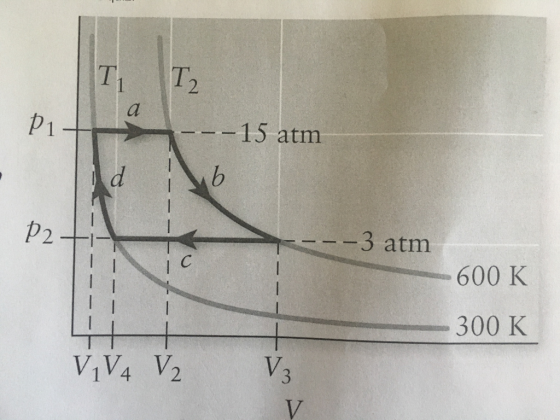
If the engine uses 5 moles of an ideal gas what are the volumes: V1, V2, V3, and V4?
Homework Answers

Add Answer to:
If the engine uses 5 moles of an ideal gas what are the volumes:
V1, V2,...
For a Carnot engine with 10 moles of ideal gas (Cv = 1.5 nR) and operating...
For a Carnot engine with 10 moles of ideal gas (Cv = 1.5 nR) and operating between a hot reservoir of 500 K and a cold reservoir of 300 K, a) What would be the heat exchanges (q1) and entropy change (∆S1) for step 1, where the gas reversibly and isothermally expands to double its volume (V2 = 2 V1) at 500 K? b) What would be the heat exchanges (q3) and entropy change (∆S3) for step 3, where the...
For a Carnot engine with 10 moles of ideal gas (Cv= 1.5 nR) and operatingbetween a...
For a Carnot engine with 10 moles of ideal gas (Cv= 1.5 nR) and operatingbetween a hot reservoir of 500 K and a cold reservoir of 300 K,a. (6 Points) What would be the heat exchanges (q1) and entropy change (∆S1) for step 1, where thegas reversibly and isothermally expands to double its volume (V2= 2 V1) at 500 K?b. (6 Points) What would be the heat exchanges (q3) and entropy change (∆S3) for step 3, where thegas is reversibly...
please solve this in detail! 9. Consider a heat engine uses a 0.50 moles of a...
 please solve this in detail!
9. Consider a heat engine uses a 0.50 moles of a monoatomic ideal gas. The initial temperature is where V1= 1.000L V2= 3.375 L, V3=8.210 L and V4=2.433 L while the highest temperature was obser during adiabatic process is 450 K 12 (10) a) For reversible adiabatic expansion calculate P3 w.. AD, AS
please solve this in detail!
9. Consider a heat engine uses a 0.50 moles of a monoatomic ideal gas. The initial temperature is where V1= 1.000L V2= 3.375 L, V3=8.210 L and V4=2.433 L while the highest temperature was obser during adiabatic process is 450 K 12 (10) a) For reversible adiabatic expansion calculate P3 w.. AD, AS
An ideal monatomic gas goes from P1 = 140 atm and V1 = 55 m3 to...
An ideal monatomic gas goes from P1 = 140 atm and V1 = 55 m3 to P2 and V2 via an adiabatic process. If P2 = 60 atm, what is V2 in m3?
An ideal monatomic gas goes from P1 = 150 atm and V1 = 25 m3 to...
An ideal monatomic gas goes from P1 = 150 atm and V1 = 25 m3 to P2 and V2 via an adiabatic process. If P2 = 40 atm, what is V2 in m3?
please solve part B!!! 9. Consider a heat engine uses a 0.50 moles of a monoatomic...
 please solve part B!!!
9. Consider a heat engine uses a 0.50 moles of a monoatomic ideal gas. The initial temperature is 200K where V1= 1.000L V2= 3.375 L, V3=8.210 L and V4=2.433 L while the highest temperature was observed during adiabatic process is 450 K 2 a) For reversible adiabatic expansion, calculate P3, W. 9, AO, AS. (10) At=0 te P3, W. a. At, AS 10305+ 1.433 40 731.45/.am WE STV wa (1)(2.433L - 1.000L = + 1,433 Loung,...
please solve part B!!!
9. Consider a heat engine uses a 0.50 moles of a monoatomic ideal gas. The initial temperature is 200K where V1= 1.000L V2= 3.375 L, V3=8.210 L and V4=2.433 L while the highest temperature was observed during adiabatic process is 450 K 2 a) For reversible adiabatic expansion, calculate P3, W. 9, AO, AS. (10) At=0 te P3, W. a. At, AS 10305+ 1.433 40 731.45/.am WE STV wa (1)(2.433L - 1.000L = + 1,433 Loung,...
Please answer the whole page. Ideal Gas Law PV = nRT Gas Laws Formulas Combined Gas Law (P1)(V1) Ti (P2)(V2) Tz = Dalto...
 Please answer the whole page.
Ideal Gas Law PV = nRT Gas Laws Formulas Combined Gas Law (P1)(V1) Ti (P2)(V2) Tz = Dalton's Law of Partial Pressures P = P, +P+P, + ...etc. K="C + 273 3. A 5.0 L sample of gas has a pressure of 1200 torr. What is the new pressure if the temperature is changed from 220 K to 440 K and the volume increased to 20.0 L ? 4. A 10.0 mL sample of gas...
Please answer the whole page.
Ideal Gas Law PV = nRT Gas Laws Formulas Combined Gas Law (P1)(V1) Ti (P2)(V2) Tz = Dalton's Law of Partial Pressures P = P, +P+P, + ...etc. K="C + 273 3. A 5.0 L sample of gas has a pressure of 1200 torr. What is the new pressure if the temperature is changed from 220 K to 440 K and the volume increased to 20.0 L ? 4. A 10.0 mL sample of gas...
What is the volume of an ideal gas sample that has a pressure of 3.0 atm,...
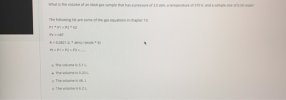 What is the volume of an ideal gas sample that has a pressure of 3.0 atm, a temperature of 370 K and a sample size of 0.50 mole? The following list are some of the gas equations in Chapter 10: P1 * V1 = P2 * V2 PV = nRT R 0.0821 Latm)/(molek) Pt = P1 P2 + P3 + ...... The volume is 5.1 L The volume is 0.20 L The volume is 46. L The volume is 6.2L
12. 1 mole of an ideal gas undergoes an isothermal expansion from V1 = 1.4L followed...
 12. 1 mole of an ideal gas undergoes an isothermal expansion from V1 = 1.4L followed by isobaric compression, p = cst.if P1 = 4.4atm, p2 = 1.7atm → ?- m calculate the work done by gas during the expansion. Express work in J = N·m! • For isothermal processes, AT = 0 T = cst → w=faw=fr&v=/MRT AV 594 Show your work like: `x-int_0^5 v(t)dt rarr x-int_0^5(-4*t)dt=-50 m 13. 1 mole of an ideal gas undergoes an isothermal expansion...
3.1 moles of ideal gas undergo an expansion from V1 = 1.2 m3 to V2 =...
 3.1 moles of ideal gas undergo an expansion from V1 = 1.2 m3 to V2 = 1.7 m3 during an isothermal process taking place at T = 25 degree C. Calculate Delta U, Delta H, Q, W when The expansion takes place in The following conditions: A reversible expansion. A rapid non-reversible expansion against a constant surrounding pressure equal to The final pressure of The gas. A free expansion where The gas expands in vacuum against zero external pressure.
 please solve this in detail!
9. Consider a heat engine uses a 0.50 moles of a monoatomic ideal gas. The initial temperature is where V1= 1.000L V2= 3.375 L, V3=8.210 L and V4=2.433 L while the highest temperature was obser during adiabatic process is 450 K 12 (10) a) For reversible adiabatic expansion calculate P3 w.. AD, AS
please solve this in detail!
9. Consider a heat engine uses a 0.50 moles of a monoatomic ideal gas. The initial temperature is where V1= 1.000L V2= 3.375 L, V3=8.210 L and V4=2.433 L while the highest temperature was obser during adiabatic process is 450 K 12 (10) a) For reversible adiabatic expansion calculate P3 w.. AD, AS
 please solve part B!!!
9. Consider a heat engine uses a 0.50 moles of a monoatomic ideal gas. The initial temperature is 200K where V1= 1.000L V2= 3.375 L, V3=8.210 L and V4=2.433 L while the highest temperature was observed during adiabatic process is 450 K 2 a) For reversible adiabatic expansion, calculate P3, W. 9, AO, AS. (10) At=0 te P3, W. a. At, AS 10305+ 1.433 40 731.45/.am WE STV wa (1)(2.433L - 1.000L = + 1,433 Loung,...
please solve part B!!!
9. Consider a heat engine uses a 0.50 moles of a monoatomic ideal gas. The initial temperature is 200K where V1= 1.000L V2= 3.375 L, V3=8.210 L and V4=2.433 L while the highest temperature was observed during adiabatic process is 450 K 2 a) For reversible adiabatic expansion, calculate P3, W. 9, AO, AS. (10) At=0 te P3, W. a. At, AS 10305+ 1.433 40 731.45/.am WE STV wa (1)(2.433L - 1.000L = + 1,433 Loung,...
 Please answer the whole page.
Ideal Gas Law PV = nRT Gas Laws Formulas Combined Gas Law (P1)(V1) Ti (P2)(V2) Tz = Dalton's Law of Partial Pressures P = P, +P+P, + ...etc. K="C + 273 3. A 5.0 L sample of gas has a pressure of 1200 torr. What is the new pressure if the temperature is changed from 220 K to 440 K and the volume increased to 20.0 L ? 4. A 10.0 mL sample of gas...
Please answer the whole page.
Ideal Gas Law PV = nRT Gas Laws Formulas Combined Gas Law (P1)(V1) Ti (P2)(V2) Tz = Dalton's Law of Partial Pressures P = P, +P+P, + ...etc. K="C + 273 3. A 5.0 L sample of gas has a pressure of 1200 torr. What is the new pressure if the temperature is changed from 220 K to 440 K and the volume increased to 20.0 L ? 4. A 10.0 mL sample of gas...
 What is the volume of an ideal gas sample that has a pressure of 3.0 atm, a temperature of 370 K and a sample size of 0.50 mole? The following list are some of the gas equations in Chapter 10: P1 * V1 = P2 * V2 PV = nRT R 0.0821 Latm)/(molek) Pt = P1 P2 + P3 + ...... The volume is 5.1 L The volume is 0.20 L The volume is 46. L The volume is 6.2L
 12. 1 mole of an ideal gas undergoes an isothermal expansion from V1 = 1.4L followed by isobaric compression, p = cst.if P1 = 4.4atm, p2 = 1.7atm → ?- m calculate the work done by gas during the expansion. Express work in J = N·m! • For isothermal processes, AT = 0 T = cst → w=faw=fr&v=/MRT AV 594 Show your work like: `x-int_0^5 v(t)dt rarr x-int_0^5(-4*t)dt=-50 m 13. 1 mole of an ideal gas undergoes an isothermal expansion...
 3.1 moles of ideal gas undergo an expansion from V1 = 1.2 m3 to V2 = 1.7 m3 during an isothermal process taking place at T = 25 degree C. Calculate Delta U, Delta H, Q, W when The expansion takes place in The following conditions: A reversible expansion. A rapid non-reversible expansion against a constant surrounding pressure equal to The final pressure of The gas. A free expansion where The gas expands in vacuum against zero external pressure.
Most questions answered within 3 hours.
-
Where is the error in this code sequence?
String s1 = "Hello";
String s2 = "ello";...
asked 11 months ago -
Financial data for Joel de Paris, Inc., for last year
follow:
Joel de Paris, Inc.
Balance...
asked 11 months ago -
Consider this reaction:
Al2(SO4)3 (aq)+ BaCl3
(aq) Al2Cl6 (aq)- +
3BaSO4(s) . What is the...
asked 11 months ago -
Suppose that Savneet is considering increasing her
recent random sample from 20 car rentals to 40...
asked 11 months ago -
Trucks arrive at an unloading terminal at an average rate of 120
per hour.
Trucks arrive...
asked 11 months ago -
Why are methanol and ethanol completely soluble in water while
octanol is not very little soluble....
asked 11 months ago -
A facilities manager at a university reads in a research report
that the mean amount of...
asked 11 months ago -
When the CuSO4 is rehydrated by adding water to the anhydrous
compound, is this an endothermic...
asked 11 months ago -
A ray of sunlight is passing from diamond into crown glass; the
angle of incidence is...
asked 11 months ago -
A block of mass 0.249 kg is placed on top of a light, vertical
spring of...
asked 11 months ago -
how do the kidneys compensate in the presences of acidosis
a) trigger hyperventilate
b) reserve acid...
asked 11 months ago -
Question 501 pts
The rental rate of capital to the firm increases. Which of the
following...
asked 11 months ago