1) Suppose a pendulum bob is suspended from a pivot by a massless string of length...
1) Suppose a pendulum bob is suspended from a pivot by a massless string of length l, measured to the center of the bob.
a) Show that if I draw pendulum back by an angle theta, the center of the bob is elevated by the distance

b) Using the results of part (a), show that the speed of the pendulum bob at the bottom of its travel should be

Hint: Recall that (1-cos(theta))/2= 
2) (Ramp section) Suppose the height of the ramp is h1=0.3m. and
the foot of the ramp is horizontal, and is h2=1.00m above the
floor. What will be the horizontal distance traveled by the
following four objects before they hit the floor? Assume that
R=12.7mm in each case; assume that the density of steel is
 , and assume that the density of aluminum is
  .
.
a) A solid steel sphere sliding down the ramp without friction.
b) A solid steel sphere rolling down the remp without slipping.
c) A spherical steel shell with shell thickness 1.0mm rolling down the ramp without slipping.
d) A solid aluminum sphere rolling down the ramp without slipping.
Homework Answers
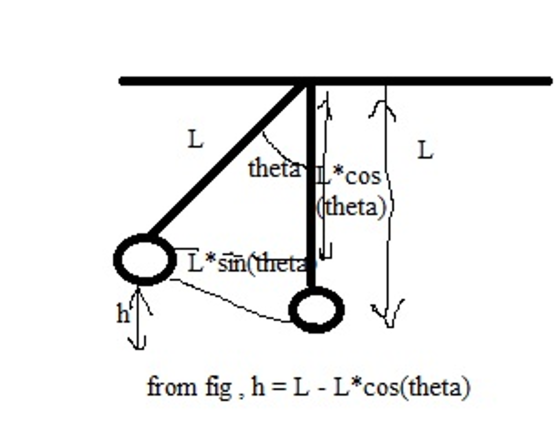
1) L = length of pendulum
h = distance by which bob get elevated
fron fig:
h = L- L*cos( theta)
h = L( 1- cos( theta))
[ from cos ( theta) = 1- 2*sin2 ( theta/2) ]
h = L*2*sin2 ( theta/2)
h = 2 L * sin2 ( theta/2)
----------------------------------------------------------
b) at height h , energy = potential energy = mgh
at bottom , energy = kinetic energy = (1/2)*m*V2
m = mass of bob
V = velocity of bob at bottom
from conservation of energy:
P.E = K.E
mgh = (1/2)*m*V2
V = ( 2 g h)1/2
= ( 2*g*2 L * sin2 ( theta/2) )1/2
= 2*( gL)1/2 * sin(theta/2)
Add Answer to:
1) Suppose a pendulum bob is suspended from a pivot by a
massless string of length...
2) Released from rest at the same height, a thin spherical shell (lamR3) and solid sphere...
 2) Released from rest at the same height, a thin spherical shell (lamR3) and solid sphere AshremR) of the same mass m and radius R roll without slipping down an incline through the same vertical drop H (see figure below). Each is moving horizontally as it leaves the ramp. The spherical shell hits the ground a horizontal distance L from the end of the ramp and the solid sphere hits the ground a distance L 'from the end of the...
4. Experiment 1 (see this first diagram, which is not to scale) A straight, thin rod...
 4. Experiment 1 (see this first diagram, which is not to scale) A straight, thin rod of non-uniform density is held initially at rest, as shown, by a frictionless pin located at the base of the wall and also by a horizontal, massless thread that connects the rod to the wall. The rod's total length is 7.94 m, and the tension in the thread is 150 N wall ro Defining the pin as r-0 m, the rod's linear mass density...
4. Experiment 1 (see this finst dingram, which is not to scale A straight, thin rod...
 4. Experiment 1 (see this finst dingram, which is not to scale A straight, thin rod of non-uniform density is held initially at rest as shown, by a frictionless pin located at the base of the wall and also by a horizontal, massless thread that connects the rod to the wall. The rod's total length is 7.94 m, and the tension in the thread is 150 N wall rod Defining the pin as r 0 m, the rod's linear mass...
4. Experiment 1 (see this first diagram, which is not to scale): A straight, thin rod...
 4. Experiment 1 (see this first diagram, which is not to scale): A straight, thin rod of non-uniform density is held initially at rest as shown, by a frictionless pin located at the base of the wall and also by a horizontal, massless thread that connects the rod to the wall The rod's total length is 7.94 m, and the tension in the thread is 150 N wall rod Defining the pin as r as this 0 m, the rod's...
A solid sphere is released from the top of a ramp that is at a height...
 A solid sphere is released from the top of a ramp that is at a
height h1 = 1.90 m. It rolls down the ramp without slipping. The
bottom of the ramp is at a height of h2 = 1.49 m above the floor.
The edge of the ramp is a short horizontal section from which the
ball leaves to land on the floor. The diameter of the ball is 0.12
m
(a)Through what horizontal distance d, in meters, does...
A solid sphere is released from the top of a ramp that is at a
height h1 = 1.90 m. It rolls down the ramp without slipping. The
bottom of the ramp is at a height of h2 = 1.49 m above the floor.
The edge of the ramp is a short horizontal section from which the
ball leaves to land on the floor. The diameter of the ball is 0.12
m
(a)Through what horizontal distance d, in meters, does...
4. Experiment 1 (see this first diagram, which is A straight, thin rod of non-uniform density...
 4. Experiment 1 (see this first diagram, which is A straight, thin rod of non-uniform density is held initially at rest, as shown, by a frictionless pin located at the base of the wall and also by a horizontal, massless thread that connects the rod to the wall all The rod's total length is 7.94 m, and the tension in the thread is 150 N rod Defining the pin as r-0 m, the rod's linear mass density can be described...
4. Experiment 1 (see this first diagram, which is not to scale) A straight, thin rod...
 4. Experiment 1 (see this first diagram, which is not to scale) A straight, thin rod of non-uniform density is held initially at rest, as shown, by a frictionless pin located at the base of the wall and also by a horizontal, massless thread that connects the rod to the wall The rod's total length is 7.94 m, and the tension in the thread is 150 N Defining the pin as r 0 m, the rod's linear mass density can...
4. Experiment 1 (see this first diagram, which is not to scale) A straight, thin rod...
 4. Experiment 1 (see this first diagram, which is not to scale) A straight, thin rod of non-uniform density is held initially at rest, as shown, by a frictionless pin located at the base of the wall and also by a horizontal, massless thread that connects the rod to the wall. The rod's total length is 7.94 m, and the tension in the thread is 150 N wall ro Defining the pin as r = 0 m, the rod's linear...
4. Experiment 1 (see this first diagram, which is not to scale) A straight, thin rod...
 4. Experiment 1 (see this first diagram, which is not to scale) A straight, thin rod of non-uniform density is held initially at rest, as shown, by a frictionless pin located at the base of the wall and also by a horizontal, massless thread that connects the rod to the w all The rod's total length is 7.94 m, and the tension in the thread is 150 N rod Defining the pin as r as this 0 m, the rod's...
A thin hoop of radius r = 0.82 m and mass M = 7.3 kg rolls...
A thin hoop of radius r = 0.82 m and mass M = 7.3 kg rolls without slipping across a horizontal floor with a velocity v = 1.1 m/s. It then rolls up an incline with an angle of inclination theta = 44 degrees. a) What is the maximum height h reached by the hoop before rolling back down the incline? b) Now, suppose a uniform solid sphere is used instead of a hoop. Use the same values of r,...
 2) Released from rest at the same height, a thin spherical shell (lamR3) and solid sphere AshremR) of the same mass m and radius R roll without slipping down an incline through the same vertical drop H (see figure below). Each is moving horizontally as it leaves the ramp. The spherical shell hits the ground a horizontal distance L from the end of the ramp and the solid sphere hits the ground a distance L 'from the end of the...
 4. Experiment 1 (see this first diagram, which is not to scale) A straight, thin rod of non-uniform density is held initially at rest, as shown, by a frictionless pin located at the base of the wall and also by a horizontal, massless thread that connects the rod to the wall. The rod's total length is 7.94 m, and the tension in the thread is 150 N wall ro Defining the pin as r-0 m, the rod's linear mass density...
 4. Experiment 1 (see this finst dingram, which is not to scale A straight, thin rod of non-uniform density is held initially at rest as shown, by a frictionless pin located at the base of the wall and also by a horizontal, massless thread that connects the rod to the wall. The rod's total length is 7.94 m, and the tension in the thread is 150 N wall rod Defining the pin as r 0 m, the rod's linear mass...
 4. Experiment 1 (see this first diagram, which is not to scale): A straight, thin rod of non-uniform density is held initially at rest as shown, by a frictionless pin located at the base of the wall and also by a horizontal, massless thread that connects the rod to the wall The rod's total length is 7.94 m, and the tension in the thread is 150 N wall rod Defining the pin as r as this 0 m, the rod's...
 A solid sphere is released from the top of a ramp that is at a
height h1 = 1.90 m. It rolls down the ramp without slipping. The
bottom of the ramp is at a height of h2 = 1.49 m above the floor.
The edge of the ramp is a short horizontal section from which the
ball leaves to land on the floor. The diameter of the ball is 0.12
m
(a)Through what horizontal distance d, in meters, does...
A solid sphere is released from the top of a ramp that is at a
height h1 = 1.90 m. It rolls down the ramp without slipping. The
bottom of the ramp is at a height of h2 = 1.49 m above the floor.
The edge of the ramp is a short horizontal section from which the
ball leaves to land on the floor. The diameter of the ball is 0.12
m
(a)Through what horizontal distance d, in meters, does...
 4. Experiment 1 (see this first diagram, which is A straight, thin rod of non-uniform density is held initially at rest, as shown, by a frictionless pin located at the base of the wall and also by a horizontal, massless thread that connects the rod to the wall all The rod's total length is 7.94 m, and the tension in the thread is 150 N rod Defining the pin as r-0 m, the rod's linear mass density can be described...
 4. Experiment 1 (see this first diagram, which is not to scale) A straight, thin rod of non-uniform density is held initially at rest, as shown, by a frictionless pin located at the base of the wall and also by a horizontal, massless thread that connects the rod to the wall The rod's total length is 7.94 m, and the tension in the thread is 150 N Defining the pin as r 0 m, the rod's linear mass density can...
 4. Experiment 1 (see this first diagram, which is not to scale) A straight, thin rod of non-uniform density is held initially at rest, as shown, by a frictionless pin located at the base of the wall and also by a horizontal, massless thread that connects the rod to the wall. The rod's total length is 7.94 m, and the tension in the thread is 150 N wall ro Defining the pin as r = 0 m, the rod's linear...
 4. Experiment 1 (see this first diagram, which is not to scale) A straight, thin rod of non-uniform density is held initially at rest, as shown, by a frictionless pin located at the base of the wall and also by a horizontal, massless thread that connects the rod to the w all The rod's total length is 7.94 m, and the tension in the thread is 150 N rod Defining the pin as r as this 0 m, the rod's...
Most questions answered within 3 hours.
-
Where is the error in this code sequence?
String s1 = "Hello";
String s2 = "ello";...
asked 10 months ago -
Financial data for Joel de Paris, Inc., for last year
follow:
Joel de Paris, Inc.
Balance...
asked 10 months ago -
Consider this reaction:
Al2(SO4)3 (aq)+ BaCl3
(aq) Al2Cl6 (aq)- +
3BaSO4(s) . What is the...
asked 10 months ago -
Suppose that Savneet is considering increasing her
recent random sample from 20 car rentals to 40...
asked 10 months ago -
Trucks arrive at an unloading terminal at an average rate of 120
per hour.
Trucks arrive...
asked 10 months ago -
Why are methanol and ethanol completely soluble in water while
octanol is not very little soluble....
asked 10 months ago -
A facilities manager at a university reads in a research report
that the mean amount of...
asked 10 months ago -
When the CuSO4 is rehydrated by adding water to the anhydrous
compound, is this an endothermic...
asked 10 months ago -
A ray of sunlight is passing from diamond into crown glass; the
angle of incidence is...
asked 10 months ago -
A block of mass 0.249 kg is placed on top of a light, vertical
spring of...
asked 10 months ago -
how do the kidneys compensate in the presences of acidosis
a) trigger hyperventilate
b) reserve acid...
asked 10 months ago -
Question 501 pts
The rental rate of capital to the firm increases. Which of the
following...
asked 10 months ago