
Homework Answers
Add Answer to:
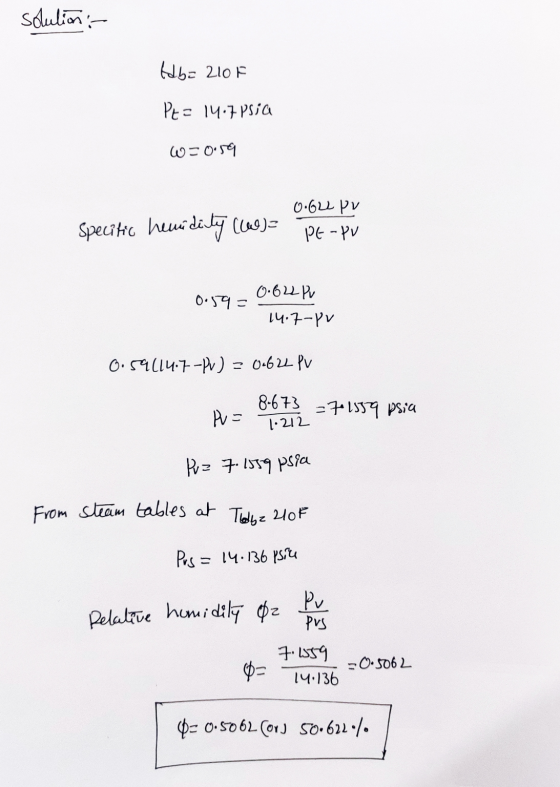
6. Suppose moist air enters the RTO for the project at 210 F at pressure 14.7...
Problem 14.7: An air-conditioning system operates at a total pressure of 95kPa and consists of a...
 Problem 14.7: An air-conditioning system operates at a total pressure of 95kPa and consists of a heating section and a humidifier that supplies wet steam (saturated water vapor) at 100°C. Air enters the heating section at 10°C and 70 percent relative humidity at a rate of 35 m'/min, and it leaves the humidifying section at 20°C and 60 percent relative humidity. Determine (a) the temperature and relative humidity of air when it leaves the heating section, (b) the rate of...
Moist air is at 80F (26.67C) dry-bulb, 0.0150 lb-w/lb-da (0.0150 kg-w/kg-da) humidity ratio, pressure of 14.696...
Moist air is at 80F (26.67C) dry-bulb, 0.0150 lb-w/lb-da (0.0150 kg-w/kg-da) humidity ratio, pressure of 14.696 psia (101.35 kPa). Determine the dew-point temperature, relative humidity, volume in cu ft/lb-da (cu meters/kg-da), and enthalpy in Btu/lb-da (kJ/kg-da) using the moist air property tables and the ideal gas equations. What error is incurred using the ideal gas approach? Compare these results with the psychrometric charts (available in ASHRAE Fundamentals)
Exercise 2 Moist air at 1 atm. barometric pressure has a dry bulb temperature of 40°C...
 Exercise 2 Moist air at 1 atm. barometric pressure has a dry bulb temperature of 40°C and a wet bulb temperature of 320C. Using both the equations for the moist air properties and the psychrometric chart find: g) the partial pressure of the water vapor h) humidity ratio i) relative humidity j) dew-point temperature k) specific volume 1) enthalpy of moist air Insert the data and the results from the chart in the following table: Enthalpy Specific kJ/kg m/kg Humidity...
Exercise 3 Moist air at 1 atm. barometric pressure has a dry bulb temperature of 29...
 Exercise 3 Moist air at 1 atm. barometric pressure has a dry bulb temperature of 29 C and a wet bulb temperature of 22°C. Using the psychrometric chart and the table for saturated vapor find the following air properties: Pr T- 40 a) the partial pressure of the water vapor b) humidity ratio c) relative humidity d) dew-point temperature e) specific volume ) enthalpy of moist air
please solve it quickly ignore p=75 Problem 3 Part a P=57 Moist air enters the cooler...
 please solve it quickly
ignore p=75
Problem 3 Part a P=57 Moist air enters the cooler of an air conditioning unit at 25 °C and a relative humidity of 70%. The cooled and dehumidified air leaves the cooler saturated at 18 °C. The temperature of condensed water is 18 °C. The pressure is constant at 101.325 kPa. The mass flow rate of the dry air is mda=67 kg/s. Use the psychometric chart to determine a) The humidity ratio at the...
please solve it quickly
ignore p=75
Problem 3 Part a P=57 Moist air enters the cooler of an air conditioning unit at 25 °C and a relative humidity of 70%. The cooled and dehumidified air leaves the cooler saturated at 18 °C. The temperature of condensed water is 18 °C. The pressure is constant at 101.325 kPa. The mass flow rate of the dry air is mda=67 kg/s. Use the psychometric chart to determine a) The humidity ratio at the...
Air at 95°F, 1 atm, and 10% relative humidity enters an evaporative cooler operating at steady...
Air at 95°F, 1 atm, and 10% relative humidity enters an evaporative cooler operating at steady state. The volumetric flow rate of the incoming air is 895 ft3/min. Liquid water at 68°F enters the cooler and fully evaporates. Moist air exits the cooler at 70°F, 1 atm. There is no significant heat transfer between the device and its surroundings and kinetic and potential energy effects can be neglected. a)Determine the mass flow rate of the dry air in lb(dry air)/min....
Air at 95°F, 1 atm, and 10% relative humidity enters an evaporative cooler operating at steady...
 Air at 95°F, 1 atm, and 10% relative humidity enters an evaporative cooler operating at steady state. The volumetric flow rate of the incoming air is 1765 ft3/min. Liquid water at 68°F enters the cooler and fully evaporates. Moist air exits the cooler at 70°F, 1 atm. There is no significant heat transfer between the device and its surroundings and kinetic and potential energy effects can be neglected. A. Determine the mass flow rate of the dry air in lbm(dry...
Air at 95°F, 1 atm, and 10% relative humidity enters an evaporative cooler operating at steady...
 Air at 95°F, 1 atm, and 10% relative humidity enters an evaporative cooler operating at steady state. The volumetric flow rate of the incoming air is 1765 ft3/min. Liquid water at 68°F enters the cooler and fully evaporates. Moist air exits the cooler at 70°F, 1 atm. There is no significant heat transfer between the device and its surroundings and kinetic and potential energy effects can be neglected. A. Determine the mass flow rate of the dry air in Ibm(dry...
Uestion 2 Moist air, saturated at 5°C, enters a heating coil at a rate of 10 m'/s. Air leaves the...
 uestion 2 Moist air, saturated at 5°C, enters a heating coil at a rate of 10 m'/s. Air leaves the coil with of h2-50 kJ/kgda. i an enthalpy a) Find each of the initial and final states the dry and wet temperatures, dew point, relative humidity, humidity ratio, specific volume. b) Imagine a simple transformation to reach a dry temperature of 25°C and a relative humidity of 50%. What is the nature of this transformation? What is the required heat...
Problem2 (a) Suppose outside temperature is 55 °F while the temperature inside a building is 72 F. The building is heated but not air conditioned, so the partial pressure of water vapor is the sa...
 Problem2 (a) Suppose outside temperature is 55 °F while the temperature inside a building is 72 F. The building is heated but not air conditioned, so the partial pressure of water vapor is the same both inside and outside the building. Finally, suppose the dew point outside is 40°F What is the dew point inside? What are the relative humidities inside and outside the building? (We are most comfortable if relative humidity is between 30% and 50%-This question shows why...
 Problem 14.7: An air-conditioning system operates at a total pressure of 95kPa and consists of a heating section and a humidifier that supplies wet steam (saturated water vapor) at 100°C. Air enters the heating section at 10°C and 70 percent relative humidity at a rate of 35 m'/min, and it leaves the humidifying section at 20°C and 60 percent relative humidity. Determine (a) the temperature and relative humidity of air when it leaves the heating section, (b) the rate of...
 Exercise 2 Moist air at 1 atm. barometric pressure has a dry bulb temperature of 40°C and a wet bulb temperature of 320C. Using both the equations for the moist air properties and the psychrometric chart find: g) the partial pressure of the water vapor h) humidity ratio i) relative humidity j) dew-point temperature k) specific volume 1) enthalpy of moist air Insert the data and the results from the chart in the following table: Enthalpy Specific kJ/kg m/kg Humidity...
 Exercise 3 Moist air at 1 atm. barometric pressure has a dry bulb temperature of 29 C and a wet bulb temperature of 22°C. Using the psychrometric chart and the table for saturated vapor find the following air properties: Pr T- 40 a) the partial pressure of the water vapor b) humidity ratio c) relative humidity d) dew-point temperature e) specific volume ) enthalpy of moist air
 please solve it quickly
ignore p=75
Problem 3 Part a P=57 Moist air enters the cooler of an air conditioning unit at 25 °C and a relative humidity of 70%. The cooled and dehumidified air leaves the cooler saturated at 18 °C. The temperature of condensed water is 18 °C. The pressure is constant at 101.325 kPa. The mass flow rate of the dry air is mda=67 kg/s. Use the psychometric chart to determine a) The humidity ratio at the...
please solve it quickly
ignore p=75
Problem 3 Part a P=57 Moist air enters the cooler of an air conditioning unit at 25 °C and a relative humidity of 70%. The cooled and dehumidified air leaves the cooler saturated at 18 °C. The temperature of condensed water is 18 °C. The pressure is constant at 101.325 kPa. The mass flow rate of the dry air is mda=67 kg/s. Use the psychometric chart to determine a) The humidity ratio at the...
 Air at 95°F, 1 atm, and 10% relative humidity enters an evaporative cooler operating at steady state. The volumetric flow rate of the incoming air is 1765 ft3/min. Liquid water at 68°F enters the cooler and fully evaporates. Moist air exits the cooler at 70°F, 1 atm. There is no significant heat transfer between the device and its surroundings and kinetic and potential energy effects can be neglected. A. Determine the mass flow rate of the dry air in lbm(dry...
 Air at 95°F, 1 atm, and 10% relative humidity enters an evaporative cooler operating at steady state. The volumetric flow rate of the incoming air is 1765 ft3/min. Liquid water at 68°F enters the cooler and fully evaporates. Moist air exits the cooler at 70°F, 1 atm. There is no significant heat transfer between the device and its surroundings and kinetic and potential energy effects can be neglected. A. Determine the mass flow rate of the dry air in Ibm(dry...
 uestion 2 Moist air, saturated at 5°C, enters a heating coil at a rate of 10 m'/s. Air leaves the coil with of h2-50 kJ/kgda. i an enthalpy a) Find each of the initial and final states the dry and wet temperatures, dew point, relative humidity, humidity ratio, specific volume. b) Imagine a simple transformation to reach a dry temperature of 25°C and a relative humidity of 50%. What is the nature of this transformation? What is the required heat...
 Problem2 (a) Suppose outside temperature is 55 °F while the temperature inside a building is 72 F. The building is heated but not air conditioned, so the partial pressure of water vapor is the same both inside and outside the building. Finally, suppose the dew point outside is 40°F What is the dew point inside? What are the relative humidities inside and outside the building? (We are most comfortable if relative humidity is between 30% and 50%-This question shows why...
Most questions answered within 3 hours.
-
Where is the error in this code sequence?
String s1 = "Hello";
String s2 = "ello";...
asked 11 months ago -
Financial data for Joel de Paris, Inc., for last year
follow:
Joel de Paris, Inc.
Balance...
asked 11 months ago -
Consider this reaction:
Al2(SO4)3 (aq)+ BaCl3
(aq) Al2Cl6 (aq)- +
3BaSO4(s) . What is the...
asked 11 months ago -
Suppose that Savneet is considering increasing her
recent random sample from 20 car rentals to 40...
asked 11 months ago -
Trucks arrive at an unloading terminal at an average rate of 120
per hour.
Trucks arrive...
asked 11 months ago -
Why are methanol and ethanol completely soluble in water while
octanol is not very little soluble....
asked 11 months ago -
A facilities manager at a university reads in a research report
that the mean amount of...
asked 11 months ago -
When the CuSO4 is rehydrated by adding water to the anhydrous
compound, is this an endothermic...
asked 11 months ago -
A ray of sunlight is passing from diamond into crown glass; the
angle of incidence is...
asked 11 months ago -
A block of mass 0.249 kg is placed on top of a light, vertical
spring of...
asked 11 months ago -
how do the kidneys compensate in the presences of acidosis
a) trigger hyperventilate
b) reserve acid...
asked 11 months ago -
Question 501 pts
The rental rate of capital to the firm increases. Which of the
following...
asked 11 months ago