
Homework Answers
Add Answer to:
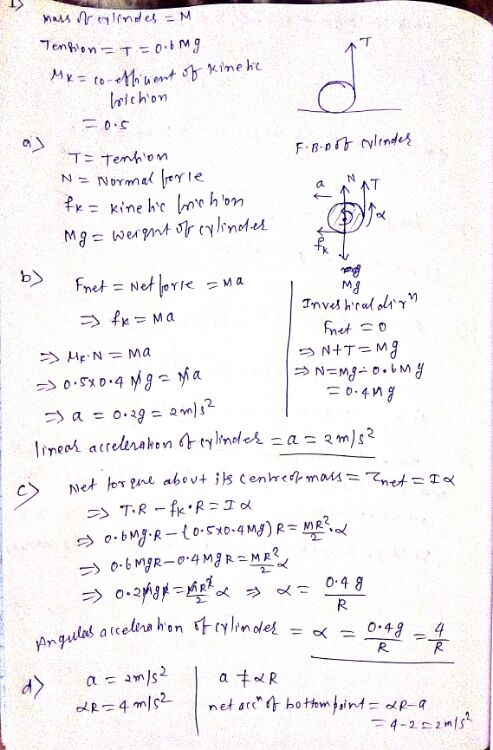
1977M2. A uniform cylinder of mass M, and radius R is initially at rest on a...
A flywheel (a uniform solid cylinder of radius 0.25 m and mass 80 kg) is initially...
A flywheel (a uniform solid cylinder of radius 0.25 m and mass 80 kg) is initially at rest, but free to rotate about the axis through its center. A belt wrapped around it is pulled off horizontally, providing a tangential force of 45 N to the outer rim of the flywheel for 2.00 s. Calculate the final kinetic energy of the wheel.
Q7 (15 points): A solid cylinder of mass 5 kg and radius R 0.15 m rolls...
 Q7 (15 points): A solid cylinder of mass 5 kg and radius R 0.15 m rolls without slipping on a horizontal surface and is accelerated to the right by a constant force F of magnitude 6 N that is applied at the cylinder by a massless rope as shown in the below figure. Find a) the magnitude of the acceleration of the center of mass of the cylinder, b) the magnitude of the angular acceleration of the cylinder about the...
6. A 25-kg solid cylinder with a radius of 11 cm, initially at rest, is free...
 6. A 25-kg solid cylinder with a radius of 11 cm, initially at rest, is free to rotate about the axis of the cylinder. A rope of negligible mass is wrapped around it and pulled with a force of 17 N. Assuming that the rope does not slip, determine the following a) The torque exerted on the cylinder by the rope b) The angular acceleration of the cylinder c) The angular speed of the cylinder after 0.5 s
3. A merry-go-round (uniform disk) of mass M = 125 kg and radius R = 1.5...
 3. A merry-go-round (uniform disk) of mass M = 125 kg and radius R = 1.5 m is rotating initially wi = 12 rad/s. A person (we'll call the person a thin uniform rod) of mass m = 65 kg and height h= R initially stands over the rotation axis. The person decides to lie down with feet at the center and head at the outer edge (see figure). Since the person is a "thin rod', we can ignore the...
A uniform disc with mass M and radius R = 0.10 m is mounted on a...
 A uniform disc with mass M and radius R = 0.10 m is mounted on a frictionless, horizontal axle, as shown in the figure. The light cord wrapped around the disk is pulled so that it has a constant tension of T = 20.0 N. Starting from the rest, the disk performs a rotational motion with a constant angular acceleration a = 2 rad/s2 Find mass M of the disk. (Note that the moment of inertia of the disk is...
A 2.7-kg 12-cm-radius cylinder, initially at rest, is free to rotate about the axis of the...
A 2.7-kg 12-cm-radius cylinder, initially at rest, is free to rotate about the axis of the cylinder. A rope of negligible mass is wrapped around it and pulled with a force of 18 N. (a) Find the magnitude of the torque exerted by the rope. N · m (b) Find the angular acceleration of the cylinder. rad/s2 (c) Find the angular velocity of the cylinder at t = 0.70 s. rad/s
A non-uniform density cylinder has a radius R=6m. The rotational inertia of this cylinder can be...
A non-uniform density cylinder has a radius R=6m. The rotational inertia of this cylinder can be taken to be I=βMR2, where β is unknown and M is the mass of the cylinder. The cylinder is initially rotating with angular velocity ω0= 1.00rad/s, and is placed on a rough horizontal surface. The speed of the center of mass (CM) of the cylinder, as it is placed on the surface, is 0. The cylinder at first rolls and slips. Just as it...
A solid uniform cylinder of mass M and radius R is at rest in the center...
 A solid uniform cylinder of mass M and radius R is at rest in
the center on a flat slab of mass m and thickness d, which in turn
rests on a horizontal, frictionless table, as shown in the figure at
right below. A horizontal force of magnitude F is applied to the
slab, acting through the center of the slab, causing it to
accelerate to the right. The cylinder rolls without slipping on the
slab. (The direction of F...
A solid uniform cylinder of mass M and radius R is at rest in
the center on a flat slab of mass m and thickness d, which in turn
rests on a horizontal, frictionless table, as shown in the figure at
right below. A horizontal force of magnitude F is applied to the
slab, acting through the center of the slab, causing it to
accelerate to the right. The cylinder rolls without slipping on the
slab. (The direction of F...
A cylinder of radius 0.40 m and a mass of 12 kg has a string wound around it. The string is pulled off perpendicular to the radius, so that it doesn't slip while spooling off the cylinder, ma...
 A cylinder of radius 0.40 m and a mass of 12 kg has a string wound around it. The string is pulled off perpendicular to the radius, so that it doesn't slip while spooling off the cylinder, making the cylinder rotate around an axis through its center with a rotational acceleration of 0.60 rad/s. (The formula for the moment of rotational inertia for the cylinder in this situation is I-% mr, where "m" is the mass and "t" is the...
A cylinder with moment of inertia I about its center of mass, mass m, and radius r has a string wrapped around it whi...
 A cylinder with moment of inertia I about its center of mass, mass
m, and radius r has a string wrapped around it which is tied to the
ceiling (Figure 1) . The cylinder's vertical position as a function
of time is y(t).At time t=0 the cylinder is released from rest at a height h above
the ground.Part
BIn similar problems involving rotating bodies, you will often also
need the relationship between angular acceleration, ?, and linear acceleration, a. Find...
A cylinder with moment of inertia I about its center of mass, mass
m, and radius r has a string wrapped around it which is tied to the
ceiling (Figure 1) . The cylinder's vertical position as a function
of time is y(t).At time t=0 the cylinder is released from rest at a height h above
the ground.Part
BIn similar problems involving rotating bodies, you will often also
need the relationship between angular acceleration, ?, and linear acceleration, a. Find...
 Q7 (15 points): A solid cylinder of mass 5 kg and radius R 0.15 m rolls without slipping on a horizontal surface and is accelerated to the right by a constant force F of magnitude 6 N that is applied at the cylinder by a massless rope as shown in the below figure. Find a) the magnitude of the acceleration of the center of mass of the cylinder, b) the magnitude of the angular acceleration of the cylinder about the...
 6. A 25-kg solid cylinder with a radius of 11 cm, initially at rest, is free to rotate about the axis of the cylinder. A rope of negligible mass is wrapped around it and pulled with a force of 17 N. Assuming that the rope does not slip, determine the following a) The torque exerted on the cylinder by the rope b) The angular acceleration of the cylinder c) The angular speed of the cylinder after 0.5 s
 3. A merry-go-round (uniform disk) of mass M = 125 kg and radius R = 1.5 m is rotating initially wi = 12 rad/s. A person (we'll call the person a thin uniform rod) of mass m = 65 kg and height h= R initially stands over the rotation axis. The person decides to lie down with feet at the center and head at the outer edge (see figure). Since the person is a "thin rod', we can ignore the...
 A uniform disc with mass M and radius R = 0.10 m is mounted on a frictionless, horizontal axle, as shown in the figure. The light cord wrapped around the disk is pulled so that it has a constant tension of T = 20.0 N. Starting from the rest, the disk performs a rotational motion with a constant angular acceleration a = 2 rad/s2 Find mass M of the disk. (Note that the moment of inertia of the disk is...
 A solid uniform cylinder of mass M and radius R is at rest in
the center on a flat slab of mass m and thickness d, which in turn
rests on a horizontal, frictionless table, as shown in the figure at
right below. A horizontal force of magnitude F is applied to the
slab, acting through the center of the slab, causing it to
accelerate to the right. The cylinder rolls without slipping on the
slab. (The direction of F...
A solid uniform cylinder of mass M and radius R is at rest in
the center on a flat slab of mass m and thickness d, which in turn
rests on a horizontal, frictionless table, as shown in the figure at
right below. A horizontal force of magnitude F is applied to the
slab, acting through the center of the slab, causing it to
accelerate to the right. The cylinder rolls without slipping on the
slab. (The direction of F...
 A cylinder of radius 0.40 m and a mass of 12 kg has a string wound around it. The string is pulled off perpendicular to the radius, so that it doesn't slip while spooling off the cylinder, making the cylinder rotate around an axis through its center with a rotational acceleration of 0.60 rad/s. (The formula for the moment of rotational inertia for the cylinder in this situation is I-% mr, where "m" is the mass and "t" is the...
 A cylinder with moment of inertia I about its center of mass, mass
m, and radius r has a string wrapped around it which is tied to the
ceiling (Figure 1) . The cylinder's vertical position as a function
of time is y(t).At time t=0 the cylinder is released from rest at a height h above
the ground.Part
BIn similar problems involving rotating bodies, you will often also
need the relationship between angular acceleration, ?, and linear acceleration, a. Find...
A cylinder with moment of inertia I about its center of mass, mass
m, and radius r has a string wrapped around it which is tied to the
ceiling (Figure 1) . The cylinder's vertical position as a function
of time is y(t).At time t=0 the cylinder is released from rest at a height h above
the ground.Part
BIn similar problems involving rotating bodies, you will often also
need the relationship between angular acceleration, ?, and linear acceleration, a. Find...
Most questions answered within 3 hours.
-
Where is the error in this code sequence?
String s1 = "Hello";
String s2 = "ello";...
asked 11 months ago -
Financial data for Joel de Paris, Inc., for last year
follow:
Joel de Paris, Inc.
Balance...
asked 11 months ago -
Consider this reaction:
Al2(SO4)3 (aq)+ BaCl3
(aq) Al2Cl6 (aq)- +
3BaSO4(s) . What is the...
asked 11 months ago -
Suppose that Savneet is considering increasing her
recent random sample from 20 car rentals to 40...
asked 11 months ago -
Trucks arrive at an unloading terminal at an average rate of 120
per hour.
Trucks arrive...
asked 11 months ago -
Why are methanol and ethanol completely soluble in water while
octanol is not very little soluble....
asked 11 months ago -
A facilities manager at a university reads in a research report
that the mean amount of...
asked 11 months ago -
When the CuSO4 is rehydrated by adding water to the anhydrous
compound, is this an endothermic...
asked 11 months ago -
A ray of sunlight is passing from diamond into crown glass; the
angle of incidence is...
asked 11 months ago -
A block of mass 0.249 kg is placed on top of a light, vertical
spring of...
asked 11 months ago -
how do the kidneys compensate in the presences of acidosis
a) trigger hyperventilate
b) reserve acid...
asked 11 months ago -
Question 501 pts
The rental rate of capital to the firm increases. Which of the
following...
asked 11 months ago