
Homework Answers
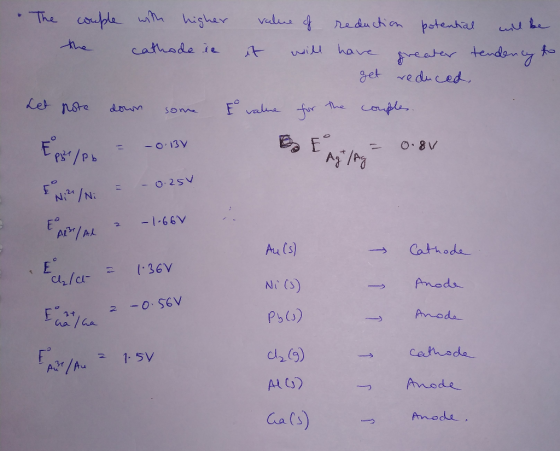
In case of any doubt please feel free to ask and comment down
below and please do rate if you found the answer helpful.
Thank you.
Add Answer to:
Assigned as Homeworko HQ18.07 If we make a voltaic cell having a Ag(s) strip as one...
A voltaic cell is constructed in which the anode is a Ag Ag half cell and...
 A voltaic cell is constructed in which the anode is a Ag Ag half cell and the cathode is a CI Cl2 half cell. The half-cell compartments are connected by a salt bridge. (Use the lowest possible coefficients. Use the pull-down boxes to specify states such as (aq) or (s). If a box is not needed, leave it blank.) The anode reaction is: The cathode reaction is: The net cell reaction is: the Ag Ag electrode. |the CIICl2 electrode In...
Consider a voltaic (galvanic) cell with the following metal electrodes. Identify which metal is the cathode...
 Consider a voltaic (galvanic) cell with the following metal electrodes. Identify which metal is the cathode and which is the anode, and calculate the cell potential. (Use the table of Standard Electrode Potentials.) (a) Ca(II) and Sc(III) Cathode: . Ca(II) Sc(III) Anode: Ca(II) Sc(III) Ecell = 0.0591 x V (b) Pb(II) and In(III) Cathode: . Pb(II) In(III) Anode: Pb(II) In(III) Ecell - (c) Ni(II) and Zr(IV) Cathode: NI(II) Zr(IV) Anode: Ni(II) Zr(IV) Ecell - V Supporting Materials Periodic Table Supplemental...
Folder# Grade 1. In the voltaic cell shown below, the electrons flow from Zn(s)|Zn²+ (aq)|| Cu"...
 Folder# Grade 1. In the voltaic cell shown below, the electrons flow from Zn(s)|Zn²+ (aq)|| Cu" (aq)|Cu(s) Cu(s) (a) Cu(s) ® Zn(s) (b) Zn(s) (c) Zn(s) ® cu (d) Cut ® Zn(s) 2. Which of the following statements about the voltaic cell shown below is correct? Zn(s)[Zn** (aq)|| Cu** (aq) Cu(s) (a) Oxidation takes place at the cathode and reduction takes place at the anode. (b) Oxidation takes place at both the cathode and the anode. (c) Reduction takes place...
A voltaic cell is constructed in which the following cellreaction occurs. The half-cell compartments are...
A voltaic cell is constructed in which the following cell reaction occurs. The half-cell compartments are connected by a salt bridge.Cl2(g) +Mg(s) ----------> 2Cl-(aq)+ Mg2+(aq)The anode reaction (including states) is:The cathode reaction (including states) is:In the external circuit, electrons migrate _____fromto the Mg|Mg2+ electrode _____fromto the Cl-|Cl2 electrode.In the salt bridge, anions migrate _____fromto the Cl-|Cl2 compartment _____fromto the Mg|Mg2+compartment.
A voltaic cell is constructed in which the following cell reaction occurs. The half-cell compartments are...
A voltaic cell is constructed in which the following cell reaction occurs. The half-cell compartments are connected by a salt bridge. 3Cl2(g) + 2Al(s) 6Cl-(aq) + 2Al3+(aq) The anode reaction is: _____+ _____+_____ The cathode reaction is:_____ +_____ +_____ In the external circuit, electrons migrate_____ the Al|Al3+ electrode_____ the Cl-|Cl2 electrode. In the salt bridge, anions migrate_____the Cl-|Cl2 compartment____ the Al|Al3+ compartment.
Part A Consider a voltaic cell that is set up as follows: Anode contains an Zn(s) electrode and 1M Zn2+(aq) Cathode cont...
Part A Consider a voltaic cell that is set up as follows: Anode contains an Zn(s) electrode and 1M Zn2+(aq) Cathode contains a Pt(s) electrode and 1M MnO4–(aq),Mn2+(aq), and H+(aq) Which of the following statements match the cathode? Select all that apply. Group of answer choices The electrode increases in mass Oxidation occurs at this half-cell Electrons enter the half-cell The electrode is inactive Cations from the salt-bridge move to this half-cell The electrode is negative Part B Which of...
For a voltaic cell based on the reaction below, what reaction happens at the anode? 2Ni3+(aq)+Cd(s)→2Ni2+(s)+Cd2+(aq)...
For a voltaic cell based on the reaction below, what reaction happens at the anode? 2Ni3+(aq)+Cd(s)→2Ni2+(s)+Cd2+(aq) Ni3+(aq)+e-→Ni2+(aq) Ni2+(aq)→ Ni3+(aq)+e- Cd2+(aq)+2e-→Cd(s) Cd(s)→Cd2+(aq)+2e- A student measures the voltage across different metal electrodes placed in a voltaic cell. Using a copper cathode, the voltages when using a first a tin, then gold anode are positive and negative, respectively. The order of chemical reactivity of the solid metals must be Au>Cu>Sn Au=Sn Sn>Cu>Au Au=Sn>Cu
A voltaic cell is constructed in which the following cell reaction occurs. The half-cell compartments are...
 A voltaic cell is constructed in which the following cell reaction occurs. The half-cell compartments are connected by a salt bridge. F2(g) + 28°(aq) — 2F (aq) + 12(s) The anode reaction is: The cathode reaction is: In the external circuit, electrons migrate the I'l, electrode the FF, electrode. In the salt bridge, anions migrate the FF, compartment the l'I, compartment. A voltaic cell is constructed in which the following cell reaction occurs. The half-cell compartments are connected by a...
Consider a voltaic (galvanic) cell with the following metal electrodes. Identify which metal is the cathode and which i...
 Consider a voltaic (galvanic) cell with the following metal electrodes. Identify which metal is the cathode and which is the anode, and calculate the cell potential. (Use the table of Standard Electrode Potentials.) (a) Cd(II) and Sc(III) Cathode: Cd(II) Sc(III) Anode: Cd(II) Sc(III) Ecell 42 (b) Pb(II) and In(III) Cathode: Pb(II) In(III) Anode: Pb(II) In(III) Ecell - (c) Ni(II) and Zr(IV) Cathode: Ni(II) Zr(IV) Anode: Ni(II) Zr(IV) Ecell- Supporting Materials We were unable to transcribe this imageAGº and Eº can...
In a copper-zinc voltaic cell, one half-cell consists of a ZnZn electrode inserted in a solution...
 In a copper-zinc voltaic cell, one half-cell consists of a ZnZn
electrode inserted in a solution of zinc sulfate and the other
half-cell consists of a CuCu electrode inserted in a copper sulfate
solution. These two half-cells are separated by a salt bridge.
At the zinc electrode (anode), ZnZn metal undergoes oxidation by
losing two electrons and enters the solution as Zn2+Zn2+ ions. The
oxidation half-cell reaction that takes place at the anode is
Zn(s)→Zn2+(aq)+2e−Zn(s)→Zn2+(aq)+2e−
The CuCu ions undergo reduction...
In a copper-zinc voltaic cell, one half-cell consists of a ZnZn
electrode inserted in a solution of zinc sulfate and the other
half-cell consists of a CuCu electrode inserted in a copper sulfate
solution. These two half-cells are separated by a salt bridge.
At the zinc electrode (anode), ZnZn metal undergoes oxidation by
losing two electrons and enters the solution as Zn2+Zn2+ ions. The
oxidation half-cell reaction that takes place at the anode is
Zn(s)→Zn2+(aq)+2e−Zn(s)→Zn2+(aq)+2e−
The CuCu ions undergo reduction...
 A voltaic cell is constructed in which the anode is a Ag Ag half cell and the cathode is a CI Cl2 half cell. The half-cell compartments are connected by a salt bridge. (Use the lowest possible coefficients. Use the pull-down boxes to specify states such as (aq) or (s). If a box is not needed, leave it blank.) The anode reaction is: The cathode reaction is: The net cell reaction is: the Ag Ag electrode. |the CIICl2 electrode In...
 Consider a voltaic (galvanic) cell with the following metal electrodes. Identify which metal is the cathode and which is the anode, and calculate the cell potential. (Use the table of Standard Electrode Potentials.) (a) Ca(II) and Sc(III) Cathode: . Ca(II) Sc(III) Anode: Ca(II) Sc(III) Ecell = 0.0591 x V (b) Pb(II) and In(III) Cathode: . Pb(II) In(III) Anode: Pb(II) In(III) Ecell - (c) Ni(II) and Zr(IV) Cathode: NI(II) Zr(IV) Anode: Ni(II) Zr(IV) Ecell - V Supporting Materials Periodic Table Supplemental...
 Folder# Grade 1. In the voltaic cell shown below, the electrons flow from Zn(s)|Zn²+ (aq)|| Cu" (aq)|Cu(s) Cu(s) (a) Cu(s) ® Zn(s) (b) Zn(s) (c) Zn(s) ® cu (d) Cut ® Zn(s) 2. Which of the following statements about the voltaic cell shown below is correct? Zn(s)[Zn** (aq)|| Cu** (aq) Cu(s) (a) Oxidation takes place at the cathode and reduction takes place at the anode. (b) Oxidation takes place at both the cathode and the anode. (c) Reduction takes place...
 A voltaic cell is constructed in which the following cell reaction occurs. The half-cell compartments are connected by a salt bridge. F2(g) + 28°(aq) — 2F (aq) + 12(s) The anode reaction is: The cathode reaction is: In the external circuit, electrons migrate the I'l, electrode the FF, electrode. In the salt bridge, anions migrate the FF, compartment the l'I, compartment. A voltaic cell is constructed in which the following cell reaction occurs. The half-cell compartments are connected by a...
 Consider a voltaic (galvanic) cell with the following metal electrodes. Identify which metal is the cathode and which is the anode, and calculate the cell potential. (Use the table of Standard Electrode Potentials.) (a) Cd(II) and Sc(III) Cathode: Cd(II) Sc(III) Anode: Cd(II) Sc(III) Ecell 42 (b) Pb(II) and In(III) Cathode: Pb(II) In(III) Anode: Pb(II) In(III) Ecell - (c) Ni(II) and Zr(IV) Cathode: Ni(II) Zr(IV) Anode: Ni(II) Zr(IV) Ecell- Supporting Materials We were unable to transcribe this imageAGº and Eº can...
 In a copper-zinc voltaic cell, one half-cell consists of a ZnZn
electrode inserted in a solution of zinc sulfate and the other
half-cell consists of a CuCu electrode inserted in a copper sulfate
solution. These two half-cells are separated by a salt bridge.
At the zinc electrode (anode), ZnZn metal undergoes oxidation by
losing two electrons and enters the solution as Zn2+Zn2+ ions. The
oxidation half-cell reaction that takes place at the anode is
Zn(s)→Zn2+(aq)+2e−Zn(s)→Zn2+(aq)+2e−
The CuCu ions undergo reduction...
In a copper-zinc voltaic cell, one half-cell consists of a ZnZn
electrode inserted in a solution of zinc sulfate and the other
half-cell consists of a CuCu electrode inserted in a copper sulfate
solution. These two half-cells are separated by a salt bridge.
At the zinc electrode (anode), ZnZn metal undergoes oxidation by
losing two electrons and enters the solution as Zn2+Zn2+ ions. The
oxidation half-cell reaction that takes place at the anode is
Zn(s)→Zn2+(aq)+2e−Zn(s)→Zn2+(aq)+2e−
The CuCu ions undergo reduction...
Most questions answered within 3 hours.
-
Where is the error in this code sequence?
String s1 = "Hello";
String s2 = "ello";...
asked 10 months ago -
Financial data for Joel de Paris, Inc., for last year
follow:
Joel de Paris, Inc.
Balance...
asked 10 months ago -
Consider this reaction:
Al2(SO4)3 (aq)+ BaCl3
(aq) Al2Cl6 (aq)- +
3BaSO4(s) . What is the...
asked 10 months ago -
Suppose that Savneet is considering increasing her
recent random sample from 20 car rentals to 40...
asked 10 months ago -
Trucks arrive at an unloading terminal at an average rate of 120
per hour.
Trucks arrive...
asked 10 months ago -
Why are methanol and ethanol completely soluble in water while
octanol is not very little soluble....
asked 10 months ago -
A facilities manager at a university reads in a research report
that the mean amount of...
asked 10 months ago -
When the CuSO4 is rehydrated by adding water to the anhydrous
compound, is this an endothermic...
asked 10 months ago -
A ray of sunlight is passing from diamond into crown glass; the
angle of incidence is...
asked 10 months ago -
A block of mass 0.249 kg is placed on top of a light, vertical
spring of...
asked 10 months ago -
how do the kidneys compensate in the presences of acidosis
a) trigger hyperventilate
b) reserve acid...
asked 10 months ago -
Question 501 pts
The rental rate of capital to the firm increases. Which of the
following...
asked 10 months ago