
Homework Answers
Add Answer to:
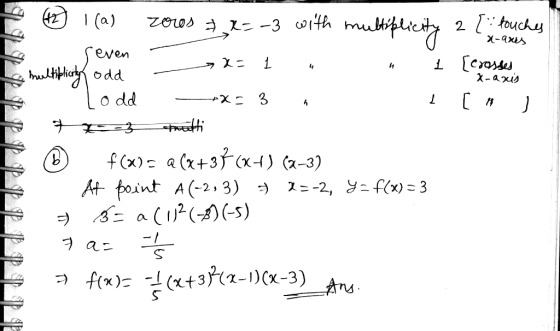
1. Given the graph below: a. Find all possible zeros. Indicate whether the zeros are odd...
Given the graph of a polynomial function, determine the minimum possible degree, the zeros and if...
 Given the graph of a polynomial function, determine the minimum possible degree, the zeros and if the multiplicity of the zeros is even or odd. Assume the end behavior and all turning points are represented on the graph. གནད་ a. Determine the minimum degree of the polynomial based on the number of turning points. b. Approximate the real zeros of the function, and determine if their multiplicity is odd or even O a. Minimum degree 4 b. -4 (even multiplicity),...
Determine if the graph can represent a polynomial function. If so, assume the end behavior and...
 Determine if the graph can represent a polynomial function. If so, assume the end behavior and all turning points are represented on the graph. 7) 7) - 4+ 3+ a. Determine the minimum degree of the polynomial based on the number of tuming points. b. Determine whether the leading coefficient is positive or negative based on the end behavior and whether the degree of the polynomial is odd or even. c. Approximate the real zeros of the function, and determine...
Determine if the graph can represent a polynomial function. If so, assume the end behavior and...
 Determine if the graph can represent a polynomial function. If so, assume the end behavior and all turning points are represented on the graph 7) 7) 2 a. Determine the minimum degree of the polynomial based on the number of turning points. b. Determine whether the leading coefficient is positive or negative based on the end behavior and whether the degree of the polynomial is odd or even c. Approximate the real zeros of the function, and determine if their...
For each graph fill out thebchart by identifying the zeros and linear factorization. Determine the degree,...
 For
each graph fill out thebchart by identifying the zeros and linear
factorization. Determine the degree, number of turning points, and
describe the end behaviors. Determine if the leading coefficient is
positive or negative and find the multiplicity of each zero. The
graphs are in incriments of one.
Section 5.3 and 5.4 1. For each graph fill out the chart by identifying the zeros and linear factorization. Determine the degree, number of turning points, and describe the end behaviors. Determine...
For
each graph fill out thebchart by identifying the zeros and linear
factorization. Determine the degree, number of turning points, and
describe the end behaviors. Determine if the leading coefficient is
positive or negative and find the multiplicity of each zero. The
graphs are in incriments of one.
Section 5.3 and 5.4 1. For each graph fill out the chart by identifying the zeros and linear factorization. Determine the degree, number of turning points, and describe the end behaviors. Determine...
8) 8) 41 3+ 2+ + 3-4-5 org 2+ 3+ 4+ a. Determine the minimum degree...
 8) 8) 41 3+ 2+ + 3-4-5 org 2+ 3+ 4+ a. Determine the minimum degree of the polynomial based on the number of turning points. b. Determine whether the leading coefficient is positive or negative based on the end behavior and whether the degree of the polynomial is odd or even. c. Approximate the real zeros of the function, and determine if their multiplicity is odd or even. A) a. Minimum degree 2 b. Lending coefficient positive degree even...
Form a polynomial whose zeros and degree are given. Zeros: 3, multiplicity 1; 1, multiplicity 2;...
 Form a polynomial whose zeros and degree are given. Zeros: 3, multiplicity 1; 1, multiplicity 2; degree 3 Type a polynomial with integer coefficients and a leading coefficient of 1 in the box below. f(x) = x2 - 7x² +21x – 18 (Simplify your answer.)
Consider the following. g(x) = 3x(x2 - 4x – 2) (a) Find all real zeros of...
 Consider the following. g(x) = 3x(x2 - 4x – 2) (a) Find all real zeros of the polynomial function. (Enter your answers as a comma-separated list. If there is no solution, enter NO SOLUTION.) 0, x= 2 +V6 , x = 2 – V6 x X = (b) Determine whether the multiplicity of each zero is even or odd. smallest x-value even multiplicity even multiplicity largest x-value even multiplicity (c) Determine the maximum possible number of turning points of the...
Given f (x) = x4 + 5x3 – 24x2, find all real zeros off and determine...
 Given f (x) = x4 + 5x3 – 24x2, find all real zeros off and determine whether the multiplicity of each zero is even or odd. Then determine the maximum number of turning points of the graph off.
Q2 4 Points For questions 2.1 and 2.2, find and graph a polynomial function with the...
 Q2 4 Points For questions 2.1 and 2.2, find and graph a polynomial function with the given zeros, multiplicities, and degree. (There are many correct answers.) Zero: -3, multiplicity: 1 Zero: 1, multiplicity: 3 Degree 4 Rises to the right Rises to the left Q2.1 2 Points Write the function definition. Leave your answer in factored form. You do not have to multiply it out. f(x) = (type your answer below or upload a picture) N Enter your answer here...
What does the graph of the polynomial function tell you about the (A) sign of the...
 What does the graph of the polynomial function tell you about the (A) sign of the leading coefficient, (B) the degree of the function, and (C) the number of real zeros? Explain your answers! A. OThe sign of the leading coefficient is negative because the end behavior is from an equation of odd degree and negative leading coefficient OThe sign of the leading coefficient is positive because the end behavior is from an equation of odd degree and positive leading...
 Given the graph of a polynomial function, determine the minimum possible degree, the zeros and if the multiplicity of the zeros is even or odd. Assume the end behavior and all turning points are represented on the graph. གནད་ a. Determine the minimum degree of the polynomial based on the number of turning points. b. Approximate the real zeros of the function, and determine if their multiplicity is odd or even O a. Minimum degree 4 b. -4 (even multiplicity),...
 Determine if the graph can represent a polynomial function. If so, assume the end behavior and all turning points are represented on the graph. 7) 7) - 4+ 3+ a. Determine the minimum degree of the polynomial based on the number of tuming points. b. Determine whether the leading coefficient is positive or negative based on the end behavior and whether the degree of the polynomial is odd or even. c. Approximate the real zeros of the function, and determine...
 Determine if the graph can represent a polynomial function. If so, assume the end behavior and all turning points are represented on the graph 7) 7) 2 a. Determine the minimum degree of the polynomial based on the number of turning points. b. Determine whether the leading coefficient is positive or negative based on the end behavior and whether the degree of the polynomial is odd or even c. Approximate the real zeros of the function, and determine if their...
 For
each graph fill out thebchart by identifying the zeros and linear
factorization. Determine the degree, number of turning points, and
describe the end behaviors. Determine if the leading coefficient is
positive or negative and find the multiplicity of each zero. The
graphs are in incriments of one.
Section 5.3 and 5.4 1. For each graph fill out the chart by identifying the zeros and linear factorization. Determine the degree, number of turning points, and describe the end behaviors. Determine...
For
each graph fill out thebchart by identifying the zeros and linear
factorization. Determine the degree, number of turning points, and
describe the end behaviors. Determine if the leading coefficient is
positive or negative and find the multiplicity of each zero. The
graphs are in incriments of one.
Section 5.3 and 5.4 1. For each graph fill out the chart by identifying the zeros and linear factorization. Determine the degree, number of turning points, and describe the end behaviors. Determine...
 8) 8) 41 3+ 2+ + 3-4-5 org 2+ 3+ 4+ a. Determine the minimum degree of the polynomial based on the number of turning points. b. Determine whether the leading coefficient is positive or negative based on the end behavior and whether the degree of the polynomial is odd or even. c. Approximate the real zeros of the function, and determine if their multiplicity is odd or even. A) a. Minimum degree 2 b. Lending coefficient positive degree even...
 Form a polynomial whose zeros and degree are given. Zeros: 3, multiplicity 1; 1, multiplicity 2; degree 3 Type a polynomial with integer coefficients and a leading coefficient of 1 in the box below. f(x) = x2 - 7x² +21x – 18 (Simplify your answer.)
 Consider the following. g(x) = 3x(x2 - 4x – 2) (a) Find all real zeros of the polynomial function. (Enter your answers as a comma-separated list. If there is no solution, enter NO SOLUTION.) 0, x= 2 +V6 , x = 2 – V6 x X = (b) Determine whether the multiplicity of each zero is even or odd. smallest x-value even multiplicity even multiplicity largest x-value even multiplicity (c) Determine the maximum possible number of turning points of the...
 Given f (x) = x4 + 5x3 – 24x2, find all real zeros off and determine whether the multiplicity of each zero is even or odd. Then determine the maximum number of turning points of the graph off.
 Q2 4 Points For questions 2.1 and 2.2, find and graph a polynomial function with the given zeros, multiplicities, and degree. (There are many correct answers.) Zero: -3, multiplicity: 1 Zero: 1, multiplicity: 3 Degree 4 Rises to the right Rises to the left Q2.1 2 Points Write the function definition. Leave your answer in factored form. You do not have to multiply it out. f(x) = (type your answer below or upload a picture) N Enter your answer here...
 What does the graph of the polynomial function tell you about the (A) sign of the leading coefficient, (B) the degree of the function, and (C) the number of real zeros? Explain your answers! A. OThe sign of the leading coefficient is negative because the end behavior is from an equation of odd degree and negative leading coefficient OThe sign of the leading coefficient is positive because the end behavior is from an equation of odd degree and positive leading...
Most questions answered within 3 hours.
-
Where is the error in this code sequence?
String s1 = "Hello";
String s2 = "ello";...
asked 10 months ago -
Financial data for Joel de Paris, Inc., for last year
follow:
Joel de Paris, Inc.
Balance...
asked 10 months ago -
Consider this reaction:
Al2(SO4)3 (aq)+ BaCl3
(aq) Al2Cl6 (aq)- +
3BaSO4(s) . What is the...
asked 10 months ago -
Suppose that Savneet is considering increasing her
recent random sample from 20 car rentals to 40...
asked 10 months ago -
Trucks arrive at an unloading terminal at an average rate of 120
per hour.
Trucks arrive...
asked 10 months ago -
Why are methanol and ethanol completely soluble in water while
octanol is not very little soluble....
asked 10 months ago -
A facilities manager at a university reads in a research report
that the mean amount of...
asked 10 months ago -
When the CuSO4 is rehydrated by adding water to the anhydrous
compound, is this an endothermic...
asked 10 months ago -
A ray of sunlight is passing from diamond into crown glass; the
angle of incidence is...
asked 10 months ago -
A block of mass 0.249 kg is placed on top of a light, vertical
spring of...
asked 10 months ago -
how do the kidneys compensate in the presences of acidosis
a) trigger hyperventilate
b) reserve acid...
asked 10 months ago -
Question 501 pts
The rental rate of capital to the firm increases. Which of the
following...
asked 10 months ago