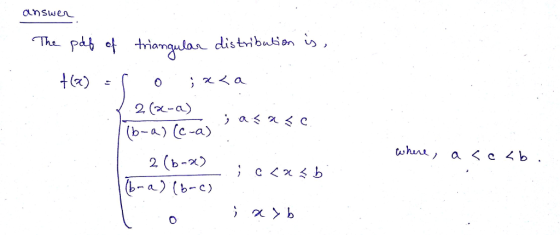
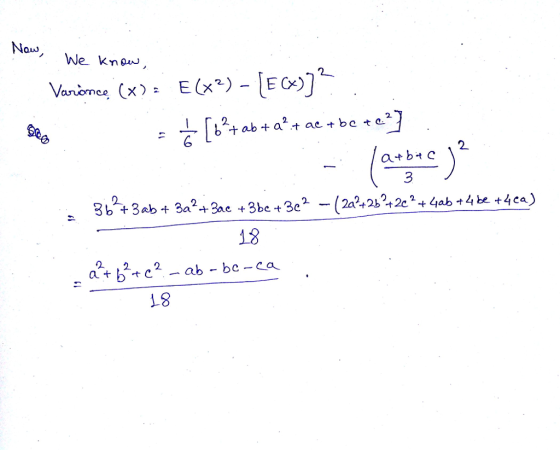
1. Determine the Variance V(X) of the triangular distrbution.
1. Determine the Variance V(X) of the triangular distrbution.
Homework Answers
![2 (x-a) , χ , 2 (6-2) (b-a) ( b-cj 2 23 (b-a)(c-a) (b-a)(b-c) [2e2.ac-aj + [b2+be-2e2] 3 (b-a) 3 (b-a) 3 2 2 b-x) (b-a) (c-a)](http://img.homeworklib.com/questions/4c959830-c7e1-11eb-9f53-ed76cac48099.png?x-oss-process=image/resize,w_560)
СТ 5. The triangular distribution has pdf 0<<1 f(x) = (2-2) 1<x<2. It is the sum...
 СТ 5. The triangular distribution has pdf 0<<1 f(x) = (2-2) 1<x<2. It is the sum of two independent uniform(0.1) random variables. (a) Find c so that f(x) is a density function. (b) Draw the pdf, and derive the cdf using simple geometry. (c) Derive the cdf from its definition. (d) Derive the mean and variance of a random variable with this distribution.
c. Let X~Ber(p), i.e. , ? = 0,1. Derive the variance V(X). px (I) = p'(1...
 c. Let X~Ber(p), i.e.
, ? = 0,1. Derive the variance V(X).
px (I) = p'(1 - p)1-1
c. Let X~Ber(p), i.e.
, ? = 0,1. Derive the variance V(X).
px (I) = p'(1 - p)1-1
E = "Expected Value" V = "Variance" 0 < x < 00, x < y <...
 E = "Expected Value"
V = "Variance"
0 < x < 00, x < y < oo IS joint probability density function a) Compute the probability that X < 1 and Y < 2. b) Find E(X) c) Find E(Y d) Find V(X) e) Find V(Y)
E = "Expected Value"
V = "Variance"
0 < x < 00, x < y < oo IS joint probability density function a) Compute the probability that X < 1 and Y < 2. b) Find E(X) c) Find E(Y d) Find V(X) e) Find V(Y)
) Use the theorem on triangular matrices, to determine the deter minant of the matrix (it...
 ) Use the theorem on triangular matrices, to determine the deter minant of the matrix (it is a one liner): (e) Use the theorem on triangular matrices, to determine the deter- minant of the matrix (it is a one liner) 2 3 4 A=1031 0 0 1 (f) Use the theorem on triangular matrices, to determine the deter- minant of the matrix (it is a one liner) 3 4
(1) Consider the solid S described below. The base of S is the triangular region with...
(1) Consider the solid S described below. The base of S is the triangular region with vertices (0, 0), (3, 0), and (0, 3). Cross-sections perpendicular to the y-axis are equilateral triangles. Find the volume V of this solid. V = (2)Consider the solid S described below. The base of S is the triangular region with vertices (0, 0), (1, 0), and (0, 1). Cross-sections perpendicular to the x-axis are squares. Find the volume V of this solid. V =...
1. (This tests Corollary 1 on page 35 of your book.) A triangular prism is placed...
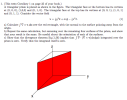 1. (This tests Corollary 1 on page 35 of your book.) A triangular prism is placed as shown in the figure. The triangular face at the bottom has its vertices at (0, 0, 0), (1,0,0) and (0,1,0. The triangular face at the top has its vertices at (0, 0,1), (1, 0, 1) and (0, 1, 1). Consider the vector field a) Calculate V x v.da over the red rectangle, with the normal to the surface pointing away from the origin...
Determine the volumes in mm of the solids generated by revolving triangular plate ABC (shown) one...
 Determine the volumes in mm of the solids generated by revolving triangular plate ABC (shown) one revolution about the following axes. 250 mm С 300 mm 200 mm 750 mm (a) the x-axis 3 mm (b) the y-axis mm3 Determine the surface area in in- and the volume in in of the body of revolution obtained by revolving the blue square one revolution about the a-a-axis. 76 2.2 in in 2 V- in
The table below shows the probability distribution of X. Find V(X), that is, the variance of...
The table below shows the probability distribution of X. Find V(X), that is, the variance of X, to three decimal places. x P(X = x) -1 0.08 2 0.1 6 0.3 10 0.52 Please help I am not sure where to begin and how to solve. This is a business analysis 2372 homework problem I got wrong and guessed on.
Consider the following pmf: p(x)- .25 for x - 1, 2, 3, 4 Determine the variance...
 Consider the following pmf: p(x)- .25 for x - 1, 2, 3, 4 Determine the variance of the random variable, X. C. 15/12 O infinity 8/12 O9/12
Find the Fourier Transform of the triangular pulse _(1 + t for -1<t < 0 x(t)...
 Find the Fourier Transform of the triangular pulse _(1 + t for -1<t < 0 x(t) = (1 - t for 0 <t<1
 СТ 5. The triangular distribution has pdf 0<<1 f(x) = (2-2) 1<x<2. It is the sum of two independent uniform(0.1) random variables. (a) Find c so that f(x) is a density function. (b) Draw the pdf, and derive the cdf using simple geometry. (c) Derive the cdf from its definition. (d) Derive the mean and variance of a random variable with this distribution.
 c. Let X~Ber(p), i.e.
, ? = 0,1. Derive the variance V(X).
px (I) = p'(1 - p)1-1
c. Let X~Ber(p), i.e.
, ? = 0,1. Derive the variance V(X).
px (I) = p'(1 - p)1-1
 E = "Expected Value"
V = "Variance"
0 < x < 00, x < y < oo IS joint probability density function a) Compute the probability that X < 1 and Y < 2. b) Find E(X) c) Find E(Y d) Find V(X) e) Find V(Y)
E = "Expected Value"
V = "Variance"
0 < x < 00, x < y < oo IS joint probability density function a) Compute the probability that X < 1 and Y < 2. b) Find E(X) c) Find E(Y d) Find V(X) e) Find V(Y)
 ) Use the theorem on triangular matrices, to determine the deter minant of the matrix (it is a one liner): (e) Use the theorem on triangular matrices, to determine the deter- minant of the matrix (it is a one liner) 2 3 4 A=1031 0 0 1 (f) Use the theorem on triangular matrices, to determine the deter- minant of the matrix (it is a one liner) 3 4
 1. (This tests Corollary 1 on page 35 of your book.) A triangular prism is placed as shown in the figure. The triangular face at the bottom has its vertices at (0, 0, 0), (1,0,0) and (0,1,0. The triangular face at the top has its vertices at (0, 0,1), (1, 0, 1) and (0, 1, 1). Consider the vector field a) Calculate V x v.da over the red rectangle, with the normal to the surface pointing away from the origin...
 Determine the volumes in mm of the solids generated by revolving triangular plate ABC (shown) one revolution about the following axes. 250 mm С 300 mm 200 mm 750 mm (a) the x-axis 3 mm (b) the y-axis mm3 Determine the surface area in in- and the volume in in of the body of revolution obtained by revolving the blue square one revolution about the a-a-axis. 76 2.2 in in 2 V- in
 Consider the following pmf: p(x)- .25 for x - 1, 2, 3, 4 Determine the variance of the random variable, X. C. 15/12 O infinity 8/12 O9/12
 Find the Fourier Transform of the triangular pulse _(1 + t for -1<t < 0 x(t) = (1 - t for 0 <t<1
Most questions answered within 3 hours.
-
Where is the error in this code sequence?
String s1 = "Hello";
String s2 = "ello";...
asked 10 months ago -
Financial data for Joel de Paris, Inc., for last year
follow:
Joel de Paris, Inc.
Balance...
asked 10 months ago -
Consider this reaction:
Al2(SO4)3 (aq)+ BaCl3
(aq) Al2Cl6 (aq)- +
3BaSO4(s) . What is the...
asked 10 months ago -
Suppose that Savneet is considering increasing her
recent random sample from 20 car rentals to 40...
asked 10 months ago -
Trucks arrive at an unloading terminal at an average rate of 120
per hour.
Trucks arrive...
asked 10 months ago -
Why are methanol and ethanol completely soluble in water while
octanol is not very little soluble....
asked 10 months ago -
A facilities manager at a university reads in a research report
that the mean amount of...
asked 10 months ago -
When the CuSO4 is rehydrated by adding water to the anhydrous
compound, is this an endothermic...
asked 10 months ago -
A ray of sunlight is passing from diamond into crown glass; the
angle of incidence is...
asked 10 months ago -
A block of mass 0.249 kg is placed on top of a light, vertical
spring of...
asked 10 months ago -
how do the kidneys compensate in the presences of acidosis
a) trigger hyperventilate
b) reserve acid...
asked 10 months ago -
Question 501 pts
The rental rate of capital to the firm increases. Which of the
following...
asked 10 months ago