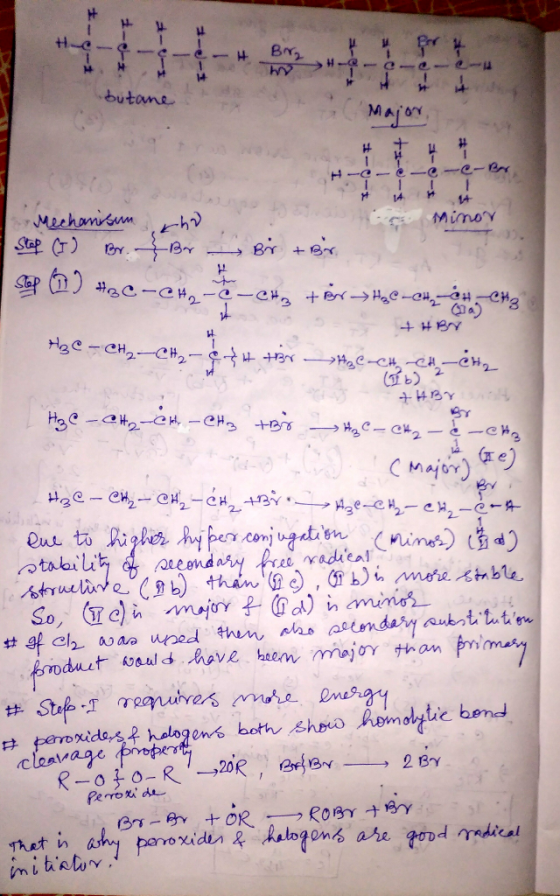
Draw the mechanism for the formation of bromobutane from butane and br2. what is the major...
Draw the mechanism for the formation of bromobutane from butane and br2. what is the major product? would your answer change if cl2 was used instead?
which step of the radical reaction typically requires the most energy?
why are peroxides and halogens good radical initiators?
Homework Answers
Add Answer to:
Draw the mechanism for the formation of bromobutane from butane
and br2. what is the major...
9. A two-step synthesis of compound A from butane is shown. Draw the structure of the...
 9. A two-step synthesis of compound A from butane is shown. Draw the structure of the product from the first step and provide a mechanism for its formation. Your mechanism must show all steps of the reaction. Br2 NaCN CN hv DMF Page 5
The reaction shown below yields one major addition product as a racemic mixture H2о Br2 CH3SOCH3...
 The reaction shown below yields one major addition product as a racemic mixture H2о Br2 CH3SOCH3 (DMSO) For the mechanism step below, draw curved arrows to show electron reorganization. Consider the formation of just one of the product stereoisomers Arrow-pushing Instructions Br Br Chlorine and bromine react in the dark with alkenes. The reaction shown below affords a single major product as a racemic mixture Cl2 For the mechanism step below, draw curved arrows to show electron reorganization. Consider the...
Devise a detailed mechanism for formation of the major product of the elimination reaction below.
 Devise a detailed mechanism for formation of the major product of the elimination reaction below. Draw curved arrows to show electron reorganization for the mechanism step below. Make the ends of your arrows specify the origin and destination of reorganizing electrons. Devise a detailed mechanism for formation of the major product of the elimination reaction below. Draw curved arrows to show electron reorganization for the mechanism step below. Make the ends of your arrows specify the origin and destination of reorganizing electrons. Devise a...
Draw curved arrows to show the movement of electrons in this step of the mechanism.
 Electrophilic addition of hypohalous acids to alkenes yields a 1,2-haloalcohol called a halohydrin. Halohydrin formation, however, does not result from the addition of HO-Br, for example. Instead the addition is done indirectly by reaction of the alkene with Br2 in the presence of water. The reaction also works with Cl2 to give chlorohydrins instead of bromohydrins. The reaction proceeds through a cyclic intermediate known as a bromonium ion. In the second step of the reaction, water is the nucleophile and reacts with the...
4. (5 pts) Draw a complete, step by step mechanism to account for the formation of...
 4. (5 pts) Draw a complete, step by step mechanism to account for the formation of following product. Draw all the resonance structures of the intermediate and indicate which one is the major resonance contributor. осна OCH3 Br2 FeBr3
Draw a complete arrow pushing mechanism for the acid catalyzed hydration of 3 methyl 1 butane....
 Draw a complete arrow pushing mechanism for the acid catalyzed hydration of 3 methyl 1 butane. Draw each step on a new line there are 4. Circle the final organic product of the reaction. Fill in each box with the best reagent to accomplish each trans formation:
5. Draw a complete reaction mechanism that describes the formation of ONLY the major product from...
 5. Draw a complete reaction mechanism that describes the formation of ONLY the major product from the reaction below. You must begin your mechanism by re-drawing the reactants. Use all proper arrow formalisms. Dic.com VOH VOH solvent MINOR MAJOR
3. Provide the major product of the reaction below and the mechanism of the formation of...
 3. Provide the major product of the reaction below and the mechanism of the formation of that product H20 35. Draw the most stable chair conformation of cis-3-methyl-cyclohexanol. sos 36. Draw the most stable chair conformation of trans-2-methylcyclohexanol.
Look up and draw the mechanism for the addition of Br2 to double bonds. Reference the...
 Look up and draw the mechanism for the addition of Br2 to
double bonds. Reference the source from which you acquired the
mechanism.
Give the IUPAC name of the major product in the above-mentioned
reaction.
Draw the major product of obtained in the addition of Br2 to
stilbene.
Is this isomer chiral? What would be the optical rotation if
this sample was placed in a polarimeter?
Would a student obtain the same product if you started with
cis-stilbene instead of...
Look up and draw the mechanism for the addition of Br2 to
double bonds. Reference the source from which you acquired the
mechanism.
Give the IUPAC name of the major product in the above-mentioned
reaction.
Draw the major product of obtained in the addition of Br2 to
stilbene.
Is this isomer chiral? What would be the optical rotation if
this sample was placed in a polarimeter?
Would a student obtain the same product if you started with
cis-stilbene instead of...
Devise a detailed mechanism for formation of the major product of the elimination reaction below.
 Devise a detailed mechanism for formation of the major product of the elimination reaction below. Draw curved arrows to show electron reorganization for the mechanism step below. Make the ends of your arrows specify the origin and destination of reorganizing electrons.
 9. A two-step synthesis of compound A from butane is shown. Draw the structure of the product from the first step and provide a mechanism for its formation. Your mechanism must show all steps of the reaction. Br2 NaCN CN hv DMF Page 5
 The reaction shown below yields one major addition product as a racemic mixture H2о Br2 CH3SOCH3 (DMSO) For the mechanism step below, draw curved arrows to show electron reorganization. Consider the formation of just one of the product stereoisomers Arrow-pushing Instructions Br Br Chlorine and bromine react in the dark with alkenes. The reaction shown below affords a single major product as a racemic mixture Cl2 For the mechanism step below, draw curved arrows to show electron reorganization. Consider the...
 4. (5 pts) Draw a complete, step by step mechanism to account for the formation of following product. Draw all the resonance structures of the intermediate and indicate which one is the major resonance contributor. осна OCH3 Br2 FeBr3
 Draw a complete arrow pushing mechanism for the acid catalyzed hydration of 3 methyl 1 butane. Draw each step on a new line there are 4. Circle the final organic product of the reaction. Fill in each box with the best reagent to accomplish each trans formation:
 5. Draw a complete reaction mechanism that describes the formation of ONLY the major product from the reaction below. You must begin your mechanism by re-drawing the reactants. Use all proper arrow formalisms. Dic.com VOH VOH solvent MINOR MAJOR
 3. Provide the major product of the reaction below and the mechanism of the formation of that product H20 35. Draw the most stable chair conformation of cis-3-methyl-cyclohexanol. sos 36. Draw the most stable chair conformation of trans-2-methylcyclohexanol.
 Look up and draw the mechanism for the addition of Br2 to
double bonds. Reference the source from which you acquired the
mechanism.
Give the IUPAC name of the major product in the above-mentioned
reaction.
Draw the major product of obtained in the addition of Br2 to
stilbene.
Is this isomer chiral? What would be the optical rotation if
this sample was placed in a polarimeter?
Would a student obtain the same product if you started with
cis-stilbene instead of...
Look up and draw the mechanism for the addition of Br2 to
double bonds. Reference the source from which you acquired the
mechanism.
Give the IUPAC name of the major product in the above-mentioned
reaction.
Draw the major product of obtained in the addition of Br2 to
stilbene.
Is this isomer chiral? What would be the optical rotation if
this sample was placed in a polarimeter?
Would a student obtain the same product if you started with
cis-stilbene instead of...
Most questions answered within 3 hours.
-
Where is the error in this code sequence?
String s1 = "Hello";
String s2 = "ello";...
asked 10 months ago -
Financial data for Joel de Paris, Inc., for last year
follow:
Joel de Paris, Inc.
Balance...
asked 10 months ago -
Consider this reaction:
Al2(SO4)3 (aq)+ BaCl3
(aq) Al2Cl6 (aq)- +
3BaSO4(s) . What is the...
asked 10 months ago -
Suppose that Savneet is considering increasing her
recent random sample from 20 car rentals to 40...
asked 10 months ago -
Trucks arrive at an unloading terminal at an average rate of 120
per hour.
Trucks arrive...
asked 10 months ago -
Why are methanol and ethanol completely soluble in water while
octanol is not very little soluble....
asked 10 months ago -
A facilities manager at a university reads in a research report
that the mean amount of...
asked 10 months ago -
When the CuSO4 is rehydrated by adding water to the anhydrous
compound, is this an endothermic...
asked 10 months ago -
A ray of sunlight is passing from diamond into crown glass; the
angle of incidence is...
asked 10 months ago -
A block of mass 0.249 kg is placed on top of a light, vertical
spring of...
asked 10 months ago -
how do the kidneys compensate in the presences of acidosis
a) trigger hyperventilate
b) reserve acid...
asked 10 months ago -
Question 501 pts
The rental rate of capital to the firm increases. Which of the
following...
asked 10 months ago