JAVA Assume that you are developing an Employee class with idNum, firstName, and lastName. – Now,...
JAVA
Assume that you are developing an Employee class with idNum, firstName, and lastName. – Now, you want to keep the Employee objects in an ArrayList. – Develop the correct equals() method of the Employee class.
Sample Run
1. Input a number: 100
2. Input a name: Tom
3. More items?(Y/N) y
4. Input a number: 200
5. Input a name: John
6. More items?(Y/N) n
7. The list contains:
8. 100 Tom
9. 200 John
10. Type the number and name to search
11. Number: 100
12. Name: Tom
13. 100 Tom is in the list
14. More search?(Y/N) n
15. Type the number and name to remove
16. Number: 100
17. Name: Tom
18. 100 Tom is removed from the list
19. The list contains:
20. 200 John
21. More remove?(Y/N) n
Homework Answers
Request Answer!
We need at least 10 more requests to produce the answer.
0 / 10 have requested this problem solution
The more requests, the faster the answer.
Add Answer to:
JAVA
Assume that you are developing an Employee class with idNum,
firstName, and lastName. – Now,...
In Java: Executable Class create an array of Employee objects. You can copy the array you...
In Java: Executable Class create an array of Employee objects. You can copy the array you made for Chapter 20. create an ArrayList of Employee objects from that array. use an enhanced for loop to print all employees as shown in the sample output. create a TreeMap that uses Strings for keys and Employees as values. this TreeMap should map Employee ID numbers to their associated Employees. process the ArrayList to add elements to this map. print all employees in...
in Java Create a custom class Employee with field like name , empNo and salary. a....
in Java Create a custom class Employee with field like name , empNo and salary. a. Create 5 objects b. Add all objects to ArrayList c. Print all employee details from ArrayList . d. Remove employee having salary less than 5000 $ [12] e. Insert a new employee object with more salary value at same index at which other object was removed. *
Create the Employee class: The Employee class has three attributes: private: string firstName; string lastName; string...
Create the Employee class: The Employee class has three attributes: private: string firstName; string lastName; string SSN; The Employee class has ▪ a no-arg constructor (a no-arg contructor is a contructor with an empty parameter list): In this no-arg constructor, use “unknown” to initialize all private attributes. ▪ a constructor with parameters for each of the attributes ▪ getter and setter methods for each of the private attributes ▪ a method getFullName() that returns the last name, followed by a...
Using Java: Question 2 (30 pts). Suppose that a class, Employee, is defined as follows: class...
 Using Java:
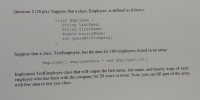
Question 2 (30 pts). Suppose that a class, Employee, is defined as follows: class Employeet String lastName; string firstName; double hourlywage; int yearsWithCompany; Suppose that a class, TestEmployee, has the data for 100 employees stored in an array: Employee[] employeeData Employee [ 100]; new Implement TestEmployee class that will output the first name, last name, and hourly wage of each employee who has been with the company for 20 years or more. Note: you can fill part of...
Using Java:
Question 2 (30 pts). Suppose that a class, Employee, is defined as follows: class Employeet String lastName; string firstName; double hourlywage; int yearsWithCompany; Suppose that a class, TestEmployee, has the data for 100 employees stored in an array: Employee[] employeeData Employee [ 100]; new Implement TestEmployee class that will output the first name, last name, and hourly wage of each employee who has been with the company for 20 years or more. Note: you can fill part of...
Part 1 Start by designing the Employee class Employee holds the following private attributes: a count...
Part 1 Start by designing the Employee class Employee holds the following private attributes: a count of employees (a static variable called NUM_EMP)* an employee’s last name an employee’s first name an employeeNumber (a String that is unique – that will use the NUM_EMP)* a department a jobTitle an annual salary (e.g., 45000). NOTE: *NUM_EMP should start off as zero and get updated every time a new Employee is created. The employeeNumber always starts with empl_ followed by the current...
QUESTION B1. (7 marks) This question assumes the following relational schema Employee (employeeNumber, lastName, firstName, DOB,...
 QUESTION B1. (7 marks) This question assumes the following relational schema Employee (employeeNumber, lastName, firstName, DOB, HireDate, Position Salary, Dept) Primary Key: employeeNumber Foreign key: Dept refers to DeptID in Department Department (DeptID, DeptName, DeptLocation) Primary Key: DeptID You have been given the following MySQL stored procedure: CREATE PROCEDURE Find_EmployeeName (IN employeeNo INT (11), OUT employeeName VARCHAR (60)) BEGIN SELECT concat(firstName, '', lastName) INTO employeeName FROM employees WHERE employeeNumber employeeNo; END (a) (2 marks) Name the two types of parameters...
----------------------------------- public class Customer { String firstName,lastName; //constructor public Customer(String firstName,String lastName) { this.firstName=firstName; this.lastName=lastName; }...
 -----------------------------------
public class Customer
{
String firstName,lastName;
//constructor
public Customer(String firstName,String lastName)
{
this.firstName=firstName;
this.lastName=lastName;
}
//override toString() method
public String toString()
{
return this.lastName+", "+this.firstName;
}
boolean equals(Customer obj)
{
if(this.firstName.equals(obj.firstName) &&
this.lastName.equals(obj.lastName))
return true;
else
return false;
}
}
-----------------------------------
public class Ingredient
{
String ingredientName;
int amount;
double price;
public Ingredient(String ingredientName,int amount,double
price)
{
this.ingredientName=ingredientName;
this.amount=amount;
this.price=price;
}
double getCost()
{
return amount/1000.0*price;
}
public String toString()
{
return this.ingredientName+", "+this.amount+" mls,
$"+this.price+"/L";
}
}
-----------------------------------...
-----------------------------------
public class Customer
{
String firstName,lastName;
//constructor
public Customer(String firstName,String lastName)
{
this.firstName=firstName;
this.lastName=lastName;
}
//override toString() method
public String toString()
{
return this.lastName+", "+this.firstName;
}
boolean equals(Customer obj)
{
if(this.firstName.equals(obj.firstName) &&
this.lastName.equals(obj.lastName))
return true;
else
return false;
}
}
-----------------------------------
public class Ingredient
{
String ingredientName;
int amount;
double price;
public Ingredient(String ingredientName,int amount,double
price)
{
this.ingredientName=ingredientName;
this.amount=amount;
this.price=price;
}
double getCost()
{
return amount/1000.0*price;
}
public String toString()
{
return this.ingredientName+", "+this.amount+" mls,
$"+this.price+"/L";
}
}
-----------------------------------...
Introduction In this lab, you will be working with three classes: Person, Student, and Roster. Person...
Introduction In this lab, you will be working with three classes: Person, Student, and Roster. Person and Student represent individuals with a first and last name as String class variables, and Student has an additional int class variable that represents a ID number. The Roster class represents a group of people that are objects of either the Person or Student class. It contains an ArrayList. The Person class has been completed for you with class variables, a constructor, and a...
In Java programming language Please write code for the 6 methods below: Assume that Student class...
In Java programming language Please write code for the 6 methods below: Assume that Student class has name, age, gpa, and major, constructor to initialize all data, method toString() to return string reresentation of student objects, getter methods to get age, major, and gpa, setter method to set age to given input, and method isHonors that returns boolean value true for honors students and false otherwise. 1) Write a method that accepts an array of student objects, and n, the...
Write a Java class named Employee to meet the requirements described in the UML Class Diagram...
 Write a Java class named Employee to meet the
requirements described in the UML Class Diagram below:
Note: Code added in the toString cell are not usually included
in a regular UML class diagram. This was added so you can
understand what I expect from you.
If your code compiles cleanly, is defined correctly and
functions exactly as required, the expected output of your program
will solve the following problem:
“An IT company with four departments and a staff strength...
Write a Java class named Employee to meet the
requirements described in the UML Class Diagram below:
Note: Code added in the toString cell are not usually included
in a regular UML class diagram. This was added so you can
understand what I expect from you.
If your code compiles cleanly, is defined correctly and
functions exactly as required, the expected output of your program
will solve the following problem:
“An IT company with four departments and a staff strength...
 Using Java:
Question 2 (30 pts). Suppose that a class, Employee, is defined as follows: class Employeet String lastName; string firstName; double hourlywage; int yearsWithCompany; Suppose that a class, TestEmployee, has the data for 100 employees stored in an array: Employee[] employeeData Employee [ 100]; new Implement TestEmployee class that will output the first name, last name, and hourly wage of each employee who has been with the company for 20 years or more. Note: you can fill part of...
Using Java:
Question 2 (30 pts). Suppose that a class, Employee, is defined as follows: class Employeet String lastName; string firstName; double hourlywage; int yearsWithCompany; Suppose that a class, TestEmployee, has the data for 100 employees stored in an array: Employee[] employeeData Employee [ 100]; new Implement TestEmployee class that will output the first name, last name, and hourly wage of each employee who has been with the company for 20 years or more. Note: you can fill part of...
 QUESTION B1. (7 marks) This question assumes the following relational schema Employee (employeeNumber, lastName, firstName, DOB, HireDate, Position Salary, Dept) Primary Key: employeeNumber Foreign key: Dept refers to DeptID in Department Department (DeptID, DeptName, DeptLocation) Primary Key: DeptID You have been given the following MySQL stored procedure: CREATE PROCEDURE Find_EmployeeName (IN employeeNo INT (11), OUT employeeName VARCHAR (60)) BEGIN SELECT concat(firstName, '', lastName) INTO employeeName FROM employees WHERE employeeNumber employeeNo; END (a) (2 marks) Name the two types of parameters...
 -----------------------------------
public class Customer
{
String firstName,lastName;
//constructor
public Customer(String firstName,String lastName)
{
this.firstName=firstName;
this.lastName=lastName;
}
//override toString() method
public String toString()
{
return this.lastName+", "+this.firstName;
}
boolean equals(Customer obj)
{
if(this.firstName.equals(obj.firstName) &&
this.lastName.equals(obj.lastName))
return true;
else
return false;
}
}
-----------------------------------
public class Ingredient
{
String ingredientName;
int amount;
double price;
public Ingredient(String ingredientName,int amount,double
price)
{
this.ingredientName=ingredientName;
this.amount=amount;
this.price=price;
}
double getCost()
{
return amount/1000.0*price;
}
public String toString()
{
return this.ingredientName+", "+this.amount+" mls,
$"+this.price+"/L";
}
}
-----------------------------------...
-----------------------------------
public class Customer
{
String firstName,lastName;
//constructor
public Customer(String firstName,String lastName)
{
this.firstName=firstName;
this.lastName=lastName;
}
//override toString() method
public String toString()
{
return this.lastName+", "+this.firstName;
}
boolean equals(Customer obj)
{
if(this.firstName.equals(obj.firstName) &&
this.lastName.equals(obj.lastName))
return true;
else
return false;
}
}
-----------------------------------
public class Ingredient
{
String ingredientName;
int amount;
double price;
public Ingredient(String ingredientName,int amount,double
price)
{
this.ingredientName=ingredientName;
this.amount=amount;
this.price=price;
}
double getCost()
{
return amount/1000.0*price;
}
public String toString()
{
return this.ingredientName+", "+this.amount+" mls,
$"+this.price+"/L";
}
}
-----------------------------------...
 Write a Java class named Employee to meet the
requirements described in the UML Class Diagram below:
Note: Code added in the toString cell are not usually included
in a regular UML class diagram. This was added so you can
understand what I expect from you.
If your code compiles cleanly, is defined correctly and
functions exactly as required, the expected output of your program
will solve the following problem:
“An IT company with four departments and a staff strength...
Write a Java class named Employee to meet the
requirements described in the UML Class Diagram below:
Note: Code added in the toString cell are not usually included
in a regular UML class diagram. This was added so you can
understand what I expect from you.
If your code compiles cleanly, is defined correctly and
functions exactly as required, the expected output of your program
will solve the following problem:
“An IT company with four departments and a staff strength...
Most questions answered within 3 hours.
-
Where is the error in this code sequence?
String s1 = "Hello";
String s2 = "ello";...
asked 11 months ago -
Financial data for Joel de Paris, Inc., for last year
follow:
Joel de Paris, Inc.
Balance...
asked 11 months ago -
Consider this reaction:
Al2(SO4)3 (aq)+ BaCl3
(aq) Al2Cl6 (aq)- +
3BaSO4(s) . What is the...
asked 11 months ago -
Suppose that Savneet is considering increasing her
recent random sample from 20 car rentals to 40...
asked 11 months ago -
Trucks arrive at an unloading terminal at an average rate of 120
per hour.
Trucks arrive...
asked 11 months ago -
Why are methanol and ethanol completely soluble in water while
octanol is not very little soluble....
asked 11 months ago -
A facilities manager at a university reads in a research report
that the mean amount of...
asked 11 months ago -
When the CuSO4 is rehydrated by adding water to the anhydrous
compound, is this an endothermic...
asked 11 months ago -
A ray of sunlight is passing from diamond into crown glass; the
angle of incidence is...
asked 11 months ago -
A block of mass 0.249 kg is placed on top of a light, vertical
spring of...
asked 11 months ago -
how do the kidneys compensate in the presences of acidosis
a) trigger hyperventilate
b) reserve acid...
asked 11 months ago -
Question 501 pts
The rental rate of capital to the firm increases. Which of the
following...
asked 11 months ago