statistics
Let n X , X ,..., X 1 2 be a random sample of size n > 2 from a distribution with p.d.f
f (x;θ ) =θ xθ-1 , 0 < x < 1, θ > 0
Find Cramer-Rao lower bound(CRLB)
Homework Answers
The joint probability distribution is given by,
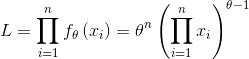
Taking logarithm in both sides we get,
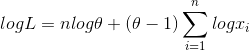
Differentiating with respect of  we get,
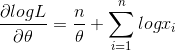
To get maximum likelihood value of we equate right side to zero.
Solving we get,
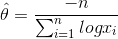
We know MLE follows invariant property.
So, required MLE of 1/ is given by
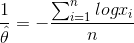
Cramer-Rao lower bound-
Cramer-Rao lower bound is given by
![\frac{\left [ g'\left ( \theta \right ) \right ]^2}{I\left ( \theta \right )}](http://img.homeworklib.com/questions/87ccf1d0-ca05-11eb-9a27-61897df88cfe.png?x-oss-process=image/resize,w_560)
where

and
![I\left ( \theta \right )=-n\left [ \frac{\partial^2 }{\partial \theta^2}logf_\theta(x) \right ]=\frac{1}{\theta^2}](http://img.homeworklib.com/questions/887a2780-ca05-11eb-9dda-f1bdd5d5a58d.png?x-oss-process=image/resize,w_560)
Also, we get,

So, CRLB is given by  .
.
Let X1, . . . , Xn be a random sample from a population X with...
Let X1, . . . , Xn be a random sample from a population X with p.d.f fθ(x) = θ xθ−1 , for 0 < x < 1 0, otherwise, where θ > 1 is parameter. Find the MLE of 1/θ. If it is an unbiased estimator of 1/θ, compare its variance with the Cramer-Rao lower bound.
1. Let Xi,..., Xn be a random sample from a distribution with p.d.f. f(x:0)-829-1 , 0...
 1. Let Xi,..., Xn be a random sample from a distribution with p.d.f. f(x:0)-829-1 , 0 < x < 1. where θ > 0. (a) Find a sufficient statistic Y for θ. (b) Show that the maximum likelihood estimator θ is a function of Y. (c) Determine the Rao-Cramér lower bound for the variance of unbiased estimators 12) Of θ
Let X,, X,,...X be a random sample of size n from a normal distribution with parameters a. Derive the Cramer-Rao lower...
 Let X,, X,,...X be a random sample of size n from a normal distribution with parameters a. Derive the Cramer-Rao lower bound matrix for an unbiased estimator of the vector of parameters (μ, σ2). b. Using the Cramer-Rao lower bound prove that the sample mean X is the minimum variance unbiased estimator of u Is the maximum likelihood estimator of σ--σ-->|··( X,-X ) unbiased? c.
Let X,, X,,...X be a random sample of size n from a normal distribution with...
Let X,, X,,...X be a random sample of size n from a normal distribution with parameters a. Derive the Cramer-Rao lower bound matrix for an unbiased estimator of the vector of parameters (μ, σ2). b. Using the Cramer-Rao lower bound prove that the sample mean X is the minimum variance unbiased estimator of u Is the maximum likelihood estimator of σ--σ-->|··( X,-X ) unbiased? c.
Let X,, X,,...X be a random sample of size n from a normal distribution with...
Suppose that X1, X2,., Xn is an iid sample from the probability mass function (pmf) given...
 Suppose that X1, X2,., Xn is an iid sample from the probability mass function (pmf) given by (1 - 0)0r, 0,1,2, 0, otherwise, where 001 (a) Find the maximum likelihood estimator of θ. (b) Find the Cramer-Rao Lower Bound (CRLB) on the variance of unbiased estimators of Eo(X). Can this lower bound be attained? (c) Find the method of moments estimator of θ. (d) Put a beta(2,3) prior distribution on θ. Find the posterior mean. Treating this as a fre-...
Suppose X1, X2, , xn is an iid sample from fx(x10)-θe_&z1 (a) For n 2 2,...
 Suppose X1, X2, , xn is an iid sample from fx(x10)-θe_&z1 (a) For n 2 2, show that (x > 0), where θ > 0 . n- is the uniformly minimum variance unbiased estimator (UMVUE) of θ (b) Calculate varo(0). Comment, in particular, on the n 2 case. (c) Show that vars(0) does not attain the Cramer-Rao Lower Bound (CRLB) on the variance of all unbiased estimators of T(9-0 (d) For this part only, suppose that n 1, 11T(X) is...
please use as many steps as possible. 5. Find the Cramer-Rao lower bound for the variance...
 please use as many steps as possible.
5. Find the Cramer-Rao lower bound for the variance of unbiased estimators of 8 based on a random sample of size n from a distribution with pdf f(1:0) = (1 + (1 - 0)2) for - 00 < < 00
please use as many steps as possible.
5. Find the Cramer-Rao lower bound for the variance of unbiased estimators of 8 based on a random sample of size n from a distribution with pdf f(1:0) = (1 + (1 - 0)2) for - 00 < < 00
5. Find the Fisher Information and the Cramer-Rao lower bound for the variance of an unbiased...
 5. Find the Fisher Information and the Cramer-Rao lower bound for the variance of an unbiased estimator of θ given a random sample . . . , xn from the density f(x:0) where < x < oo and-oo < θ < 00 You may use WolframAlpha.com to evaluate a complicated integral that might arise.
4. Find the Fisher Information and the Cramer-Rao lower bound for the variance of an unbiased...
 4. Find the Fisher Information and the Cramer-Rao lower bound for the variance of an unbiased estimator of θ given a random sample Xi,... ,Xn from the density f(x; θ) 6 Ae-x/0 where x 〉 0 and θ 〉 0 601
Please give detailed steps. Thank you. 5. Let {X, : i-1..n^ denote a random sample of...
 Please give detailed steps. Thank you.
5. Let {X, : i-1..n^ denote a random sample of size n from a population described by a random varaible X following a Poisson(θ) distribution with PDF given by θ and var(X) θ (i.e. you do not You may take it as given that E(X) need to show these) a. Recall that an estimator is efficient, if it satisfies 2 conditions: 2) it achieves the Cramer-Rao Lower Bound (CLRB) for unbiased estimators: Show that...
Please give detailed steps. Thank you.
5. Let {X, : i-1..n^ denote a random sample of size n from a population described by a random varaible X following a Poisson(θ) distribution with PDF given by θ and var(X) θ (i.e. you do not You may take it as given that E(X) need to show these) a. Recall that an estimator is efficient, if it satisfies 2 conditions: 2) it achieves the Cramer-Rao Lower Bound (CLRB) for unbiased estimators: Show that...
5. Find the Fisher Information and the Cramer-Rao lower bound for the variance of an unbiased...
 5. Find the Fisher Information and the Cramer-Rao lower bound for the variance of an unbiased estimator of θ given a random sample X1, , Xn from the density )=n-li + (r-0)21 where-oo < z < oo and-oo < θ < oo. You may use WolframAlpha.com to evaluate a complicated integral that might arise.
 1. Let Xi,..., Xn be a random sample from a distribution with p.d.f. f(x:0)-829-1 , 0 < x < 1. where θ > 0. (a) Find a sufficient statistic Y for θ. (b) Show that the maximum likelihood estimator θ is a function of Y. (c) Determine the Rao-Cramér lower bound for the variance of unbiased estimators 12) Of θ
 Let X,, X,,...X be a random sample of size n from a normal distribution with parameters a. Derive the Cramer-Rao lower bound matrix for an unbiased estimator of the vector of parameters (μ, σ2). b. Using the Cramer-Rao lower bound prove that the sample mean X is the minimum variance unbiased estimator of u Is the maximum likelihood estimator of σ--σ-->|··( X,-X ) unbiased? c.
Let X,, X,,...X be a random sample of size n from a normal distribution with...
Let X,, X,,...X be a random sample of size n from a normal distribution with parameters a. Derive the Cramer-Rao lower bound matrix for an unbiased estimator of the vector of parameters (μ, σ2). b. Using the Cramer-Rao lower bound prove that the sample mean X is the minimum variance unbiased estimator of u Is the maximum likelihood estimator of σ--σ-->|··( X,-X ) unbiased? c.
Let X,, X,,...X be a random sample of size n from a normal distribution with...
 Suppose that X1, X2,., Xn is an iid sample from the probability mass function (pmf) given by (1 - 0)0r, 0,1,2, 0, otherwise, where 001 (a) Find the maximum likelihood estimator of θ. (b) Find the Cramer-Rao Lower Bound (CRLB) on the variance of unbiased estimators of Eo(X). Can this lower bound be attained? (c) Find the method of moments estimator of θ. (d) Put a beta(2,3) prior distribution on θ. Find the posterior mean. Treating this as a fre-...
 Suppose X1, X2, , xn is an iid sample from fx(x10)-θe_&z1 (a) For n 2 2, show that (x > 0), where θ > 0 . n- is the uniformly minimum variance unbiased estimator (UMVUE) of θ (b) Calculate varo(0). Comment, in particular, on the n 2 case. (c) Show that vars(0) does not attain the Cramer-Rao Lower Bound (CRLB) on the variance of all unbiased estimators of T(9-0 (d) For this part only, suppose that n 1, 11T(X) is...
 please use as many steps as possible.
5. Find the Cramer-Rao lower bound for the variance of unbiased estimators of 8 based on a random sample of size n from a distribution with pdf f(1:0) = (1 + (1 - 0)2) for - 00 < < 00
please use as many steps as possible.
5. Find the Cramer-Rao lower bound for the variance of unbiased estimators of 8 based on a random sample of size n from a distribution with pdf f(1:0) = (1 + (1 - 0)2) for - 00 < < 00
 5. Find the Fisher Information and the Cramer-Rao lower bound for the variance of an unbiased estimator of θ given a random sample . . . , xn from the density f(x:0) where < x < oo and-oo < θ < 00 You may use WolframAlpha.com to evaluate a complicated integral that might arise.
 4. Find the Fisher Information and the Cramer-Rao lower bound for the variance of an unbiased estimator of θ given a random sample Xi,... ,Xn from the density f(x; θ) 6 Ae-x/0 where x 〉 0 and θ 〉 0 601
 Please give detailed steps. Thank you.
5. Let {X, : i-1..n^ denote a random sample of size n from a population described by a random varaible X following a Poisson(θ) distribution with PDF given by θ and var(X) θ (i.e. you do not You may take it as given that E(X) need to show these) a. Recall that an estimator is efficient, if it satisfies 2 conditions: 2) it achieves the Cramer-Rao Lower Bound (CLRB) for unbiased estimators: Show that...
Please give detailed steps. Thank you.
5. Let {X, : i-1..n^ denote a random sample of size n from a population described by a random varaible X following a Poisson(θ) distribution with PDF given by θ and var(X) θ (i.e. you do not You may take it as given that E(X) need to show these) a. Recall that an estimator is efficient, if it satisfies 2 conditions: 2) it achieves the Cramer-Rao Lower Bound (CLRB) for unbiased estimators: Show that...
 5. Find the Fisher Information and the Cramer-Rao lower bound for the variance of an unbiased estimator of θ given a random sample X1, , Xn from the density )=n-li + (r-0)21 where-oo < z < oo and-oo < θ < oo. You may use WolframAlpha.com to evaluate a complicated integral that might arise.
Most questions answered within 3 hours.
-
Where is the error in this code sequence?
String s1 = "Hello";
String s2 = "ello";...
asked 10 months ago -
Financial data for Joel de Paris, Inc., for last year
follow:
Joel de Paris, Inc.
Balance...
asked 10 months ago -
Consider this reaction:
Al2(SO4)3 (aq)+ BaCl3
(aq) Al2Cl6 (aq)- +
3BaSO4(s) . What is the...
asked 10 months ago -
Suppose that Savneet is considering increasing her
recent random sample from 20 car rentals to 40...
asked 10 months ago -
Trucks arrive at an unloading terminal at an average rate of 120
per hour.
Trucks arrive...
asked 10 months ago -
Why are methanol and ethanol completely soluble in water while
octanol is not very little soluble....
asked 10 months ago -
A facilities manager at a university reads in a research report
that the mean amount of...
asked 10 months ago -
When the CuSO4 is rehydrated by adding water to the anhydrous
compound, is this an endothermic...
asked 10 months ago -
A ray of sunlight is passing from diamond into crown glass; the
angle of incidence is...
asked 10 months ago -
A block of mass 0.249 kg is placed on top of a light, vertical
spring of...
asked 10 months ago -
how do the kidneys compensate in the presences of acidosis
a) trigger hyperventilate
b) reserve acid...
asked 10 months ago -
Question 501 pts
The rental rate of capital to the firm increases. Which of the
following...
asked 10 months ago