

Homework Answers
Add Answer to:
Problem 2: (5 points each) Draw the most likely structure of th Points each) Draw the...
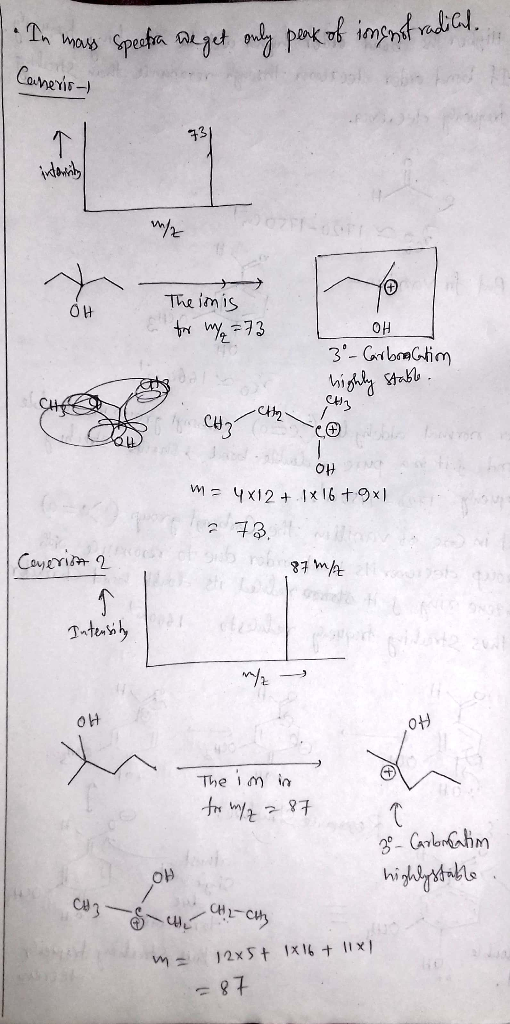
Provide a plausible structure. Draw the structure that corresponds to each fragment as well. Large, broad...
Provide a plausible structure. Draw the structure that corresponds to each fragment as well. Large, broad peak from 3200 – 3500 cm-1 M+ = 88 Fragment = 84 Fragment = 73 Fragment = 59
OK, now to look at the fragments. This is the most difficult aspect of interpreting MS...
 OK, now to look at the fragments. This is the most difficult aspect of interpreting MS data, and fortunately you often don't need to do this yourself (let a computer do it!) Consider this spectrum which is for a molecule of formula C3H1.0.(M) - 86. Relative Abundance T 20 0 10 ill 30 40 50 60 70 80 90 m/z This molecule is an aldehyde or ketone with a formula of CsH100. Draw all isomers of this formula that have...
5. Draw a structure for and name a compound that is consistent with compound that is...
 5. Draw a structure for and name a compound that is consistent with compound that is consistent with the following MS. abundance 73 M 80 90 100 110 120 130 140 150 160 10 20 30 40 50 60 70 m/z Question 5: Structure and name: Mass Spectrum (include the molecular ion) Observed Fragment & MW Expected MW Fragmentation type Explanation:
6. Characterization and Synthesis (20 points total) Use the information provided below and the IR and...
 6. Characterization and Synthesis (20 points total) Use the information provided below and the IR and NMR spectra on the next page to answer the following questions. a) An MS was taken of molecule A and the table is given below. Determine the molecular formula of A from the MS given below m/z 119 118 Relative abundance (Intensity) 9.9 100 b) Calculate the Index of Hydrogen Deficiency (IHD) for the molecule in A, above. c) Using the information in a...
Label the peaks that characterize the structure. Functional Group(s): HNMR Label each peak with the type...
 Label the peaks that characterize the structure. Functional Group(s): HNMR Label each peak with the type of hydrogen from the structure. Molecular Structure: triplet quartet ppm O A -Br OB. CH ос с 9 D. CH2-CH, Label the peaks that characterize the structure Functional Group(s): HNMR Label each peak with the type of hydrogen from the structure. Molecular Structure: triplet quartet ОА -Br OB. -CH Occ ® D -CH2-CH, Doent Colantion 1 Points on 39 of 40 from the original...
Lab 6 Mass Spectrometry Worksheet Please show your work for the following problems in your laboratory...
 Lab 6 Mass Spectrometry Worksheet Please show your work for the following problems in your laboratory notebook. Your notebook carbons will be collected at the beginning of the next lab period. 1. For each of the following molecular formulas, calculate the index of hydrogen deficiency (IHD), and draw at least two possible structures: a. CaH4 22+2--6+04-2 b. CaHs c. CoHsNO2 26)-54t 4 d. CHioBr2 2 215)+2--0+o 2. Write the molecular formulas for three hydrocarbons with the following molecular ion (M)...
Assistance needed with the NMR and fragmentation portions. a. Formula: C12H1.0 b. IR (see information below)...
 Assistance needed with the NMR and fragmentation
portions.
a. Formula: C12H1.0 b. IR (see information below) IR Peak Frequency 3062 2962 1759 1613 IR Peak Frequency 1509 1432 1202 1166 c TH-NMR (see information below) Integration Peak A B C D Chemical Shift 7.135 6939 2.391 2.306 2.224 1035 Splitting Singlet Singlet Doublet Singlet Multiplet Doublet 2 3 1 6 F d. MS Label Peak #1 (base) 2 Peak # Peak #3 Pal Peak #4 Peak #5 (M) M/Z value...
Assistance needed with the NMR and fragmentation
portions.
a. Formula: C12H1.0 b. IR (see information below) IR Peak Frequency 3062 2962 1759 1613 IR Peak Frequency 1509 1432 1202 1166 c TH-NMR (see information below) Integration Peak A B C D Chemical Shift 7.135 6939 2.391 2.306 2.224 1035 Splitting Singlet Singlet Doublet Singlet Multiplet Doublet 2 3 1 6 F d. MS Label Peak #1 (base) 2 Peak # Peak #3 Pal Peak #4 Peak #5 (M) M/Z value...
Unknown H415 100 50 1000 1S00 2000 3000 BRVENUMBERI 4000 Unknown H415 ЗН 1 H-N 2H,...
 Unknown H415 100 50 1000 1S00 2000 3000 BRVENUMBERI 4000 Unknown H415 ЗН 1 H-N 2H, q 1H, d 5H, m 1H, d 0 1 2 3 6 7 8 10 11 ppm HSP-00-049 Unknown H415 q 140 120 100 200 180 160 ppm CDS-00-726 20 -40 60 80 Relative Intensity 09 Unknown H415 100 MS-NJ-0442 80 20 thmpt 25 50 75 100 125 150 175 m/z Date: Name: Section/Group: Instructor: Report Sheet: Laboratory 14 MS,IR, 13C NMR, and 'H...
2. Draw the 'H-NMR for the structure below. Label each peak on the NMR (2 points):
 2. Draw the 'H-NMR for the structure below. Label each peak on the NMR (2 points):
4. Draw the 'H-NMR for the structure below. Label each peak on the NMR (2 points):
 4. Draw the 'H-NMR for the structure below. Label each peak on the NMR (2 points):
 OK, now to look at the fragments. This is the most difficult aspect of interpreting MS data, and fortunately you often don't need to do this yourself (let a computer do it!) Consider this spectrum which is for a molecule of formula C3H1.0.(M) - 86. Relative Abundance T 20 0 10 ill 30 40 50 60 70 80 90 m/z This molecule is an aldehyde or ketone with a formula of CsH100. Draw all isomers of this formula that have...
 5. Draw a structure for and name a compound that is consistent with compound that is consistent with the following MS. abundance 73 M 80 90 100 110 120 130 140 150 160 10 20 30 40 50 60 70 m/z Question 5: Structure and name: Mass Spectrum (include the molecular ion) Observed Fragment & MW Expected MW Fragmentation type Explanation:
 6. Characterization and Synthesis (20 points total) Use the information provided below and the IR and NMR spectra on the next page to answer the following questions. a) An MS was taken of molecule A and the table is given below. Determine the molecular formula of A from the MS given below m/z 119 118 Relative abundance (Intensity) 9.9 100 b) Calculate the Index of Hydrogen Deficiency (IHD) for the molecule in A, above. c) Using the information in a...
 Label the peaks that characterize the structure. Functional Group(s): HNMR Label each peak with the type of hydrogen from the structure. Molecular Structure: triplet quartet ppm O A -Br OB. CH ос с 9 D. CH2-CH, Label the peaks that characterize the structure Functional Group(s): HNMR Label each peak with the type of hydrogen from the structure. Molecular Structure: triplet quartet ОА -Br OB. -CH Occ ® D -CH2-CH, Doent Colantion 1 Points on 39 of 40 from the original...
 Lab 6 Mass Spectrometry Worksheet Please show your work for the following problems in your laboratory notebook. Your notebook carbons will be collected at the beginning of the next lab period. 1. For each of the following molecular formulas, calculate the index of hydrogen deficiency (IHD), and draw at least two possible structures: a. CaH4 22+2--6+04-2 b. CaHs c. CoHsNO2 26)-54t 4 d. CHioBr2 2 215)+2--0+o 2. Write the molecular formulas for three hydrocarbons with the following molecular ion (M)...
 Assistance needed with the NMR and fragmentation
portions.
a. Formula: C12H1.0 b. IR (see information below) IR Peak Frequency 3062 2962 1759 1613 IR Peak Frequency 1509 1432 1202 1166 c TH-NMR (see information below) Integration Peak A B C D Chemical Shift 7.135 6939 2.391 2.306 2.224 1035 Splitting Singlet Singlet Doublet Singlet Multiplet Doublet 2 3 1 6 F d. MS Label Peak #1 (base) 2 Peak # Peak #3 Pal Peak #4 Peak #5 (M) M/Z value...
Assistance needed with the NMR and fragmentation
portions.
a. Formula: C12H1.0 b. IR (see information below) IR Peak Frequency 3062 2962 1759 1613 IR Peak Frequency 1509 1432 1202 1166 c TH-NMR (see information below) Integration Peak A B C D Chemical Shift 7.135 6939 2.391 2.306 2.224 1035 Splitting Singlet Singlet Doublet Singlet Multiplet Doublet 2 3 1 6 F d. MS Label Peak #1 (base) 2 Peak # Peak #3 Pal Peak #4 Peak #5 (M) M/Z value...
 Unknown H415 100 50 1000 1S00 2000 3000 BRVENUMBERI 4000 Unknown H415 ЗН 1 H-N 2H, q 1H, d 5H, m 1H, d 0 1 2 3 6 7 8 10 11 ppm HSP-00-049 Unknown H415 q 140 120 100 200 180 160 ppm CDS-00-726 20 -40 60 80 Relative Intensity 09 Unknown H415 100 MS-NJ-0442 80 20 thmpt 25 50 75 100 125 150 175 m/z Date: Name: Section/Group: Instructor: Report Sheet: Laboratory 14 MS,IR, 13C NMR, and 'H...
 2. Draw the 'H-NMR for the structure below. Label each peak on the NMR (2 points):
 4. Draw the 'H-NMR for the structure below. Label each peak on the NMR (2 points):
Most questions answered within 3 hours.
-
Where is the error in this code sequence?
String s1 = "Hello";
String s2 = "ello";...
asked 10 months ago -
Financial data for Joel de Paris, Inc., for last year
follow:
Joel de Paris, Inc.
Balance...
asked 10 months ago -
Consider this reaction:
Al2(SO4)3 (aq)+ BaCl3
(aq) Al2Cl6 (aq)- +
3BaSO4(s) . What is the...
asked 10 months ago -
Suppose that Savneet is considering increasing her
recent random sample from 20 car rentals to 40...
asked 10 months ago -
Trucks arrive at an unloading terminal at an average rate of 120
per hour.
Trucks arrive...
asked 10 months ago -
Why are methanol and ethanol completely soluble in water while
octanol is not very little soluble....
asked 10 months ago -
A facilities manager at a university reads in a research report
that the mean amount of...
asked 10 months ago -
When the CuSO4 is rehydrated by adding water to the anhydrous
compound, is this an endothermic...
asked 10 months ago -
A ray of sunlight is passing from diamond into crown glass; the
angle of incidence is...
asked 10 months ago -
A block of mass 0.249 kg is placed on top of a light, vertical
spring of...
asked 10 months ago -
how do the kidneys compensate in the presences of acidosis
a) trigger hyperventilate
b) reserve acid...
asked 10 months ago -
Question 501 pts
The rental rate of capital to the firm increases. Which of the
following...
asked 10 months ago