(a)At the equilibrium position when the distance between to ions? = ?0, the force of Coulombic...
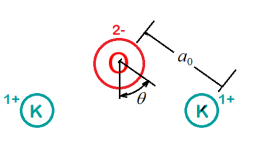
(a)At the equilibrium position when the distance between to ions? = ?0, the force of Coulombic attraction, ?? and the repulsive force ?? cancel each other, and the bond behaves like a spring. What is the important consequence of this behavior?
(b) What causes the repulsive force ?? ?
(c) Why is the radius of a ??1+-ion is less than that of ??-atom?
Homework Answers
- (a) At equilibrium as the force of columbic attraction and repulsive force cancel each other the bond length is maintained. The bond does not break as it behaves like a spring.
(b) As the atoms come closer the electron-electron interactions & nuclear –nuclear interactions between 2 atoms cause the repulsive force, FR.
(c) Electronic configuration of sodium atom: Na – [Ne]1s1.
Atomic number of sodium, Na is 11. Thus, it has 11 protons which pull the 11 electrons outside the nucleus. This is called the effective nuclear charge.
In case of Na+ ion, there are only 10 electrons outside the nucleus. Hence, the same pull of the protons are experienced by fewer number of electrons that is the effective nuclear charge on the electrons is increased. Hence because of relatively greater pull they are drawn more towards the nucleus, thereby having a smaller radius. Whereas in case of Na-, the number of electrons are increased, hence the radius increases.
Add Answer to:
(a)At the equilibrium position when the distance between to
ions? = ?0, the force of Coulombic...
In a potassium oxide (?2?) molecule, if ?0 is the equilibrium separation distance between the potassium...
In a potassium oxide (?2?) molecule, if ?0 is the equilibrium separation distance between the potassium and oxygen ions, equal to the sum of the radii of the potassium and oxygen ions. The angle ? = 54.76°. Compute the Coulombic force: (a) Between potassium and oxygen ions (b) Between the two potassium ions
A uranium and iron atom reside a distance R = 39.10 nm apart. The uranium atom...
A uranium and iron atom reside a distance R = 39.10 nm apart. The uranium atom is singly ionized; the iron atom is doubly ionized. Calculate the distance r from the uranium atom necessary for an electron to reside in equilibrium. Ignore the insignificant gravitational attraction between the particles. An electron sits between a singly ionized uranium ion and a doubly ionized iron ion. The distance from the uranium ion to the electron is designated lowercase r, and the distance...
9. At what distance would the repulsive force between two electrons have a magnitude of 4.0...
 9. At what distance would the repulsive force between two electrons have a magnitude of 4.0 N? (1 point) O8.0 x 10-20 m O7.6 x 10-15 m 5.8 x 10⁻²⁹ m 01.9x10.5 m 10. Two like charges of the same magnitude are 1.0 mm apart. If the force of repulsion they exert (1point) upon each other is 5.0 N, what is the magnitude of each charge? The constant of proportionality for the Coulombic force is 9.0 x 10°N-m-/c2 045 x...
The magnitude of the electrostatic force between two identical ions that are separated by a distance...
The magnitude of the electrostatic force between two identical ions that are separated by a distance of 8.4 × 10⁻¹⁰ m is 188.4 × 10⁻⁹ N. (a) What is the charge of each ion? (b) How many electrons are “missing” from each ion (thus giving the ion its charge imbalance)? please show every step so I can follow along. Also, please tell me how many sig figs to use and why :( Thank you.!!
When two identical ions are separated by a distance of 6.3*10^-10 m., the electrostatic force each...
 When two identical ions are separated by a distance of
6.3*10^-10 m., the electrostatic force each exerts on the other is
5.3*10^-9N.
*Question*
How many electrons are missing from each ion?
-Express your answer as an integer.
When two identical ions are separated by a distance of 6.3x10⁻¹⁰ m, the electrostatic force each exerts on the other is 5.3 10-9 N You may want to review (Pages 664-670) How many electrons are missing from each ion? Express your answer as...
When two identical ions are separated by a distance of
6.3*10^-10 m., the electrostatic force each exerts on the other is
5.3*10^-9N.
*Question*
How many electrons are missing from each ion?
-Express your answer as an integer.
When two identical ions are separated by a distance of 6.3x10⁻¹⁰ m, the electrostatic force each exerts on the other is 5.3 10-9 N You may want to review (Pages 664-670) How many electrons are missing from each ion? Express your answer as...
The magnitude of the electrostatic force between two identical ions that are separated by a distance...
 The magnitude of the electrostatic force between two identical ions that are separated by a distance of 5.8x 10 0 m is 10.98 x 10⁻⁹ N. (a) What is the charge of each ton? (b) How many electrons are "missing" from each ion (thus giving the ion its charge imbalance)?
The magnitude of the electrostatic force between two identical ions that are separated by a distance...
 The magnitude of the electrostatic force between two identical ions that are separated by a distance of 6.6 x 10¹⁰ m is 331.1 x 10⁻⁹ N. (a) What is the charge of each ion? (b) How many electrons are "missing" from each ion (thus giving the ion its charge imbalance)? (a) NumberT 4.005E-19 (b) NumberT 2.5 Units C - u Units No units
he magnitude of the electrostatic force between two identical ions that are separated by a distance...
he magnitude of the electrostatic force between two identical ions that are separated by a distance of 8.50 nm is 3.866×10⁻¹⁰N. What is the charge of each ion? Incorrect. Tries 5/8 Previous Tries How many electrons are missing from (or have been added to) each ion thus giving the ion its charge imbalance?
When two identical ions are separated by a distance of 4.0×10⁻¹⁰ m , the electrostatic force...
When two identical ions are separated by a distance of 4.0×10⁻¹⁰ m , the electrostatic force each exerts on the other is 5.8×10⁻⁹ N . How many electrons are missing from each ion?
When two identical ions are separated by a distance of 6.4×10⁻¹⁰ m , the electrostatic force...
When two identical ions are separated by a distance of 6.4×10⁻¹⁰ m , the electrostatic force each exerts on the other is 5.0×10⁻⁹ N . Part A How many electrons are missing from each ion?
 9. At what distance would the repulsive force between two electrons have a magnitude of 4.0 N? (1 point) O8.0 x 10-20 m O7.6 x 10-15 m 5.8 x 10⁻²⁹ m 01.9x10.5 m 10. Two like charges of the same magnitude are 1.0 mm apart. If the force of repulsion they exert (1point) upon each other is 5.0 N, what is the magnitude of each charge? The constant of proportionality for the Coulombic force is 9.0 x 10°N-m-/c2 045 x...
 When two identical ions are separated by a distance of
6.3*10^-10 m., the electrostatic force each exerts on the other is
5.3*10^-9N.
*Question*
How many electrons are missing from each ion?
-Express your answer as an integer.
When two identical ions are separated by a distance of 6.3x10⁻¹⁰ m, the electrostatic force each exerts on the other is 5.3 10-9 N You may want to review (Pages 664-670) How many electrons are missing from each ion? Express your answer as...
When two identical ions are separated by a distance of
6.3*10^-10 m., the electrostatic force each exerts on the other is
5.3*10^-9N.
*Question*
How many electrons are missing from each ion?
-Express your answer as an integer.
When two identical ions are separated by a distance of 6.3x10⁻¹⁰ m, the electrostatic force each exerts on the other is 5.3 10-9 N You may want to review (Pages 664-670) How many electrons are missing from each ion? Express your answer as...
 The magnitude of the electrostatic force between two identical ions that are separated by a distance of 5.8x 10 0 m is 10.98 x 10⁻⁹ N. (a) What is the charge of each ton? (b) How many electrons are "missing" from each ion (thus giving the ion its charge imbalance)?
 The magnitude of the electrostatic force between two identical ions that are separated by a distance of 6.6 x 10¹⁰ m is 331.1 x 10⁻⁹ N. (a) What is the charge of each ion? (b) How many electrons are "missing" from each ion (thus giving the ion its charge imbalance)? (a) NumberT 4.005E-19 (b) NumberT 2.5 Units C - u Units No units
Most questions answered within 3 hours.
-
Where is the error in this code sequence?
String s1 = "Hello";
String s2 = "ello";...
asked 10 months ago -
Financial data for Joel de Paris, Inc., for last year
follow:
Joel de Paris, Inc.
Balance...
asked 10 months ago -
Consider this reaction:
Al2(SO4)3 (aq)+ BaCl3
(aq) Al2Cl6 (aq)- +
3BaSO4(s) . What is the...
asked 10 months ago -
Suppose that Savneet is considering increasing her
recent random sample from 20 car rentals to 40...
asked 10 months ago -
Trucks arrive at an unloading terminal at an average rate of 120
per hour.
Trucks arrive...
asked 10 months ago -
Why are methanol and ethanol completely soluble in water while
octanol is not very little soluble....
asked 10 months ago -
A facilities manager at a university reads in a research report
that the mean amount of...
asked 10 months ago -
When the CuSO4 is rehydrated by adding water to the anhydrous
compound, is this an endothermic...
asked 10 months ago -
A ray of sunlight is passing from diamond into crown glass; the
angle of incidence is...
asked 10 months ago -
A block of mass 0.249 kg is placed on top of a light, vertical
spring of...
asked 10 months ago -
how do the kidneys compensate in the presences of acidosis
a) trigger hyperventilate
b) reserve acid...
asked 10 months ago -
Question 501 pts
The rental rate of capital to the firm increases. Which of the
following...
asked 10 months ago