. When a 10-unit step function is applied to a system with Y (s) / X...
. When a 10-unit step function is applied to a system with Y (s)
/ X (s) = 1 / (9S2 + 3S + 1), for this system;
A) Top shot
B) The maximum value of Y
C) Y's final value
D) What is the period of oscillation, calculate?
Homework Answers
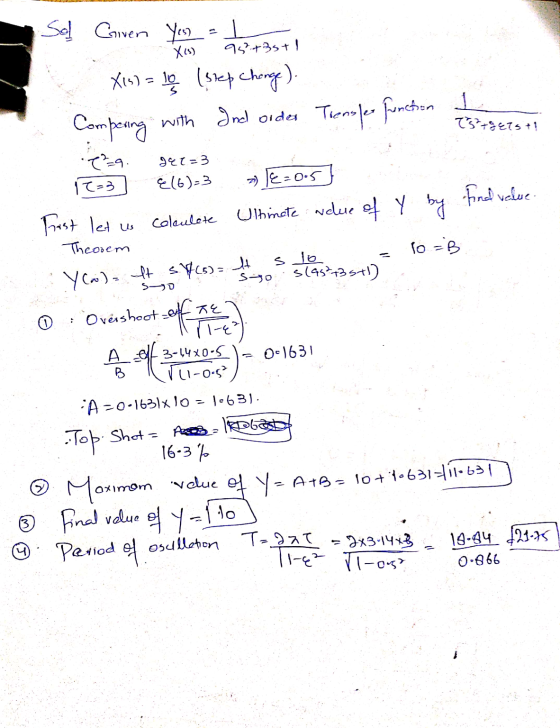
using given data and required equations we can find the required variables
for any doubts wirte in comments
Add Answer to:
. When a 10-unit step function is applied to a system with Y (s)
/ X...
The set-point of the control system under proportional control (Kc-2) undergoes a step change of ...
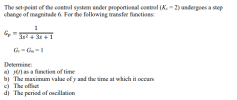 The set-point of the control system under proportional control (Kc-2) undergoes a step change of magnitude 6. For the following transfer functions 3s2 3s+1 Deterine: a) y(t) as a function of time b) The maximum value of y and the time at which it occurs d) The period of oscillation
The set-point of the control system under proportional control (Kc-2) undergoes a step change of magnitude 6. For the following transfer functions 3s2 3s+1 Deterine: a) y(t) as a function...
The set-point of the control system under proportional control (Kc-2) undergoes a step change of magnitude 6. For the following transfer functions 3s2 3s+1 Deterine: a) y(t) as a function of time b) The maximum value of y and the time at which it occurs d) The period of oscillation
The set-point of the control system under proportional control (Kc-2) undergoes a step change of magnitude 6. For the following transfer functions 3s2 3s+1 Deterine: a) y(t) as a function...
5) (10 pts) The transfer function of a system is given by: S +1 H(s) =...
 5) (10 pts) The transfer function of a system is given by: S +1 H(s) = $3+ 9s2 + 23s + 15 What is the steady state error of this system when the input is unit step function?
A chemical process unit exhibits an underdamped second order behavior as given by the transfer function:...
 A chemical process unit exhibits an underdamped second order behavior as given by the transfer function: Y(s) U(s) 18 s2 + 3s + 9 Calculate the process gain, natural period of oscillation and damping factor for the system. (3m) b. If a step change in the input with the magnitude of 3 is introduced, i. Determine the step response (5m) ii. Estimate the new steady-state value of y. (2m)
2. When a unit step is applied to a system at 0 its response is y(1)...
 2. When a unit step is applied to a system at 0 its response is y(1) = | 4 +-e-3,-e-2,(2 cos 41 + 3 sin 41) | u(t) (a) What is the transfer function of the system? (b) What is the governing differential equation for this system?
When a unit step is applied to a system at t= 0, its response is y(t)...
 When a unit step is applied to a system at t= 0, its response is y(t) = [7 +0.8e-3t-e-2t|3cos(46) + 4.5 sin(44)] (1). Is the transfer function of the given system H(s) = 7 + 1.60s 2(3+3) 2s(s+2) 52 + 4s + 20 9s S2 + 4s + 16 ? Yes No
Question three The figure below shows a unit step response of a second order system. From...
 Question three The figure below shows a unit step response of a second order system. From the graph of response find: 1- The rise timet, 2- The peak timet, 3- The maximum overshoot Mp 4- The damped natural frequency w 5. The transfer function. Hence find the damping ratio ζ and the natural frequency ah-Find also the transfer function of the system. r 4 02 15 25 35 45 Question Four For the control system shown in the figure below,...
3. Work the following problems: a. The transfer function of a system is: Y(s)/R(s) = 15(s+1)/(s2+9s+14)....
 3. Work the following problems: a. The transfer function of a system is: Y(s)/R(s) = 15(s+1)/(s2+9s+14). Determine y(t) when r(t) is a unit step input. b. Consider the following system: R(s)_ 0 G(s) i. Find the closed-loop transfer function Y(s)R(S) when G(s) = 10/(S2+2s+10) ii. Determine Y(s) when the input R(s) is a unit step. iii. Compute y(t).
using following parameters as defined G1(s)=1/(s+50) G2(s)=K/s G3(s)=1/(s+10) H(s)=1 R(s) is the unit step function a)...
 using following parameters as defined
G1(s)=1/(s+50)
G2(s)=K/s
G3(s)=1/(s+10)
H(s)=1
R(s) is the unit step function
a) find the closed loop transfer function as a function of K
b) what is the maximum value of the K the system can
tolerate?
c) is there an effect on the system if the pole in G1(s) is
changed to :
1) G1(s)= 1/(s+500)
2) G1(s)=1/(s+11)
G1(s) G2(s) G3(s) C(s) H(s)
using following parameters as defined
G1(s)=1/(s+50)
G2(s)=K/s
G3(s)=1/(s+10)
H(s)=1
R(s) is the unit step function
a) find the closed loop transfer function as a function of K
b) what is the maximum value of the K the system can
tolerate?
c) is there an effect on the system if the pole in G1(s) is
changed to :
1) G1(s)= 1/(s+500)
2) G1(s)=1/(s+11)
G1(s) G2(s) G3(s) C(s) H(s)
A closed-loop control system has Gc(s) = 10, G(s) = (s+50)/(s^2+60s+500), and H(s) = 1. a)...
A closed-loop control system has Gc(s) = 10, G(s) = (s+50)/(s^2+60s+500), and H(s) = 1. a) Find the transfer function Y(s)/R(s). b) Plot the pole-zero map of the transfer function. c) Find the response y(t) to a unit step input. d) Find the steady-state (final) value of the output.
3) Say a unit step input sequence is applied to a system yielding y/n)-4 (4)"- w{n}...
 3) Say a unit step input sequence is applied to a system yielding y/n)-4 (4)"- w{n} + 14 (-1)" (5 points) (a) Determine the system function H(z) of the system. Plot the poles and zeros of H(a), and determine the ROC (b) Determine the impulse response of the system, An (e) Write the difference equation, y/n), as a funetion of past outputs, the present input, and past inputs
 The set-point of the control system under proportional control (Kc-2) undergoes a step change of magnitude 6. For the following transfer functions 3s2 3s+1 Deterine: a) y(t) as a function of time b) The maximum value of y and the time at which it occurs d) The period of oscillation
The set-point of the control system under proportional control (Kc-2) undergoes a step change of magnitude 6. For the following transfer functions 3s2 3s+1 Deterine: a) y(t) as a function...
The set-point of the control system under proportional control (Kc-2) undergoes a step change of magnitude 6. For the following transfer functions 3s2 3s+1 Deterine: a) y(t) as a function of time b) The maximum value of y and the time at which it occurs d) The period of oscillation
The set-point of the control system under proportional control (Kc-2) undergoes a step change of magnitude 6. For the following transfer functions 3s2 3s+1 Deterine: a) y(t) as a function...
 5) (10 pts) The transfer function of a system is given by: S +1 H(s) = $3+ 9s2 + 23s + 15 What is the steady state error of this system when the input is unit step function?
 A chemical process unit exhibits an underdamped second order behavior as given by the transfer function: Y(s) U(s) 18 s2 + 3s + 9 Calculate the process gain, natural period of oscillation and damping factor for the system. (3m) b. If a step change in the input with the magnitude of 3 is introduced, i. Determine the step response (5m) ii. Estimate the new steady-state value of y. (2m)
 2. When a unit step is applied to a system at 0 its response is y(1) = | 4 +-e-3,-e-2,(2 cos 41 + 3 sin 41) | u(t) (a) What is the transfer function of the system? (b) What is the governing differential equation for this system?
 When a unit step is applied to a system at t= 0, its response is y(t) = [7 +0.8e-3t-e-2t|3cos(46) + 4.5 sin(44)] (1). Is the transfer function of the given system H(s) = 7 + 1.60s 2(3+3) 2s(s+2) 52 + 4s + 20 9s S2 + 4s + 16 ? Yes No
 Question three The figure below shows a unit step response of a second order system. From the graph of response find: 1- The rise timet, 2- The peak timet, 3- The maximum overshoot Mp 4- The damped natural frequency w 5. The transfer function. Hence find the damping ratio ζ and the natural frequency ah-Find also the transfer function of the system. r 4 02 15 25 35 45 Question Four For the control system shown in the figure below,...
 3. Work the following problems: a. The transfer function of a system is: Y(s)/R(s) = 15(s+1)/(s2+9s+14). Determine y(t) when r(t) is a unit step input. b. Consider the following system: R(s)_ 0 G(s) i. Find the closed-loop transfer function Y(s)R(S) when G(s) = 10/(S2+2s+10) ii. Determine Y(s) when the input R(s) is a unit step. iii. Compute y(t).
 using following parameters as defined
G1(s)=1/(s+50)
G2(s)=K/s
G3(s)=1/(s+10)
H(s)=1
R(s) is the unit step function
a) find the closed loop transfer function as a function of K
b) what is the maximum value of the K the system can
tolerate?
c) is there an effect on the system if the pole in G1(s) is
changed to :
1) G1(s)= 1/(s+500)
2) G1(s)=1/(s+11)
G1(s) G2(s) G3(s) C(s) H(s)
using following parameters as defined
G1(s)=1/(s+50)
G2(s)=K/s
G3(s)=1/(s+10)
H(s)=1
R(s) is the unit step function
a) find the closed loop transfer function as a function of K
b) what is the maximum value of the K the system can
tolerate?
c) is there an effect on the system if the pole in G1(s) is
changed to :
1) G1(s)= 1/(s+500)
2) G1(s)=1/(s+11)
G1(s) G2(s) G3(s) C(s) H(s)
 3) Say a unit step input sequence is applied to a system yielding y/n)-4 (4)"- w{n} + 14 (-1)" (5 points) (a) Determine the system function H(z) of the system. Plot the poles and zeros of H(a), and determine the ROC (b) Determine the impulse response of the system, An (e) Write the difference equation, y/n), as a funetion of past outputs, the present input, and past inputs
Most questions answered within 3 hours.
-
Where is the error in this code sequence?
String s1 = "Hello";
String s2 = "ello";...
asked 10 months ago -
Financial data for Joel de Paris, Inc., for last year
follow:
Joel de Paris, Inc.
Balance...
asked 10 months ago -
Consider this reaction:
Al2(SO4)3 (aq)+ BaCl3
(aq) Al2Cl6 (aq)- +
3BaSO4(s) . What is the...
asked 10 months ago -
Suppose that Savneet is considering increasing her
recent random sample from 20 car rentals to 40...
asked 10 months ago -
Trucks arrive at an unloading terminal at an average rate of 120
per hour.
Trucks arrive...
asked 10 months ago -
Why are methanol and ethanol completely soluble in water while
octanol is not very little soluble....
asked 10 months ago -
A facilities manager at a university reads in a research report
that the mean amount of...
asked 10 months ago -
When the CuSO4 is rehydrated by adding water to the anhydrous
compound, is this an endothermic...
asked 10 months ago -
A ray of sunlight is passing from diamond into crown glass; the
angle of incidence is...
asked 10 months ago -
A block of mass 0.249 kg is placed on top of a light, vertical
spring of...
asked 10 months ago -
how do the kidneys compensate in the presences of acidosis
a) trigger hyperventilate
b) reserve acid...
asked 10 months ago -
Question 501 pts
The rental rate of capital to the firm increases. Which of the
following...
asked 10 months ago