
Homework Answers
Add Answer to:
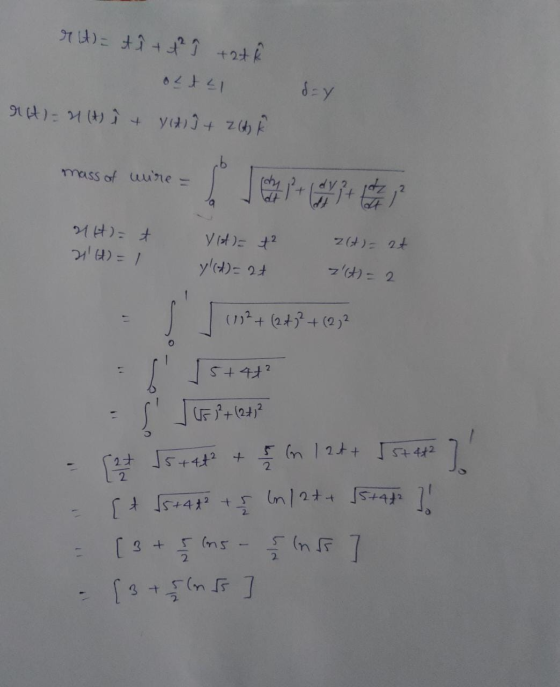
5. Find a definite integral (in terms of t) for the mass of a wire that...
Please explain all steps. Need to understand. Thanks Let C be the closed curve defined by...
 Please explain all steps. Need to understand.
Thanks
Let C be the closed curve defined by r(t) = cos ti + sin tj + sin 2tk for 0 <t< 27. (a) (5 pts) Show that this curve C lies on the surface S defined by z = 2xy. (b) (20 pts) By using Stokes' Theorem, evaluate the line integral / F. dr C where F(x, y, z) = (y2 + cos x)i + (sin y + x2)j + xk
Please explain all steps. Need to understand.
Thanks
Let C be the closed curve defined by r(t) = cos ti + sin tj + sin 2tk for 0 <t< 27. (a) (5 pts) Show that this curve C lies on the surface S defined by z = 2xy. (b) (20 pts) By using Stokes' Theorem, evaluate the line integral / F. dr C where F(x, y, z) = (y2 + cos x)i + (sin y + x2)j + xk
PLEASE SHOW ALL WORK AND EXPLAIN BOTH PARTS. Thanks Let C be the closed curve defined...
 PLEASE SHOW ALL WORK AND EXPLAIN BOTH PARTS.
Thanks
Let C be the closed curve defined by r(t) = cos ti + sin tj + sin 2tk for 0 <t< 27. (a) (5 pts) Show that this curve C lies on the surface S defined by z = 2xy. (b) (20 pts) By using Stokes' Theorem, evaluate the line integral / F. dr C where F(x, y, z) = (y2 + cos x)i + (sin y + x2)j + xk
PLEASE SHOW ALL WORK AND EXPLAIN BOTH PARTS.
Thanks
Let C be the closed curve defined by r(t) = cos ti + sin tj + sin 2tk for 0 <t< 27. (a) (5 pts) Show that this curve C lies on the surface S defined by z = 2xy. (b) (20 pts) By using Stokes' Theorem, evaluate the line integral / F. dr C where F(x, y, z) = (y2 + cos x)i + (sin y + x2)j + xk
good evening. i need help with this calculus question. i will thumbs up your answer. Let...
 good evening.
i need help with this calculus question.
i will thumbs up your answer.
Let C be the closed curve defined by r(t) = cos ti+ sin tj + sin 2tk for 0 <t<27. (a) [5 pts) Show that this curve C lies on the surface s defined by 2 = 2xry. (b) (20 pts] By using Stokes' Theorem, evaluate the line integral s F. dr where F(x, y, z) = (y2 + cos z)i + (sin y +22)j...
good evening.
i need help with this calculus question.
i will thumbs up your answer.
Let C be the closed curve defined by r(t) = cos ti+ sin tj + sin 2tk for 0 <t<27. (a) [5 pts) Show that this curve C lies on the surface s defined by 2 = 2xry. (b) (20 pts] By using Stokes' Theorem, evaluate the line integral s F. dr where F(x, y, z) = (y2 + cos z)i + (sin y +22)j...
Directions: In each problem (1)-(5), write a definite integral of a single variable. For problems...
 Need ONLY 2-3 with work shown
Directions: In each problem (1)-(5), write a definite integral of a single variable. For problems marked [FTC], use the Fundamental Theorem of Calculus to evaluate the definite integral. Use a calculator utility for problems marked [Calculator Active]. Show intermediate steps, and box in your final result. « Submit a single team set of solutions on the answer sheets provided.» > (0) Region R is bounded by the curve y -x and the line y...
Need ONLY 2-3 with work shown
Directions: In each problem (1)-(5), write a definite integral of a single variable. For problems marked [FTC], use the Fundamental Theorem of Calculus to evaluate the definite integral. Use a calculator utility for problems marked [Calculator Active]. Show intermediate steps, and box in your final result. « Submit a single team set of solutions on the answer sheets provided.» > (0) Region R is bounded by the curve y -x and the line y...
Let C be the closed curve defined by r(t) = costi + sin tj + sin...
 Let C be the closed curve defined by r(t) = costi + sin tj + sin 2tk for 0 <t< 27. (a) (5 pts] Show that this curve C lies on the surface S defined by z = 2xy. (b) (20 pts] By using Stokes' Theorem, evaluate the line integral F. dr C where F(x, y, z) = (y2 + cos x)i + (sin y +22)j + xk
4. Let C be the closed curve defined by r(t) = costi + sin tj +...
 4. Let C be the closed curve defined by r(t) = costi + sin tj + sin 2tk for 0 <t<2n. (a) [5 pts] Show that this curve C lies on the surface S defined by z = 2.cy. F. dr (b) (20 pts] By using Stokes' Theorem, evaluate the line integral| " where F(t,y,z) = (y2 + cos z)i + (sin y+z)j + tk
4. Let C be the closed curve defined by r(t) = costi + sin tj +...
 4. Let C be the closed curve defined by r(t) = costi + sin tj + sin 2tk for 0 <t<2n. (a) [5 pts] Show that this curve C lies on the surface S defined by z = 2.cy. (b) [20 pts] By using Stokes’ Theorem, evaluate the line integral| vi F. dr where F(x, y, z) = (y2 + cos x)i + (sin y + z2)j + xk
4. Let C be the closed curve defined by r(t) = costi + sin tj +...
 4. Let C be the closed curve defined by r(t) = costi + sin tj + sin 2tk for 0 <t< 27. (a) [5 pts) Show that this curve C lies on the surface S defined by z = 2xy. (b) (20 pts) By using Stokes' Theorem, evaluate the line integral F. dr с where F(x, y, z) = (y2 + cos x)i + (sin y + z2)j + xk
(5 points) Evaluate the definite integral by interpreting it in terms of signed area. 2x –...
 (5 points) Evaluate the definite integral by interpreting it in terms of signed area. 2x – 8 dx = Suggestion: Draw a picture of the region whose signed area is represented by the integral. Then find the signed area using formulas from high school geometry.
Find the center of mass of a thin wire lying along the curve r(t) = 3+1...
 Find the center of mass of a thin wire lying along the curve r(t) = 3+1 + 3tj + قN | ل قت نہ k, Osts 2 if the density is 8 =518+t. (X.4.2) = (0) (Type exact answers, using radicals as needed.)
 Please explain all steps. Need to understand.
Thanks
Let C be the closed curve defined by r(t) = cos ti + sin tj + sin 2tk for 0 <t< 27. (a) (5 pts) Show that this curve C lies on the surface S defined by z = 2xy. (b) (20 pts) By using Stokes' Theorem, evaluate the line integral / F. dr C where F(x, y, z) = (y2 + cos x)i + (sin y + x2)j + xk
Please explain all steps. Need to understand.
Thanks
Let C be the closed curve defined by r(t) = cos ti + sin tj + sin 2tk for 0 <t< 27. (a) (5 pts) Show that this curve C lies on the surface S defined by z = 2xy. (b) (20 pts) By using Stokes' Theorem, evaluate the line integral / F. dr C where F(x, y, z) = (y2 + cos x)i + (sin y + x2)j + xk
 PLEASE SHOW ALL WORK AND EXPLAIN BOTH PARTS.
Thanks
Let C be the closed curve defined by r(t) = cos ti + sin tj + sin 2tk for 0 <t< 27. (a) (5 pts) Show that this curve C lies on the surface S defined by z = 2xy. (b) (20 pts) By using Stokes' Theorem, evaluate the line integral / F. dr C where F(x, y, z) = (y2 + cos x)i + (sin y + x2)j + xk
PLEASE SHOW ALL WORK AND EXPLAIN BOTH PARTS.
Thanks
Let C be the closed curve defined by r(t) = cos ti + sin tj + sin 2tk for 0 <t< 27. (a) (5 pts) Show that this curve C lies on the surface S defined by z = 2xy. (b) (20 pts) By using Stokes' Theorem, evaluate the line integral / F. dr C where F(x, y, z) = (y2 + cos x)i + (sin y + x2)j + xk
 good evening.
i need help with this calculus question.
i will thumbs up your answer.
Let C be the closed curve defined by r(t) = cos ti+ sin tj + sin 2tk for 0 <t<27. (a) [5 pts) Show that this curve C lies on the surface s defined by 2 = 2xry. (b) (20 pts] By using Stokes' Theorem, evaluate the line integral s F. dr where F(x, y, z) = (y2 + cos z)i + (sin y +22)j...
good evening.
i need help with this calculus question.
i will thumbs up your answer.
Let C be the closed curve defined by r(t) = cos ti+ sin tj + sin 2tk for 0 <t<27. (a) [5 pts) Show that this curve C lies on the surface s defined by 2 = 2xry. (b) (20 pts] By using Stokes' Theorem, evaluate the line integral s F. dr where F(x, y, z) = (y2 + cos z)i + (sin y +22)j...
 Need ONLY 2-3 with work shown
Directions: In each problem (1)-(5), write a definite integral of a single variable. For problems marked [FTC], use the Fundamental Theorem of Calculus to evaluate the definite integral. Use a calculator utility for problems marked [Calculator Active]. Show intermediate steps, and box in your final result. « Submit a single team set of solutions on the answer sheets provided.» > (0) Region R is bounded by the curve y -x and the line y...
Need ONLY 2-3 with work shown
Directions: In each problem (1)-(5), write a definite integral of a single variable. For problems marked [FTC], use the Fundamental Theorem of Calculus to evaluate the definite integral. Use a calculator utility for problems marked [Calculator Active]. Show intermediate steps, and box in your final result. « Submit a single team set of solutions on the answer sheets provided.» > (0) Region R is bounded by the curve y -x and the line y...
 Let C be the closed curve defined by r(t) = costi + sin tj + sin 2tk for 0 <t< 27. (a) (5 pts] Show that this curve C lies on the surface S defined by z = 2xy. (b) (20 pts] By using Stokes' Theorem, evaluate the line integral F. dr C where F(x, y, z) = (y2 + cos x)i + (sin y +22)j + xk
 4. Let C be the closed curve defined by r(t) = costi + sin tj + sin 2tk for 0 <t<2n. (a) [5 pts] Show that this curve C lies on the surface S defined by z = 2.cy. F. dr (b) (20 pts] By using Stokes' Theorem, evaluate the line integral| " where F(t,y,z) = (y2 + cos z)i + (sin y+z)j + tk
 4. Let C be the closed curve defined by r(t) = costi + sin tj + sin 2tk for 0 <t<2n. (a) [5 pts] Show that this curve C lies on the surface S defined by z = 2.cy. (b) [20 pts] By using Stokes’ Theorem, evaluate the line integral| vi F. dr where F(x, y, z) = (y2 + cos x)i + (sin y + z2)j + xk
 4. Let C be the closed curve defined by r(t) = costi + sin tj + sin 2tk for 0 <t< 27. (a) [5 pts) Show that this curve C lies on the surface S defined by z = 2xy. (b) (20 pts) By using Stokes' Theorem, evaluate the line integral F. dr с where F(x, y, z) = (y2 + cos x)i + (sin y + z2)j + xk
 (5 points) Evaluate the definite integral by interpreting it in terms of signed area. 2x – 8 dx = Suggestion: Draw a picture of the region whose signed area is represented by the integral. Then find the signed area using formulas from high school geometry.
 Find the center of mass of a thin wire lying along the curve r(t) = 3+1 + 3tj + قN | ل قت نہ k, Osts 2 if the density is 8 =518+t. (X.4.2) = (0) (Type exact answers, using radicals as needed.)
Most questions answered within 3 hours.
-
Where is the error in this code sequence?
String s1 = "Hello";
String s2 = "ello";...
asked 11 months ago -
Financial data for Joel de Paris, Inc., for last year
follow:
Joel de Paris, Inc.
Balance...
asked 11 months ago -
Consider this reaction:
Al2(SO4)3 (aq)+ BaCl3
(aq) Al2Cl6 (aq)- +
3BaSO4(s) . What is the...
asked 11 months ago -
Suppose that Savneet is considering increasing her
recent random sample from 20 car rentals to 40...
asked 11 months ago -
Trucks arrive at an unloading terminal at an average rate of 120
per hour.
Trucks arrive...
asked 11 months ago -
Why are methanol and ethanol completely soluble in water while
octanol is not very little soluble....
asked 11 months ago -
A facilities manager at a university reads in a research report
that the mean amount of...
asked 11 months ago -
When the CuSO4 is rehydrated by adding water to the anhydrous
compound, is this an endothermic...
asked 11 months ago -
A ray of sunlight is passing from diamond into crown glass; the
angle of incidence is...
asked 11 months ago -
A block of mass 0.249 kg is placed on top of a light, vertical
spring of...
asked 11 months ago -
how do the kidneys compensate in the presences of acidosis
a) trigger hyperventilate
b) reserve acid...
asked 11 months ago -
Question 501 pts
The rental rate of capital to the firm increases. Which of the
following...
asked 11 months ago