
Homework Answers
Add Answer to:
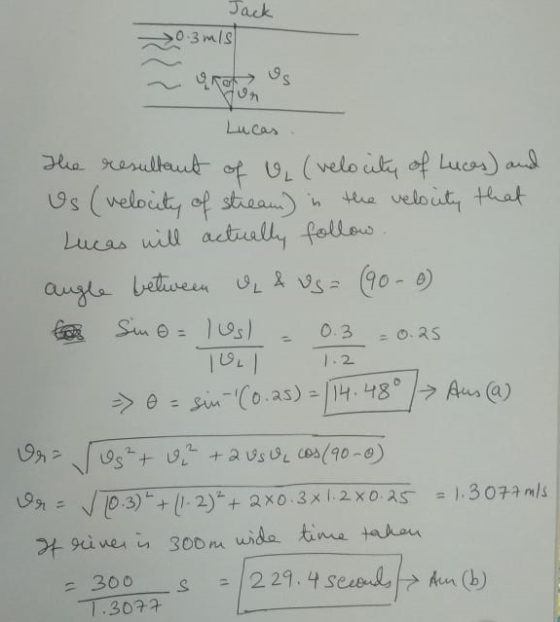
Lucas rows at a constant speed of 1.2 m/s in still water. He wants to row...
a) The constant speed of kayak paddler in still water is 0.4 m/s. The paddler needs...
a) The constant speed of kayak paddler in still water is 0.4 m/s. The paddler needs to cross a 490 m wide river and arrive at the opposite side zero meters down stream from the starting point. The paddler accomplishes this by steering the craft 27 degrees upstream. Determine the crossing time in sec. b) Heavy rain causes the river flow rate to increase 22 %. The paddler repeats the crossing at the same speed with respect to still water...
a. The constant speed of kayak paddler in still water is 1.8 m/s. The paddler needs to...
a. The constant speed of kayak paddler in still water is 1.8 m/s. The paddler needs to cross a 340 m wide river and arrive at the opposite side zero meters down stream from the starting point. The paddler accomplishes this by steering the craft 12 degrees upstream. Determine the crossing time in sec. b. Heavy rain causes the river flow rate to increase 18 %. The paddler repeats the crossing at the same speed with respect to still water and the same...
A Swimmer speed in still water is 1.85m/s. If the boat is traveling north directly across...
A Swimmer speed in still water is 1.85m/s. If the boat is traveling north directly across a river whose westward current has a speed of 1.2m/s at what upstream angle must the boat head?
A boat can travel at a speed of 4 m/s in still water. A river that...
A boat can travel at a speed of 4 m/s in still water. A river that is 170 m wide has a current that flows 0.85 m/s due West. a) If the boat points its bow directly across the river, how fast does the boat travel relative to the shore? m/s b) How long will it take to cross the river? s c) How far downriver will it land (the distance on the bank from the point directly across from...
A man rows a boat at 4 m/s north in still water. The current in a...
A man rows a boat at 4 m/s north in still water. The current in a river is 2 m/s east. The river is 40 m wide. If he wants to cross the river in the smallest possible time at what direction should he aim the boat?
A swimmer, capable of swimming at a speed of 1.02 m/s in still water (i.e., the...
A swimmer, capable of swimming at a speed of 1.02 m/s in still water (i.e., the swimmer can swim with a speed of 1.02 m/s relative to the water), starts to swim directly across a 2.96-km-wide river. However, the current is 0.550 m/s, and it carries the swimmer downstream. (a) How long does it take the swimmer to cross the river? (b) How far downstream will the swimmer be upon reaching the other side of the river?
A swimmer, capable of swimming at a speed of 1.60 m/s in still water (i.e., the...
A swimmer, capable of swimming at a speed of 1.60 m/s in still water (i.e., the swimmer can swim with a speed of 1.60 m/s relative to the water), starts to swim directly across a 2.67-km-wide river. However, the current is 1.40 m/s, and it carries the swimmer downstream. (a) How long does it take the swimmer to cross the river? (b) How far downstream will the swimmer be upon reaching the other side of the river? (Write on paper)
A swimmer, capable of swimming at a speed of 1.5 m/s in still water (i.e., the...
A swimmer, capable of swimming at a speed of 1.5 m/s in still water (i.e., the swimmer can swim with a speed of 1.5 m/s relative to the water), starts to swim directly across a 3.0-km-wide river. However, the current is 0.91 m/s, and it carries the swimmer downstream. (a) How long does it take the swimmer to cross the river? Incorrect: Your answer is incorrect. s (b) How far downstream will the swimmer be upon reaching the other side...
QUESTION 2 A man can row a boat at 2 m/s in still water. He wishes...
 QUESTION 2 A man can row a boat at 2 m/s in still water. He wishes to cross a 50-m-wide river to point B, 50 m downstream. If the river flows with a velocity of 2 m/s, determine the speed of the boat and the time needed to make the crossing 50 m 2 m/s A 50 m B T T T Arial 3 (12pt) • T ABC III
1) . A passenger on a moving train walks at a speed of 1.90 m/s due...
1) . A passenger on a moving train walks at a speed of 1.90 m/s due north relative to the train. The passenger's speed with respect to the ground is 4.5 m/s at an angle of 31.0° west of north. What are the magnitude and direction of the velocity of the train relative to the ground? 2) A ship sets sail from Rotterdam, The Netherlands, heading due north at 8.00 m/s relative to the water. The local ocean current is...
 QUESTION 2 A man can row a boat at 2 m/s in still water. He wishes to cross a 50-m-wide river to point B, 50 m downstream. If the river flows with a velocity of 2 m/s, determine the speed of the boat and the time needed to make the crossing 50 m 2 m/s A 50 m B T T T Arial 3 (12pt) • T ABC III
Most questions answered within 3 hours.
-
Where is the error in this code sequence?
String s1 = "Hello";
String s2 = "ello";...
asked 11 months ago -
Financial data for Joel de Paris, Inc., for last year
follow:
Joel de Paris, Inc.
Balance...
asked 11 months ago -
Consider this reaction:
Al2(SO4)3 (aq)+ BaCl3
(aq) Al2Cl6 (aq)- +
3BaSO4(s) . What is the...
asked 11 months ago -
Suppose that Savneet is considering increasing her
recent random sample from 20 car rentals to 40...
asked 11 months ago -
Trucks arrive at an unloading terminal at an average rate of 120
per hour.
Trucks arrive...
asked 11 months ago -
Why are methanol and ethanol completely soluble in water while
octanol is not very little soluble....
asked 11 months ago -
A facilities manager at a university reads in a research report
that the mean amount of...
asked 11 months ago -
When the CuSO4 is rehydrated by adding water to the anhydrous
compound, is this an endothermic...
asked 11 months ago -
A ray of sunlight is passing from diamond into crown glass; the
angle of incidence is...
asked 11 months ago -
A block of mass 0.249 kg is placed on top of a light, vertical
spring of...
asked 11 months ago -
how do the kidneys compensate in the presences of acidosis
a) trigger hyperventilate
b) reserve acid...
asked 11 months ago -
Question 501 pts
The rental rate of capital to the firm increases. Which of the
following...
asked 11 months ago