Interpret the following equation for a chemical reaction using the coefficients given: BOXES: ONE MOLCULE, TWO...
Interpret the following equation for a chemical reaction using the coefficients given: BOXES: ONE MOLCULE, TWO MOLCULE, ONE MOLE, TWO MOLES
Homework Answers

Add Answer to:
Interpret the following equation for a chemical reaction using
the coefficients given: BOXES: ONE MOLCULE, TWO...
Interpret the following equation for a chemical reaction using the coefficients given: CO(g) + Cl2(g) -...
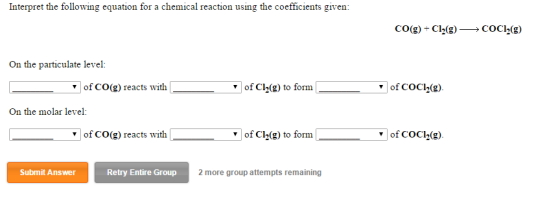
 Interpret the following equation for a chemical reaction using the coefficients given: CO(g) + Cl2(g) - COC12(g) On the particulate level: of CO(g) reacts with of Cl2(g) to form of COC12(g). On the molar level: of CO(g) reacts with of Cl2(g) to form of COCIz(g) The balanced chemical equation for the reaction between carbon disulfide and chlorine is: CS(s) + 4Cl2() CCI (1) +2 SCI2 (8) We can interpret this to mean: 4 moles of chlorine and mole(s) of carbon...
signment/takeCovalentAc to accesS Interpret the following equation for a chemical reaction using the coefficients given On...
 signment/takeCovalentAc to accesS Interpret the following equation for a chemical reaction using the coefficients given On the particulate level: of H(g) reacts with of O2(g) to form of H20(g). On the molar level: of H(g) reacts with | of O,(g) to form vof H0(g). s remaining req
Interpret the following equation for a chemical reaction using the coefficients given: 12(g) + Cl2(g) →...
 Interpret the following equation for a chemical reaction using the coefficients given: 12(g) + Cl2(g) → 2 ICI(g) On the particulate level: of 12(g) reacts with of Cl2(g) to form of ICI(g) On the molar level: of 12(g) reacts with of C12(g) to form of ICI(g)
(Part A) Determine the balanced chemical equation for this reaction. C8H18(g)+O2(g)→CO2(g)+H2O(g) Enter the coefficients for each...
(Part A) Determine the balanced chemical equation for this reaction. C8H18(g)+O2(g)→CO2(g)+H2O(g) Enter the coefficients for each compound in order, separated by commas. For example, 1,2,3,4 would indicate one mole of C8H18, two moles of O2, three moles of CO2, and four moles of H2O. (Part B) 0.170 mol of octane is allowed to react with 0.880 mol of oxygen. Which is the limiting reactant? (Part C) How many moles of water are produced in this reaction? (Part D) After the...
Chemical Reactions with Isotopes The coefficients in a balanced chemical equation represent the relative numbers of...
Chemical Reactions with Isotopes The coefficients in a balanced chemical equation represent the relative numbers of each molecule or formula unit and the relative number of moles of each molecule or formula unit. In a balanced equation, the stoichiometric relationships among the substances allow us to convert between quantities of reactants and products in a reaction. Deuterium Deuterium (written as D or 2H) is an isotope of hydrogen known as heavy hydrogen. PART A QUESTION: Balance the given chemical equation...
Part A Determine the balanced chemical equation for this reaction. C8H18(g)+O2(g)?CO2(g)+H2O(g) Enter the coefficients for each...
Part A Determine the balanced chemical equation for this reaction. C8H18(g)+O2(g)?CO2(g)+H2O(g) Enter the coefficients for each compound in order, separated by commas. For example, 1,2,3,4 would indicate one mole of C8H18, two moles of O2, three moles of CO2, and four moles of H2O. 2,25,16,18 SubmitHintsMy AnswersGive UpReview Part Correct It is important to balance a chemical equation before using it for calculations. Checking that equations are balanced will help you avoid many errors in chemistry problems. Balanced chemical equation...
Why must chemical equations be balanced? In a balanced chemical equation, the coefficients in front of...
Why must chemical equations be balanced? In a balanced chemical equation, the coefficients in front of each reactant and product allow us to predict whether the given reaction is possible or not. In a balanced chemical equation, the coefficients in front of each reactant and product allow us to predict whether the reaction requires a catalyst or not. In a balanced chemical equation, the coefficients in front of each reactant and product allow us to predict the amount of product...
Read the chemical equation. 2C2H2 + 5O2 → 4CO2 + 2H2O Which of the following statements...
Read the chemical equation. 2C2H2 + 5O2 → 4CO2 + 2H2O Which of the following statements would be correct if one mole of C2H2 was used in this reaction? One mole of oxygen was used in this reaction. Five moles of oxygen were used in this reaction. Four moles of carbon dioxide were produced from this reaction. Two moles of carbon dioxide were produced from this reaction.
The coefficients in a balanced chemical equation provide the mole-to-mole stoichiometry among the reactants and products
The coefficients in a balanced chemical equation provide the mole-to-mole stoichiometry among the reactants and products. The molar mass (in g/mol) can be used as the conversion factor between moles and the mass of a substance. Thus, the balanced equation and molar masses can be used in conjunction with one another to calculate the masses involved in a reaction. Part B What mass of carbon dioxide is produced from the complete combustion of 1.90x10⁻³ g of methane?Part C What mass of water is...
balance the following reaction Balance the following chemical equation. What are the correct stoichiometric coefficients for...
 balance the following reaction
Balance the following chemical equation. What are the correct stoichiometric coefficients for each molecule, in the order they appear in the reaction? CH +,-> CO + H2O Select one: o a. 2; 9; 6; 6 b.2; 6; 4; 4 o c. 1; 1; 1; 1 d. 1; 6; 3; 3 Next page
balance the following reaction
Balance the following chemical equation. What are the correct stoichiometric coefficients for each molecule, in the order they appear in the reaction? CH +,-> CO + H2O Select one: o a. 2; 9; 6; 6 b.2; 6; 4; 4 o c. 1; 1; 1; 1 d. 1; 6; 3; 3 Next page
 Interpret the following equation for a chemical reaction using the coefficients given: CO(g) + Cl2(g) - COC12(g) On the particulate level: of CO(g) reacts with of Cl2(g) to form of COC12(g). On the molar level: of CO(g) reacts with of Cl2(g) to form of COCIz(g) The balanced chemical equation for the reaction between carbon disulfide and chlorine is: CS(s) + 4Cl2() CCI (1) +2 SCI2 (8) We can interpret this to mean: 4 moles of chlorine and mole(s) of carbon...
 signment/takeCovalentAc to accesS Interpret the following equation for a chemical reaction using the coefficients given On the particulate level: of H(g) reacts with of O2(g) to form of H20(g). On the molar level: of H(g) reacts with | of O,(g) to form vof H0(g). s remaining req
 Interpret the following equation for a chemical reaction using the coefficients given: 12(g) + Cl2(g) → 2 ICI(g) On the particulate level: of 12(g) reacts with of Cl2(g) to form of ICI(g) On the molar level: of 12(g) reacts with of C12(g) to form of ICI(g)
 balance the following reaction
Balance the following chemical equation. What are the correct stoichiometric coefficients for each molecule, in the order they appear in the reaction? CH +,-> CO + H2O Select one: o a. 2; 9; 6; 6 b.2; 6; 4; 4 o c. 1; 1; 1; 1 d. 1; 6; 3; 3 Next page
balance the following reaction
Balance the following chemical equation. What are the correct stoichiometric coefficients for each molecule, in the order they appear in the reaction? CH +,-> CO + H2O Select one: o a. 2; 9; 6; 6 b.2; 6; 4; 4 o c. 1; 1; 1; 1 d. 1; 6; 3; 3 Next page
Most questions answered within 3 hours.
-
Where is the error in this code sequence?
String s1 = "Hello";
String s2 = "ello";...
asked 10 months ago -
Financial data for Joel de Paris, Inc., for last year
follow:
Joel de Paris, Inc.
Balance...
asked 10 months ago -
Consider this reaction:
Al2(SO4)3 (aq)+ BaCl3
(aq) Al2Cl6 (aq)- +
3BaSO4(s) . What is the...
asked 10 months ago -
Suppose that Savneet is considering increasing her
recent random sample from 20 car rentals to 40...
asked 10 months ago -
Trucks arrive at an unloading terminal at an average rate of 120
per hour.
Trucks arrive...
asked 10 months ago -
Why are methanol and ethanol completely soluble in water while
octanol is not very little soluble....
asked 10 months ago -
A facilities manager at a university reads in a research report
that the mean amount of...
asked 10 months ago -
When the CuSO4 is rehydrated by adding water to the anhydrous
compound, is this an endothermic...
asked 10 months ago -
A ray of sunlight is passing from diamond into crown glass; the
angle of incidence is...
asked 10 months ago -
A block of mass 0.249 kg is placed on top of a light, vertical
spring of...
asked 10 months ago -
how do the kidneys compensate in the presences of acidosis
a) trigger hyperventilate
b) reserve acid...
asked 10 months ago -
Question 501 pts
The rental rate of capital to the firm increases. Which of the
following...
asked 10 months ago