please provide good explanation.
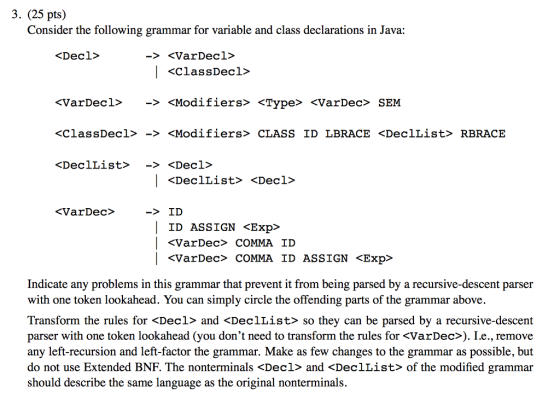
Consider the following grammar for variable and class declarations in Java:
      <Decl>      -> <VarDecl>
                   | <ClassDecl>
<VarDecl> -> <Modifiers> <Type> <VarDec> SEM
<ClassDecl> -> <Modifiers> CLASS ID LBRACE <DeclList> RBRACE
      <DeclList>  -> <Decl>
                   | <DeclList> <Decl>
      <VarDec>    -> ID
                   | ID ASSIGN <Exp>
                   | <VarDec> COMMA ID
                   | <VarDec> COMMA ID ASSIGN <Exp>
Indicate any problems in this grammar that prevent it from being parsed by a recursive-descent parser with one token lookahead. You can simply circle the offending parts of the grammar above.
Transform the rules for <Decl> and <DeclList> so they can be parsed by a recursive-descent parser with one token lookahead (you don’t need to transform the rules for <VarDec>). I.e., remove any left-recursion and left-factor the grammar. Make as few changes to the grammar as possible, but do not use Extended BNF. The nonterminals <Decl> and <DeclList> of the modified grammar should describe the same language as the original nonterminals.
Homework Answers

Add Answer to:
please provide good explanation.
Consider the following grammar for variable and class
declarations in Java:
<Decl>...
Consider the following grammar for variable and class declarations in Java: <Decl> -> <VarDecl> | <ClassDecl>...
Consider the following grammar for variable and class declarations in Java: <Decl> -> <VarDecl> | <ClassDecl> <VarDecl> -> <Modifiers> <Type> <VarDec> SEM <ClassDecl> -> <Modifiers> CLASS ID LBRACE <DeclList> RBRACE <DeclList> -> <Decl> | <DeclList> <Decl> <VarDec> -> ID | ID ASSIGN <Exp> | <VarDec> COMMA ID | <VarDec> COMMA ID ASSIGN <Exp> Indicate any problems in this grammar that prevent it from being parsed by a recursive-descent parser with one token lookahead. Transform this grammar into a form that...
Write a parser program for cSub using the method of recursive descent. The main program here...
Write a parser program for cSub using the method of recursive descent. The main program here will effectively be the main program of the compiler as a whole. The input to the program will be a Csub source file, specified on the command line. The program will construct a parse tree for the program, with one interior node for every nonterminal in the derivation of the program, and one leaf node for each of the id, num, and real tokens...
1. (p. 2-3.) Which of the following is NOT a reason for studying concepts of programming...
1. (p. 2-3.) Which of the following is NOT a reason for studying concepts of programming languages according to Sebesta? a. Increased capacity to express ideas. b. Improved background for choosing appropriate languages. c. Increased ability to design new languages. d. Increased ability to learn new languages. 2. (p. 5-6.) What programming language has dominated scientific computing over the past 50 years? a. FORTRAN b. ALGOL c. SNOBOL d. PL/I 3. (p. 6.) What programming language has dominated artificial intelligence...
Most questions answered within 3 hours.
-
Where is the error in this code sequence?
String s1 = "Hello";
String s2 = "ello";...
asked 10 months ago -
Financial data for Joel de Paris, Inc., for last year
follow:
Joel de Paris, Inc.
Balance...
asked 10 months ago -
Consider this reaction:
Al2(SO4)3 (aq)+ BaCl3
(aq) Al2Cl6 (aq)- +
3BaSO4(s) . What is the...
asked 10 months ago -
Suppose that Savneet is considering increasing her
recent random sample from 20 car rentals to 40...
asked 10 months ago -
Trucks arrive at an unloading terminal at an average rate of 120
per hour.
Trucks arrive...
asked 10 months ago -
Why are methanol and ethanol completely soluble in water while
octanol is not very little soluble....
asked 10 months ago -
A facilities manager at a university reads in a research report
that the mean amount of...
asked 10 months ago -
When the CuSO4 is rehydrated by adding water to the anhydrous
compound, is this an endothermic...
asked 10 months ago -
A ray of sunlight is passing from diamond into crown glass; the
angle of incidence is...
asked 10 months ago -
A block of mass 0.249 kg is placed on top of a light, vertical
spring of...
asked 10 months ago -
how do the kidneys compensate in the presences of acidosis
a) trigger hyperventilate
b) reserve acid...
asked 10 months ago -
Question 501 pts
The rental rate of capital to the firm increases. Which of the
following...
asked 10 months ago