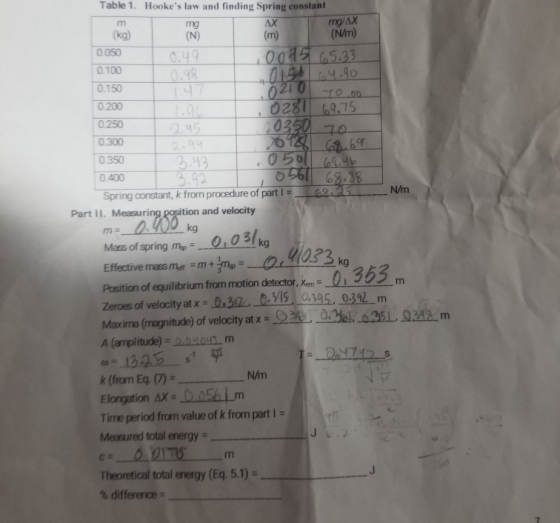
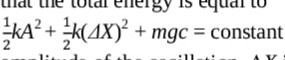
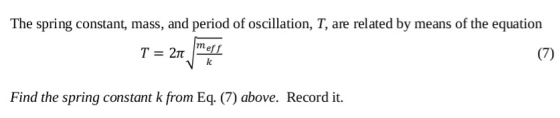
please find k, time period from k of part 1, measured total energy, and theoretical energy using the information from the pic below and the equations in the following pictures
equation 5.1:
equation 7:
Homework Answers

Add Answer to:
please find k, time period from k of part 1, measured
total energy, and theoretical energy...
PLEASE HELP ME FIND THEORETICAL PERIOD T in seconds and % error in T fill in...
PLEASE HELP ME FIND THEORETICAL PERIOD T in seconds and % error in T fill in this table from the last two PLease answer the force constant of spring k = ___ ? _____ N/m PLease answer the force constant of spring k = ___ ? _____ N/m And remember to give solution to part b of page 73 for analysis for procedure 2 click in this link to see https://docs.google.com/document/d/1_qBm8AED8B3D-rHBdP9b5wjN4PKZijZLbTYWcNJfP5k/edit?usp=sharing
A Hooke's law spring constant k=7 220 N/m is compressed 12.0 cm from equilibrium using a...
A Hooke's law spring constant k=7 220 N/m is compressed 12.0 cm from equilibrium using a 1 kg mass starts to move up on a frictionless inclined plane. Find the velocity immediately after it is released. Find its potential energy as it moves up 3 meters.
Review Constants Let's begin with a straightforward example of simple harmonic motion (SHM). A spring is...
 Review Constants Let's begin with a straightforward example of simple harmonic motion (SHM). A spring is mounted horizontally on an air track as in (Figure 1), with the left end held stationary. We attach a spring balance to the free end of the spring, pull toward the right, and measure the elongation. We determine that the stretching force is proportional to the displacement and that a force of 60 N causes an elongation of 0.030 m. We remove the spring...
(a) Find the period of oscillation for a spring-mass system where the spring constant (k) is...
(a) Find the period of oscillation for a spring-mass system where the spring constant (k) is 24 N/m and the mass (m) is 6 kg. (b) Write an equation for x(t) if the spring is stretched to an amplitude of 10 cm from its equilibrium position x = 0 at t = 0. (c) Write an equation for the following initial conditions: at t = 0, the mass is at x = 0 and has a velocity of +3 cm/s.
Simple Harmonic Motion. Effective Spring Constant: In Part I you measured the keffective of the two...
 Simple Harmonic Motion.
Effective Spring Constant: In Part I you
measured the keffective of the two springs acting
together. If the two springs had k1 and k2
individually, how would they combine to get keff?
Systemic Error: Leveling Air Track: We level
the air track in this lab because it's good lab procedure in
general, but in fact in this lab a not-level (but still straight)
air track shouldn't change any of our results. Explain why this is
true (for...
Simple Harmonic Motion.
Effective Spring Constant: In Part I you
measured the keffective of the two springs acting
together. If the two springs had k1 and k2
individually, how would they combine to get keff?
Systemic Error: Leveling Air Track: We level
the air track in this lab because it's good lab procedure in
general, but in fact in this lab a not-level (but still straight)
air track shouldn't change any of our results. Explain why this is
true (for...
part D PART II - PROBLEM SOLVING - 12 POINTS PER PROBLEM FOR A TOTAL OF...
 part D
PART II - PROBLEM SOLVING - 12 POINTS PER PROBLEM FOR A TOTAL OF 24 POINTS. 1. A block is attached to a light spring and set oscillating along a horizontal, frictionless surface. The block oscillates in simple harmonic motion (SHM) and the following observations were taken by a student a) (3 pts) Using a stop watch, the student measured the time for the block to complete 20 oscillations to be 15 seconds. What is the period of...
part D
PART II - PROBLEM SOLVING - 12 POINTS PER PROBLEM FOR A TOTAL OF 24 POINTS. 1. A block is attached to a light spring and set oscillating along a horizontal, frictionless surface. The block oscillates in simple harmonic motion (SHM) and the following observations were taken by a student a) (3 pts) Using a stop watch, the student measured the time for the block to complete 20 oscillations to be 15 seconds. What is the period of...
Elasticity, Hooke's Law, Periodic and Simple Harmonic Motion: A 1.6 kg mass is hung from a...
 Elasticity, Hooke's Law, Periodic and Simple Harmonic Motion: A 1.6 kg mass is hung from a 25 cm long coiled spring. The the total surface area of the spring is 3.20 10-4 m? (Assume no friction or air resistance, and a "mass-less" spring) Part 1. If the spring stretches 16 cm when the mass is added, what is the Spring Constant (k)? Give your answer to 2 significant digits. kg/s2 Part 2. What is the Stress on the spring? Give...
The figure shows the position-time graph of an object of mass m oscillating on the end of a massless ideal spring of spring constant k
 The figure shows the position-time graph of an object of mass m oscillating on the end of a massless ideal spring of
spring constant k. Answer the following questions.1. Which of the following graphs is the correct
velocity-time graph of the oscillation?2. Which of the following graphs is the correct
acceleration-time graph of the oscillation?3. If the mass of the object is m = 0.500 kg, what is
the spring constant k of the ideal spring?Hint: read o the period of...
The figure shows the position-time graph of an object of mass m oscillating on the end of a massless ideal spring of
spring constant k. Answer the following questions.1. Which of the following graphs is the correct
velocity-time graph of the oscillation?2. Which of the following graphs is the correct
acceleration-time graph of the oscillation?3. If the mass of the object is m = 0.500 kg, what is
the spring constant k of the ideal spring?Hint: read o the period of...
Please show all work! 4) What is the total energy of the mass-spring system shown below?...
 Please show all work!
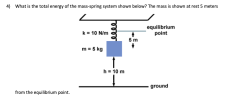
4) What is the total energy of the mass-spring system shown below? The mass is shown at rest 5 meters k = 10 N/m equilibrium point 4 5 m m = 5 kg h = 10 m ground from the equilibrium point.
Please show all work!
4) What is the total energy of the mass-spring system shown below? The mass is shown at rest 5 meters k = 10 N/m equilibrium point 4 5 m m = 5 kg h = 10 m ground from the equilibrium point.
4.) A light horizontal spring (k=4000 N/m) is compressed 10 centimeters from its relaxed state by...
4.) A light horizontal spring (k=4000 N/m) is compressed 10 centimeters from its relaxed state by a 3 kg mass on the left, and a 5 kg mass on the right, which are initially at rest. The spring then is allowed to relax, pushing the masses apart. A.) Calculate the final total kinetic energy of this system (i.e. both masses). (20 J) B.) Determine the final velocity of each mass when the spring relaxes. Assume friction is negligible.
 Review Constants Let's begin with a straightforward example of simple harmonic motion (SHM). A spring is mounted horizontally on an air track as in (Figure 1), with the left end held stationary. We attach a spring balance to the free end of the spring, pull toward the right, and measure the elongation. We determine that the stretching force is proportional to the displacement and that a force of 60 N causes an elongation of 0.030 m. We remove the spring...
 Simple Harmonic Motion.
Effective Spring Constant: In Part I you
measured the keffective of the two springs acting
together. If the two springs had k1 and k2
individually, how would they combine to get keff?
Systemic Error: Leveling Air Track: We level
the air track in this lab because it's good lab procedure in
general, but in fact in this lab a not-level (but still straight)
air track shouldn't change any of our results. Explain why this is
true (for...
Simple Harmonic Motion.
Effective Spring Constant: In Part I you
measured the keffective of the two springs acting
together. If the two springs had k1 and k2
individually, how would they combine to get keff?
Systemic Error: Leveling Air Track: We level
the air track in this lab because it's good lab procedure in
general, but in fact in this lab a not-level (but still straight)
air track shouldn't change any of our results. Explain why this is
true (for...
 part D
PART II - PROBLEM SOLVING - 12 POINTS PER PROBLEM FOR A TOTAL OF 24 POINTS. 1. A block is attached to a light spring and set oscillating along a horizontal, frictionless surface. The block oscillates in simple harmonic motion (SHM) and the following observations were taken by a student a) (3 pts) Using a stop watch, the student measured the time for the block to complete 20 oscillations to be 15 seconds. What is the period of...
part D
PART II - PROBLEM SOLVING - 12 POINTS PER PROBLEM FOR A TOTAL OF 24 POINTS. 1. A block is attached to a light spring and set oscillating along a horizontal, frictionless surface. The block oscillates in simple harmonic motion (SHM) and the following observations were taken by a student a) (3 pts) Using a stop watch, the student measured the time for the block to complete 20 oscillations to be 15 seconds. What is the period of...
 Elasticity, Hooke's Law, Periodic and Simple Harmonic Motion: A 1.6 kg mass is hung from a 25 cm long coiled spring. The the total surface area of the spring is 3.20 10-4 m? (Assume no friction or air resistance, and a "mass-less" spring) Part 1. If the spring stretches 16 cm when the mass is added, what is the Spring Constant (k)? Give your answer to 2 significant digits. kg/s2 Part 2. What is the Stress on the spring? Give...
 The figure shows the position-time graph of an object of mass m oscillating on the end of a massless ideal spring of
spring constant k. Answer the following questions.1. Which of the following graphs is the correct
velocity-time graph of the oscillation?2. Which of the following graphs is the correct
acceleration-time graph of the oscillation?3. If the mass of the object is m = 0.500 kg, what is
the spring constant k of the ideal spring?Hint: read o the period of...
The figure shows the position-time graph of an object of mass m oscillating on the end of a massless ideal spring of
spring constant k. Answer the following questions.1. Which of the following graphs is the correct
velocity-time graph of the oscillation?2. Which of the following graphs is the correct
acceleration-time graph of the oscillation?3. If the mass of the object is m = 0.500 kg, what is
the spring constant k of the ideal spring?Hint: read o the period of...
 Please show all work!
4) What is the total energy of the mass-spring system shown below? The mass is shown at rest 5 meters k = 10 N/m equilibrium point 4 5 m m = 5 kg h = 10 m ground from the equilibrium point.
Please show all work!
4) What is the total energy of the mass-spring system shown below? The mass is shown at rest 5 meters k = 10 N/m equilibrium point 4 5 m m = 5 kg h = 10 m ground from the equilibrium point.
Most questions answered within 3 hours.
-
Where is the error in this code sequence?
String s1 = "Hello";
String s2 = "ello";...
asked 11 months ago -
Financial data for Joel de Paris, Inc., for last year
follow:
Joel de Paris, Inc.
Balance...
asked 11 months ago -
Consider this reaction:
Al2(SO4)3 (aq)+ BaCl3
(aq) Al2Cl6 (aq)- +
3BaSO4(s) . What is the...
asked 11 months ago -
Suppose that Savneet is considering increasing her
recent random sample from 20 car rentals to 40...
asked 11 months ago -
Trucks arrive at an unloading terminal at an average rate of 120
per hour.
Trucks arrive...
asked 11 months ago -
Why are methanol and ethanol completely soluble in water while
octanol is not very little soluble....
asked 11 months ago -
A facilities manager at a university reads in a research report
that the mean amount of...
asked 11 months ago -
When the CuSO4 is rehydrated by adding water to the anhydrous
compound, is this an endothermic...
asked 11 months ago -
A ray of sunlight is passing from diamond into crown glass; the
angle of incidence is...
asked 11 months ago -
A block of mass 0.249 kg is placed on top of a light, vertical
spring of...
asked 11 months ago -
how do the kidneys compensate in the presences of acidosis
a) trigger hyperventilate
b) reserve acid...
asked 11 months ago -
Question 501 pts
The rental rate of capital to the firm increases. Which of the
following...
asked 11 months ago