
Homework Answers
Add Answer to:
пUTUе Hold all sodium nitrate 3. For the reactions below: a. Which substance is acting as...
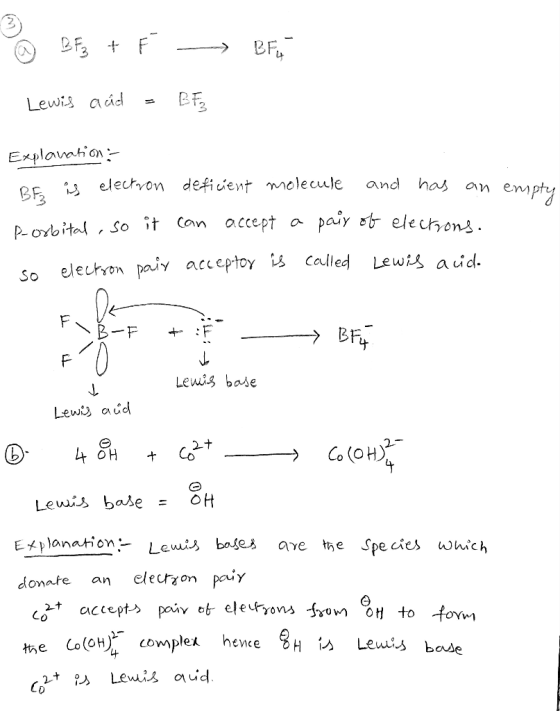
Question 22 (2 points) Which substance is acting like a Lewis acid in the following reaction?...
 Question 22 (2 points) Which substance is acting like a Lewis acid in the following reaction? BF3 (g) + Fl-(g) = BF41-(g) O BF4'- (g) This is not a Lewis acid/base reaction BF3(g) Fl-(g)
Acids and bases: definitions ut of Consider the following reactions: (a) Ca(OH)2 + 2 HCI -...
 Acids and bases: definitions ut of Consider the following reactions: (a) Ca(OH)2 + 2 HCI - CaCl + 2 H2O (b) CaH2 + 2 H2O + Ca(OH)2 + 2 H2 (c) BF3 + F - BF4 Match with the definitions that apply for the substances indicated. Note: In a given reaction, the same definition must apply for both the acid and base for it to hold true, Ca(OH)2 in reaction (a) Arrhenius, Bransted-Lowry, and Lewis base HCI Arrhenius, Bransted-Lowry, and...
1. Which of the following is NOT acidic? A. Lemons B. Lye C. Vinegar D. Soda...
 1. Which of the following is NOT acidic? A. Lemons B. Lye C. Vinegar D. Soda 2. What is the proper name for HNO3? A. Nitrate acid B. Nitric acid C. Nitrous acid D. Hydronitric acid 3. The conjugate acid and base of the ion, H2PO4, are: Conjugate Acid Conjugate Base H30+ OH H30+ PO43- H3PO4 HPO42- H3PO4 PO43- Love 4. What is the H+ concentration in a solution with a pol of 10.25? A. 5.6 x 10³ M B....
Acids and bases: Part I Consider the following reactions: (a) 2 NH3 + Ag+ → [Ag(NH3)2]+...
Acids and bases: Part I Consider the following reactions: (a) 2 NH3 + Ag+ → [Ag(NH3)2]+ (b) NH4+ + CO32- → NH3 + HCO3- (c) 2 HBr + Ca(OH)2 → CaBr2 + 2 H2O Match with the definitions that apply for the substances indicated. Note: In a given reaction, the same definition must apply for both the acid and base for it to hold true. Choices: a)Lewis-base b)Bronsted-Lowry and Lewis Base c) Lewis acid d) Arrhenius, Bronsted-Lowry, and Lewis acid...
In the reaction below, which species is acting as the acid? HCIO4 (aq)+ KOH (aq)KCIO4 (aq)...
 In the reaction below, which species is acting as the acid? HCIO4 (aq)+ KOH (aq)KCIO4 (aq) + H2O () КОН HCIO KCIO Нао Determine the net ionic reaction of the acid-base reaction below. KOH(aq)+ HNO3 (aq)-KNO3(aq)+ H2O() K (aa)+ O2(aq) + H(aq)+ H (aq)+ N (aa) + O3 (aq) K'(aq) + N3(aq) + O3 (aq)+ H2O() OH (aq)+ H (aq) H2O () C KOH(aq)+ HNO3 (aq) KNO3(aq)+ HO0) C K (aa) + OH(aq)+ H'(aa) + NO3 (aq) K(aq)+ NO3 (aq)+H2O()...
1. Which of the followi ch of the following reactions is not readily explained by the...
 1. Which of the followi ch of the following reactions is not readily explained by the Arrhenius concept of acids and bases? a. A. HCl(aq) + NaOH(aq) - NaCl(aq) + H20() b. H30(aq) + OH-(aq) + 2H20(1) c. HCI(g) + NH3(g) - NH4Cl(s) d. HC2H302(aq) + H2O(l) H30*(aq) + C2H302-(ag) e. H30 (aq) + OH-(aq) + 2H2O(aq) 2. Classify each of the following species as Brønsted acid or base or both: a) H20, b) OH", c) H30, d) NH3, e)...
1. Which of the followi ch of the following reactions is not readily explained by the Arrhenius concept of acids a...
 1. Which of the followi ch of the following reactions is not readily explained by the Arrhenius concept of acids and bases? a. A. HCl(aq) + NaOH(aq) - NaCl(aq) + H20() b. H30(aq) + OH-(aq) + 2H20(1) c. HCI(g) + NH3(g) - NH4Cl(s) d. HC2H302(aq) + H2O(l) H30*(aq) + C2H302-(ag) e. H30 (aq) + OH-(aq) + 2H2O(aq) 2. Classify each of the following species as Brønsted acid or base or both: a) H20, b) OH", c) H30, d) NH3, e)...
Which of the chemical equations below are acid-base (proton transfer) reactions? Select all that apply. Fe(NO3)3...
Which of the chemical equations below are acid-base (proton transfer) reactions? Select all that apply. Fe(NO3)3 (aq) + 3 KOH (aq) → Fe(OH)3 (s) + 3 KNO3 (aq) NH3 (aq) + HCl (aq) → NH4Cl (aq) HCl (aq) + KOH (aq) → KCl (aq) + H2O (l) Mg(OH)2 (s) + H2SO4 (aq) → MgSO4 (s) + 2 H2O (l) Mg (s) + Cu(NO3)2 (aq) --> Mg(NO3)3 (aq) + Cu (s) Zn (s) + Cu(NO3)2 (aq) → Zn(NO3)2 (aq) + Cu...
Question 51 (8 points) A 10 gram sample of which substance contains the greatest number of...
 Question 51 (8 points) A 10 gram sample of which substance contains the greatest number of hydrogen atoms? 10 grams of CH4 10 grams of HCI 10 grams of PH 3 10 grams of H2 Question 52 (8 points) What is the oxidation number of nitrogen in the nitrate ion? :0: +6 +5 O-1 +1 Question 49 (8 points) Which set of quantum numbers is correct and consistent with n = 4? me = -3 ms = +1 me =...
I just need the blank data table with all the reactions shown. I need ALL 36...
 I just need the blank data table with
all the reactions shown. I need ALL 36 spaces for reacting
solutions. I don't need the observations. Please
help.
ARE hem 310 LAB EXPERIMENT #6 Chemical Reactions: Double Replacements I. OBJECTIVES 1. To perform and record observations of some chemical reactions. 2. To gain skill in writing balanced equations from observations of chemical reactions using known reactants. 3. To look for ions that, if present, may cause the compounds to be insoluble...
I just need the blank data table with
all the reactions shown. I need ALL 36 spaces for reacting
solutions. I don't need the observations. Please
help.
ARE hem 310 LAB EXPERIMENT #6 Chemical Reactions: Double Replacements I. OBJECTIVES 1. To perform and record observations of some chemical reactions. 2. To gain skill in writing balanced equations from observations of chemical reactions using known reactants. 3. To look for ions that, if present, may cause the compounds to be insoluble...
 Question 22 (2 points) Which substance is acting like a Lewis acid in the following reaction? BF3 (g) + Fl-(g) = BF41-(g) O BF4'- (g) This is not a Lewis acid/base reaction BF3(g) Fl-(g)
 Acids and bases: definitions ut of Consider the following reactions: (a) Ca(OH)2 + 2 HCI - CaCl + 2 H2O (b) CaH2 + 2 H2O + Ca(OH)2 + 2 H2 (c) BF3 + F - BF4 Match with the definitions that apply for the substances indicated. Note: In a given reaction, the same definition must apply for both the acid and base for it to hold true, Ca(OH)2 in reaction (a) Arrhenius, Bransted-Lowry, and Lewis base HCI Arrhenius, Bransted-Lowry, and...
 1. Which of the following is NOT acidic? A. Lemons B. Lye C. Vinegar D. Soda 2. What is the proper name for HNO3? A. Nitrate acid B. Nitric acid C. Nitrous acid D. Hydronitric acid 3. The conjugate acid and base of the ion, H2PO4, are: Conjugate Acid Conjugate Base H30+ OH H30+ PO43- H3PO4 HPO42- H3PO4 PO43- Love 4. What is the H+ concentration in a solution with a pol of 10.25? A. 5.6 x 10³ M B....
 In the reaction below, which species is acting as the acid? HCIO4 (aq)+ KOH (aq)KCIO4 (aq) + H2O () КОН HCIO KCIO Нао Determine the net ionic reaction of the acid-base reaction below. KOH(aq)+ HNO3 (aq)-KNO3(aq)+ H2O() K (aa)+ O2(aq) + H(aq)+ H (aq)+ N (aa) + O3 (aq) K'(aq) + N3(aq) + O3 (aq)+ H2O() OH (aq)+ H (aq) H2O () C KOH(aq)+ HNO3 (aq) KNO3(aq)+ HO0) C K (aa) + OH(aq)+ H'(aa) + NO3 (aq) K(aq)+ NO3 (aq)+H2O()...
 1. Which of the followi ch of the following reactions is not readily explained by the Arrhenius concept of acids and bases? a. A. HCl(aq) + NaOH(aq) - NaCl(aq) + H20() b. H30(aq) + OH-(aq) + 2H20(1) c. HCI(g) + NH3(g) - NH4Cl(s) d. HC2H302(aq) + H2O(l) H30*(aq) + C2H302-(ag) e. H30 (aq) + OH-(aq) + 2H2O(aq) 2. Classify each of the following species as Brønsted acid or base or both: a) H20, b) OH", c) H30, d) NH3, e)...
 1. Which of the followi ch of the following reactions is not readily explained by the Arrhenius concept of acids and bases? a. A. HCl(aq) + NaOH(aq) - NaCl(aq) + H20() b. H30(aq) + OH-(aq) + 2H20(1) c. HCI(g) + NH3(g) - NH4Cl(s) d. HC2H302(aq) + H2O(l) H30*(aq) + C2H302-(ag) e. H30 (aq) + OH-(aq) + 2H2O(aq) 2. Classify each of the following species as Brønsted acid or base or both: a) H20, b) OH", c) H30, d) NH3, e)...
 Question 51 (8 points) A 10 gram sample of which substance contains the greatest number of hydrogen atoms? 10 grams of CH4 10 grams of HCI 10 grams of PH 3 10 grams of H2 Question 52 (8 points) What is the oxidation number of nitrogen in the nitrate ion? :0: +6 +5 O-1 +1 Question 49 (8 points) Which set of quantum numbers is correct and consistent with n = 4? me = -3 ms = +1 me =...
 I just need the blank data table with
all the reactions shown. I need ALL 36 spaces for reacting
solutions. I don't need the observations. Please
help.
ARE hem 310 LAB EXPERIMENT #6 Chemical Reactions: Double Replacements I. OBJECTIVES 1. To perform and record observations of some chemical reactions. 2. To gain skill in writing balanced equations from observations of chemical reactions using known reactants. 3. To look for ions that, if present, may cause the compounds to be insoluble...
I just need the blank data table with
all the reactions shown. I need ALL 36 spaces for reacting
solutions. I don't need the observations. Please
help.
ARE hem 310 LAB EXPERIMENT #6 Chemical Reactions: Double Replacements I. OBJECTIVES 1. To perform and record observations of some chemical reactions. 2. To gain skill in writing balanced equations from observations of chemical reactions using known reactants. 3. To look for ions that, if present, may cause the compounds to be insoluble...
Most questions answered within 3 hours.
-
Where is the error in this code sequence?
String s1 = "Hello";
String s2 = "ello";...
asked 10 months ago -
Financial data for Joel de Paris, Inc., for last year
follow:
Joel de Paris, Inc.
Balance...
asked 10 months ago -
Consider this reaction:
Al2(SO4)3 (aq)+ BaCl3
(aq) Al2Cl6 (aq)- +
3BaSO4(s) . What is the...
asked 10 months ago -
Suppose that Savneet is considering increasing her
recent random sample from 20 car rentals to 40...
asked 10 months ago -
Trucks arrive at an unloading terminal at an average rate of 120
per hour.
Trucks arrive...
asked 10 months ago -
Why are methanol and ethanol completely soluble in water while
octanol is not very little soluble....
asked 10 months ago -
A facilities manager at a university reads in a research report
that the mean amount of...
asked 10 months ago -
When the CuSO4 is rehydrated by adding water to the anhydrous
compound, is this an endothermic...
asked 10 months ago -
A ray of sunlight is passing from diamond into crown glass; the
angle of incidence is...
asked 10 months ago -
A block of mass 0.249 kg is placed on top of a light, vertical
spring of...
asked 10 months ago -
how do the kidneys compensate in the presences of acidosis
a) trigger hyperventilate
b) reserve acid...
asked 10 months ago -
Question 501 pts
The rental rate of capital to the firm increases. Which of the
following...
asked 10 months ago