
Homework Answers
Add Answer to:
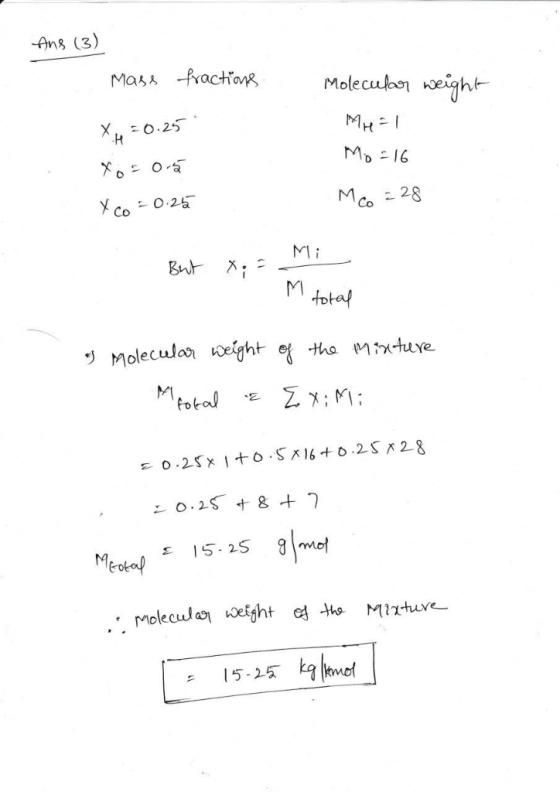
Question 3 An ideal gas mixture consists of 25 percent hydrogen, 50 oxygen, and 25 carbon...
A mixture of gases consists of 0.11 kg of oxygen, 0.80 kg of carbon dioxide, and...
 A mixture of gases consists of 0.11 kg of oxygen, 0.80 kg of carbon dioxide, and 0.55 kg of helium. This mixture is maintained at 110 kPa and 22°C. Determine the apparent molecular weight of this mixture, the volume it occupies, the partial volume of the oxygen, and the partial pressure of the helium. Ass kg/kmol (Round to three decimal places.) m (Round to three decimal places.) m Round to five decimal places.) kPa (Round to two decimal places.) In...
Question 1 25 Marks A fuel consisting of carbon, hydrogen, sulphur, oxygen and non-combustible is burnt...
 Question 1 25 Marks A fuel consisting of carbon, hydrogen, sulphur, oxygen and non-combustible is burnt under excess air conditions. A bomb calorimeter test gives the fuel energy content of 38.5 MJ/kg and after combustion the mass of ash is 5% of the original mass of fuel burnt. The percentage analysis of the exhaust gas yields (by basis) mass CO2 H20 N2 SO2 14.2% 15% 69.5% 0.3% O2 1% For this combustion calculation, assume 23% O2 and 77% N2 in...
Ynthesis gas, a mixture that includes the fuels carbon monoxide and molecular hydrogen, is used p...
 ynthesis gas, a mixture that includes the fuels carbon monoxide and molecular hydrogen, is used produce liquid hydrocarbons and methanol. It is made at pressures up to 100 atm by oxidation of methane followed by the steam re-forming and water-gas shift reactions. Because the is exothermic, temperatures reach 950 1100°C, and the conditions are such that the amounts of hydrogen, carbon monoxide, carbon dioxide, methane and water leaving the reactor are close to the equilibrium amounts for the steam re-forming...
- Question 1 (a) In an ideal gas mixture, the partial pressure of a constituent gas...
 - Question 1 (a) In an ideal gas mixture, the partial pressure of a constituent gas is: 25 points inversely proportional to the mole fraction inversely proportional to the square of the mole fraction equal to the mole fraction directly proportional to the mole fraction (b) The value of the universal molar gas constant is: 8.3145 J/(kmol) 8.3145 kJ/(kg) 8.3145 J/(kg) 8314.5 J/(kmol K) (c) A mixture of ideal gases consists of 4.42 kg of carbon monoxide (CO) and 5.91...
QUESTION THREE a) A mixture of gases consists of 30 percent hydrogen, 40 percent helium, and...
 QUESTION THREE a) A mixture of gases consists of 30 percent hydrogen, 40 percent helium, and 30 percent nitrogen by volume. Calculate: i) The mass fractions and ii) The apparent molecular weight of this mixture. (10 marks) b) A 30 percent (by mass) ethane and 70 percent methane mixture is to be blended in a 100 m tank at 130 kPa and 250 °C. If the tank is initially evacuated, to what pressure should ethane be added before methane is...
1. Based on the ideal gas law, there is a simple equivalency that exists between the...
1. Based on the ideal gas law, there is a simple equivalency that exists between the amount of gas and the volume it occupies. At standard temperature and pressure (STP; 273.15 K and 1 atm, respectively), one mole of gas occupies 22.4 L of volume. What mass of methanol (CH3OH) could you form if you reacted 3.39 L of a gas mixture (at STP) that contains an equal number of carbon monoxide (CO) and hydrogen gas (H2) molecules? 2. Assuming...
Formul Question 2 (50 points): Propane gas and burns with 20% excess air entering (molar C, Hs) at 25 C.I atm enters a reactor operating at steady state at 25 C l atm of the carbon entering with...
 Formul Question 2 (50 points): Propane gas and burns with 20% excess air entering (molar C, Hs) at 25 C.I atm enters a reactor operating at steady state at 25 C l atm of the carbon entering with the fuel, 94% s) appears in the products at CO2 and the rest as CO. Heat transfer from the reactor occurs te of 1.4 x 10° kJ per kmol or propane. Use your ideal gas tables to answer this question. ite the...
Question 3 A rigid tank, of 0.5 m volume, contains an ideal-gas mixture at 300 K....
 Question 3 A rigid tank, of 0.5 m volume, contains an ideal-gas mixture at 300 K. The mixture is made up of 2.4 kg of gas A and 1.4 kg of gas B, the molecular weights of which are MA = 32.0 kg/kmole and M 28.0 kg/kmole, respectively. i. Determine the mass fraction of A and B. (3 marks] ii. Determine the mole fraction of A and B. [5 marks] iii. Determine the molecular weight of the mixture. [2 marks]...
3-5. An ideal liquid mixture of benzene and toluene (50% by volume each) is used in...
 3-5. An ideal liquid mixture of benzene and toluene (50% by volume each) is used in a plant at 27°C and 1 atm. Determine (a) the mixture TLV, (b) the evaporation rate per unit area for this mixture, and (c) the ventilation rate required to keep the concentration below the TLV if the liquid is contained in a drum with a bung diameter of 5.1 cm. Assume the ven- tilation quality within the vicinity is average. Table AE-1 Hazardous Chemicals...
Methane (CH4) and oxygen (O2) react to form formaldehyde (CH2O) (reaction #1), with a competing side...
Methane (CH4) and oxygen (O2) react to form formaldehyde (CH2O) (reaction #1), with a competing side reaction (#2) in which methane and oxygen form carbon dioxide (CO2): CH4(v) + O2(g) -> CH2O(v) + H2O(l) (reaction #1) CH4(v) + 2O2(g) -> CO2(g) + 2H2O(l) (reaction #2) A fresh feed of an equimolar gas mixture of CH4 and O2 is combined with a recycle stream and fed to a reactor. The single-pass conversion of CH4 is 30% and the selectivity of CH2O...
 A mixture of gases consists of 0.11 kg of oxygen, 0.80 kg of carbon dioxide, and 0.55 kg of helium. This mixture is maintained at 110 kPa and 22°C. Determine the apparent molecular weight of this mixture, the volume it occupies, the partial volume of the oxygen, and the partial pressure of the helium. Ass kg/kmol (Round to three decimal places.) m (Round to three decimal places.) m Round to five decimal places.) kPa (Round to two decimal places.) In...
 Question 1 25 Marks A fuel consisting of carbon, hydrogen, sulphur, oxygen and non-combustible is burnt under excess air conditions. A bomb calorimeter test gives the fuel energy content of 38.5 MJ/kg and after combustion the mass of ash is 5% of the original mass of fuel burnt. The percentage analysis of the exhaust gas yields (by basis) mass CO2 H20 N2 SO2 14.2% 15% 69.5% 0.3% O2 1% For this combustion calculation, assume 23% O2 and 77% N2 in...
 ynthesis gas, a mixture that includes the fuels carbon monoxide and molecular hydrogen, is used produce liquid hydrocarbons and methanol. It is made at pressures up to 100 atm by oxidation of methane followed by the steam re-forming and water-gas shift reactions. Because the is exothermic, temperatures reach 950 1100°C, and the conditions are such that the amounts of hydrogen, carbon monoxide, carbon dioxide, methane and water leaving the reactor are close to the equilibrium amounts for the steam re-forming...
 - Question 1 (a) In an ideal gas mixture, the partial pressure of a constituent gas is: 25 points inversely proportional to the mole fraction inversely proportional to the square of the mole fraction equal to the mole fraction directly proportional to the mole fraction (b) The value of the universal molar gas constant is: 8.3145 J/(kmol) 8.3145 kJ/(kg) 8.3145 J/(kg) 8314.5 J/(kmol K) (c) A mixture of ideal gases consists of 4.42 kg of carbon monoxide (CO) and 5.91...
 QUESTION THREE a) A mixture of gases consists of 30 percent hydrogen, 40 percent helium, and 30 percent nitrogen by volume. Calculate: i) The mass fractions and ii) The apparent molecular weight of this mixture. (10 marks) b) A 30 percent (by mass) ethane and 70 percent methane mixture is to be blended in a 100 m tank at 130 kPa and 250 °C. If the tank is initially evacuated, to what pressure should ethane be added before methane is...
 Formul Question 2 (50 points): Propane gas and burns with 20% excess air entering (molar C, Hs) at 25 C.I atm enters a reactor operating at steady state at 25 C l atm of the carbon entering with the fuel, 94% s) appears in the products at CO2 and the rest as CO. Heat transfer from the reactor occurs te of 1.4 x 10° kJ per kmol or propane. Use your ideal gas tables to answer this question. ite the...
 Question 3 A rigid tank, of 0.5 m volume, contains an ideal-gas mixture at 300 K. The mixture is made up of 2.4 kg of gas A and 1.4 kg of gas B, the molecular weights of which are MA = 32.0 kg/kmole and M 28.0 kg/kmole, respectively. i. Determine the mass fraction of A and B. (3 marks] ii. Determine the mole fraction of A and B. [5 marks] iii. Determine the molecular weight of the mixture. [2 marks]...
 3-5. An ideal liquid mixture of benzene and toluene (50% by volume each) is used in a plant at 27°C and 1 atm. Determine (a) the mixture TLV, (b) the evaporation rate per unit area for this mixture, and (c) the ventilation rate required to keep the concentration below the TLV if the liquid is contained in a drum with a bung diameter of 5.1 cm. Assume the ven- tilation quality within the vicinity is average. Table AE-1 Hazardous Chemicals...
Most questions answered within 3 hours.
-
Where is the error in this code sequence?
String s1 = "Hello";
String s2 = "ello";...
asked 11 months ago -
Financial data for Joel de Paris, Inc., for last year
follow:
Joel de Paris, Inc.
Balance...
asked 11 months ago -
Consider this reaction:
Al2(SO4)3 (aq)+ BaCl3
(aq) Al2Cl6 (aq)- +
3BaSO4(s) . What is the...
asked 11 months ago -
Suppose that Savneet is considering increasing her
recent random sample from 20 car rentals to 40...
asked 11 months ago -
Trucks arrive at an unloading terminal at an average rate of 120
per hour.
Trucks arrive...
asked 11 months ago -
Why are methanol and ethanol completely soluble in water while
octanol is not very little soluble....
asked 11 months ago -
A facilities manager at a university reads in a research report
that the mean amount of...
asked 11 months ago -
When the CuSO4 is rehydrated by adding water to the anhydrous
compound, is this an endothermic...
asked 11 months ago -
A ray of sunlight is passing from diamond into crown glass; the
angle of incidence is...
asked 11 months ago -
A block of mass 0.249 kg is placed on top of a light, vertical
spring of...
asked 11 months ago -
how do the kidneys compensate in the presences of acidosis
a) trigger hyperventilate
b) reserve acid...
asked 11 months ago -
Question 501 pts
The rental rate of capital to the firm increases. Which of the
following...
asked 11 months ago