
Homework Answers

Add Answer to:
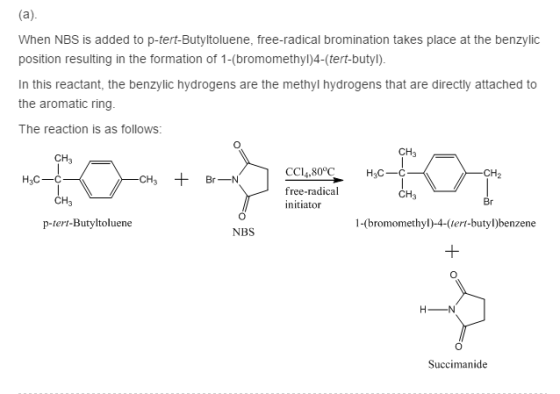
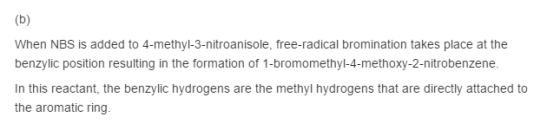
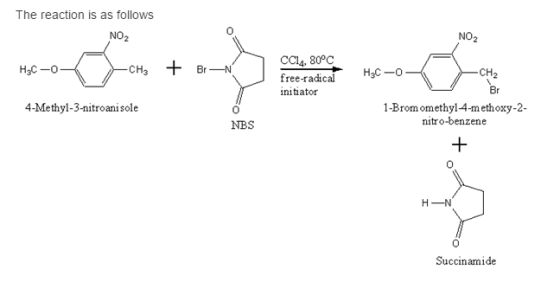
The reaction of N-bromosuccinimide with the following compounds has been reported in the chemical literature. Each...
The following nucleophilic substitution reaction has been reported in the chemical literature. Draw the product by...
 The following nucleophilic substitution reaction has been
reported in the chemical literature. Draw the product by analogy to
what you know about nucleophilic substitution in simple
systems.
1 attempts left Check my work Click the "draw structure" button to launch the drawing utility. The following nucleophilic substitution reaction has been reported in the chemical literature. Draw the product by analogy to what you know about nucleophilic substitution in simple systems. O,N- ÕNa Naci acetic acid edit structure ... p-Nitrobenzyl chloride
The following nucleophilic substitution reaction has been
reported in the chemical literature. Draw the product by analogy to
what you know about nucleophilic substitution in simple
systems.
1 attempts left Check my work Click the "draw structure" button to launch the drawing utility. The following nucleophilic substitution reaction has been reported in the chemical literature. Draw the product by analogy to what you know about nucleophilic substitution in simple systems. O,N- ÕNa Naci acetic acid edit structure ... p-Nitrobenzyl chloride
5. Each of the following reactions has been reported in the chemical literature. Predict the product...
 5. Each of the following reactions has been reported in the chemical literature. Predict the product in each case, showing stereochemistry where appropriate. (3x2-6] HC XH H,SO CH, heat 1. B He diglyme 2. H.O. HO CHCCH-CH=CHCHCCH- 1. LiAlH4, diethyl ether 2. H20 (c)
Arrange the following compounds in increasing order of their reactivity to electrophiles. (least reactive first) A....
 Arrange the following compounds in increasing order of their reactivity to electrophiles. (least reactive first) A. CH CHO (benzaldehyde) B. C&HOCH, (anisole) C. C HBr (bromobenzene) D. CH3CH, (toluene) 1) A<C<D<B 2) A<D<C< B 3 ) C<A<B<D 4) C<A<D<B Nitration of chlorobenzene occurs: 1) faster than nitration of benzene and gives the ortho and para products. 2) faster than nitration of benzene and gives the meta product. 3) slower than nitration of benzene and gives the ortho and para products....
10. Which of the following compounds is expected to show the greatest similarity with esters, both...
 10. Which of the following compounds is expected to show the greatest similarity with esters, both in terms of substitution ability and in structure? CI CIT WN 1 (B) (A) YO 0 0 0 NN... Ooooooh Na HN NON HO OH chlorpyriphos, an insecticide adenosine triphosphate (ATP) (C) о он YO p-toluenesulfonic acid p-nitrotoluene ОА Loo OD Question 9 1 pts 9. What product is formed when the lactone below is heated with excess methanol and a catalytic amount of...
52. Arrange the relative pKa's of the following compounds:( P (2 pts) соон соон COOH pKa's: 53. Arrange th compounds: (2 pts) e relative reaction rates for the electrophilic aromatic subst...
 52. Arrange the relative pKa's of the following compounds:( P (2 pts) соон соон COOH pKa's: 53. Arrange th compounds: (2 pts) e relative reaction rates for the electrophilic aromatic substitution of the following CH3 OCHa NO2 Reaction rates: 54. Arrange the relative base strength of the following compounds: (2 pts) NHCOCH3 NH2 NH2 NH2 NH. OCH3 OCH3 Basicity 55. What is the splitting pattern for the labeled hydrogens in the following compounds? (5 pt CH CH 56. Provide one...
4 (6 pts) For each of the following compounds, indicate which statement (A-E) best describes the...
 4 (6 pts) For each of the following compounds, indicate which statement (A-E) best describes the reactivity of the benzene ring in electrophilic aromatic substitution reactions (e.g., nitration). A. The ortbo and para positions are activated and the meta position is deactivated. C. The ortho and para positions are deactivated and the meta position is activated. A. All positions are activated -ortho and para are more activated than meta. D. All positions are deactivated -ortbo and para are more deactivated...
1. please check what is wrong. Thank you! Determine the product formed when each compound is treated with...
 1. please check what is wrong. Thank you!
Determine the product formed when each compound is treated with Br2 and FeBr3. Drag the atom labels to their appropriate positions. CN Atom labels H H Br Br2 A. FeBr Br H OH OH Br Br. Br2 FeBr3 H H Br Br H Br2 FeBr H1 H Reset T Rank the compounds in each group in order of decreasing reactivity in electrophilic aromatic substitution. CI Decreasing reactivity Rank the compounds in each...
1. please check what is wrong. Thank you!
Determine the product formed when each compound is treated with Br2 and FeBr3. Drag the atom labels to their appropriate positions. CN Atom labels H H Br Br2 A. FeBr Br H OH OH Br Br. Br2 FeBr3 H H Br Br H Br2 FeBr H1 H Reset T Rank the compounds in each group in order of decreasing reactivity in electrophilic aromatic substitution. CI Decreasing reactivity Rank the compounds in each...
need help with the boxed bullet point. writing the chemical reaction scheme for the experiment. Synthesis of an A...
 need help with the boxed bullet point. writing the chemical
reaction scheme for the experiment.
Synthesis of an Alkyl Halide: A Nucleophilic Substitution Reaction, Part I Pre-lab Assignment for Synthesis of an Alkyl Halide: A Nucleophilic Substitution Reaction, Part 1 1. From The Organic Chem Lab Survival Manual ( edition) by Zubrick • Review pages 201-204: Standard Reflux. • Review pages 127-140: Extraction • Review pages 164-189: Distillation, Simple Distillation. The Distillation Example, and The Distillation Mistake. 2. Read this...
need help with the boxed bullet point. writing the chemical
reaction scheme for the experiment.
Synthesis of an Alkyl Halide: A Nucleophilic Substitution Reaction, Part I Pre-lab Assignment for Synthesis of an Alkyl Halide: A Nucleophilic Substitution Reaction, Part 1 1. From The Organic Chem Lab Survival Manual ( edition) by Zubrick • Review pages 201-204: Standard Reflux. • Review pages 127-140: Extraction • Review pages 164-189: Distillation, Simple Distillation. The Distillation Example, and The Distillation Mistake. 2. Read this...
please help in all sections asap!! Identify the reagents for each of the following transformations. Select...
 please help in all sections asap!!
Identify the reagents for each of the following transformations. Select all that apply. V -a HC=CNa MCPBA NaOEt H2O2, NaOH NBS, heat Conc. H2S04, heat OBH3-THF OH PCC, CH2Cl2 Conc. H2SO4, heat OBH3-THF HC=CNa MCPBA H2O2, NaOH NBS, heat HCCNa ОМСРВА H2O2, NaOH PCC, CH2Cl2 Conc. H2SO4, heat The following two drawings are resonance structures of one compound. But the following two drawings are not resonance structures Not resonance structures They are, in fact,...
please help in all sections asap!!
Identify the reagents for each of the following transformations. Select all that apply. V -a HC=CNa MCPBA NaOEt H2O2, NaOH NBS, heat Conc. H2S04, heat OBH3-THF OH PCC, CH2Cl2 Conc. H2SO4, heat OBH3-THF HC=CNa MCPBA H2O2, NaOH NBS, heat HCCNa ОМСРВА H2O2, NaOH PCC, CH2Cl2 Conc. H2SO4, heat The following two drawings are resonance structures of one compound. But the following two drawings are not resonance structures Not resonance structures They are, in fact,...
Only need help with 5,6,7 and mechanism FTIR and NMR Spectra After completing a reaction and...
 Only need help with 5,6,7
and mechanism
FTIR and NMR Spectra After completing a reaction and working up the products, it is still necessary to confirm that the correct product was formed. The most common tools used for this analysis are Fourier Transform Infrared (FTIR) and Nuclear Magnetic Resonance (NMR) spectroscopy. In the virtual laboratory, 'H and C NMR spectra are available. Details on interpreting FTIR and NMR spectra are found in your textbook. Your instructor may or may not...
Only need help with 5,6,7
and mechanism
FTIR and NMR Spectra After completing a reaction and working up the products, it is still necessary to confirm that the correct product was formed. The most common tools used for this analysis are Fourier Transform Infrared (FTIR) and Nuclear Magnetic Resonance (NMR) spectroscopy. In the virtual laboratory, 'H and C NMR spectra are available. Details on interpreting FTIR and NMR spectra are found in your textbook. Your instructor may or may not...
 The following nucleophilic substitution reaction has been
reported in the chemical literature. Draw the product by analogy to
what you know about nucleophilic substitution in simple
systems.
1 attempts left Check my work Click the "draw structure" button to launch the drawing utility. The following nucleophilic substitution reaction has been reported in the chemical literature. Draw the product by analogy to what you know about nucleophilic substitution in simple systems. O,N- ÕNa Naci acetic acid edit structure ... p-Nitrobenzyl chloride
The following nucleophilic substitution reaction has been
reported in the chemical literature. Draw the product by analogy to
what you know about nucleophilic substitution in simple
systems.
1 attempts left Check my work Click the "draw structure" button to launch the drawing utility. The following nucleophilic substitution reaction has been reported in the chemical literature. Draw the product by analogy to what you know about nucleophilic substitution in simple systems. O,N- ÕNa Naci acetic acid edit structure ... p-Nitrobenzyl chloride
 5. Each of the following reactions has been reported in the chemical literature. Predict the product in each case, showing stereochemistry where appropriate. (3x2-6] HC XH H,SO CH, heat 1. B He diglyme 2. H.O. HO CHCCH-CH=CHCHCCH- 1. LiAlH4, diethyl ether 2. H20 (c)
 Arrange the following compounds in increasing order of their reactivity to electrophiles. (least reactive first) A. CH CHO (benzaldehyde) B. C&HOCH, (anisole) C. C HBr (bromobenzene) D. CH3CH, (toluene) 1) A<C<D<B 2) A<D<C< B 3 ) C<A<B<D 4) C<A<D<B Nitration of chlorobenzene occurs: 1) faster than nitration of benzene and gives the ortho and para products. 2) faster than nitration of benzene and gives the meta product. 3) slower than nitration of benzene and gives the ortho and para products....
 10. Which of the following compounds is expected to show the greatest similarity with esters, both in terms of substitution ability and in structure? CI CIT WN 1 (B) (A) YO 0 0 0 NN... Ooooooh Na HN NON HO OH chlorpyriphos, an insecticide adenosine triphosphate (ATP) (C) о он YO p-toluenesulfonic acid p-nitrotoluene ОА Loo OD Question 9 1 pts 9. What product is formed when the lactone below is heated with excess methanol and a catalytic amount of...
 52. Arrange the relative pKa's of the following compounds:( P (2 pts) соон соон COOH pKa's: 53. Arrange th compounds: (2 pts) e relative reaction rates for the electrophilic aromatic substitution of the following CH3 OCHa NO2 Reaction rates: 54. Arrange the relative base strength of the following compounds: (2 pts) NHCOCH3 NH2 NH2 NH2 NH. OCH3 OCH3 Basicity 55. What is the splitting pattern for the labeled hydrogens in the following compounds? (5 pt CH CH 56. Provide one...
 4 (6 pts) For each of the following compounds, indicate which statement (A-E) best describes the reactivity of the benzene ring in electrophilic aromatic substitution reactions (e.g., nitration). A. The ortbo and para positions are activated and the meta position is deactivated. C. The ortho and para positions are deactivated and the meta position is activated. A. All positions are activated -ortho and para are more activated than meta. D. All positions are deactivated -ortbo and para are more deactivated...
 1. please check what is wrong. Thank you!
Determine the product formed when each compound is treated with Br2 and FeBr3. Drag the atom labels to their appropriate positions. CN Atom labels H H Br Br2 A. FeBr Br H OH OH Br Br. Br2 FeBr3 H H Br Br H Br2 FeBr H1 H Reset T Rank the compounds in each group in order of decreasing reactivity in electrophilic aromatic substitution. CI Decreasing reactivity Rank the compounds in each...
1. please check what is wrong. Thank you!
Determine the product formed when each compound is treated with Br2 and FeBr3. Drag the atom labels to their appropriate positions. CN Atom labels H H Br Br2 A. FeBr Br H OH OH Br Br. Br2 FeBr3 H H Br Br H Br2 FeBr H1 H Reset T Rank the compounds in each group in order of decreasing reactivity in electrophilic aromatic substitution. CI Decreasing reactivity Rank the compounds in each...
 need help with the boxed bullet point. writing the chemical
reaction scheme for the experiment.
Synthesis of an Alkyl Halide: A Nucleophilic Substitution Reaction, Part I Pre-lab Assignment for Synthesis of an Alkyl Halide: A Nucleophilic Substitution Reaction, Part 1 1. From The Organic Chem Lab Survival Manual ( edition) by Zubrick • Review pages 201-204: Standard Reflux. • Review pages 127-140: Extraction • Review pages 164-189: Distillation, Simple Distillation. The Distillation Example, and The Distillation Mistake. 2. Read this...
need help with the boxed bullet point. writing the chemical
reaction scheme for the experiment.
Synthesis of an Alkyl Halide: A Nucleophilic Substitution Reaction, Part I Pre-lab Assignment for Synthesis of an Alkyl Halide: A Nucleophilic Substitution Reaction, Part 1 1. From The Organic Chem Lab Survival Manual ( edition) by Zubrick • Review pages 201-204: Standard Reflux. • Review pages 127-140: Extraction • Review pages 164-189: Distillation, Simple Distillation. The Distillation Example, and The Distillation Mistake. 2. Read this...
 please help in all sections asap!!
Identify the reagents for each of the following transformations. Select all that apply. V -a HC=CNa MCPBA NaOEt H2O2, NaOH NBS, heat Conc. H2S04, heat OBH3-THF OH PCC, CH2Cl2 Conc. H2SO4, heat OBH3-THF HC=CNa MCPBA H2O2, NaOH NBS, heat HCCNa ОМСРВА H2O2, NaOH PCC, CH2Cl2 Conc. H2SO4, heat The following two drawings are resonance structures of one compound. But the following two drawings are not resonance structures Not resonance structures They are, in fact,...
please help in all sections asap!!
Identify the reagents for each of the following transformations. Select all that apply. V -a HC=CNa MCPBA NaOEt H2O2, NaOH NBS, heat Conc. H2S04, heat OBH3-THF OH PCC, CH2Cl2 Conc. H2SO4, heat OBH3-THF HC=CNa MCPBA H2O2, NaOH NBS, heat HCCNa ОМСРВА H2O2, NaOH PCC, CH2Cl2 Conc. H2SO4, heat The following two drawings are resonance structures of one compound. But the following two drawings are not resonance structures Not resonance structures They are, in fact,...
 Only need help with 5,6,7
and mechanism
FTIR and NMR Spectra After completing a reaction and working up the products, it is still necessary to confirm that the correct product was formed. The most common tools used for this analysis are Fourier Transform Infrared (FTIR) and Nuclear Magnetic Resonance (NMR) spectroscopy. In the virtual laboratory, 'H and C NMR spectra are available. Details on interpreting FTIR and NMR spectra are found in your textbook. Your instructor may or may not...
Only need help with 5,6,7
and mechanism
FTIR and NMR Spectra After completing a reaction and working up the products, it is still necessary to confirm that the correct product was formed. The most common tools used for this analysis are Fourier Transform Infrared (FTIR) and Nuclear Magnetic Resonance (NMR) spectroscopy. In the virtual laboratory, 'H and C NMR spectra are available. Details on interpreting FTIR and NMR spectra are found in your textbook. Your instructor may or may not...
Most questions answered within 3 hours.
-
Where is the error in this code sequence?
String s1 = "Hello";
String s2 = "ello";...
asked 11 months ago -
Financial data for Joel de Paris, Inc., for last year
follow:
Joel de Paris, Inc.
Balance...
asked 11 months ago -
Consider this reaction:
Al2(SO4)3 (aq)+ BaCl3
(aq) Al2Cl6 (aq)- +
3BaSO4(s) . What is the...
asked 11 months ago -
Suppose that Savneet is considering increasing her
recent random sample from 20 car rentals to 40...
asked 11 months ago -
Trucks arrive at an unloading terminal at an average rate of 120
per hour.
Trucks arrive...
asked 11 months ago -
Why are methanol and ethanol completely soluble in water while
octanol is not very little soluble....
asked 11 months ago -
A facilities manager at a university reads in a research report
that the mean amount of...
asked 11 months ago -
When the CuSO4 is rehydrated by adding water to the anhydrous
compound, is this an endothermic...
asked 11 months ago -
A ray of sunlight is passing from diamond into crown glass; the
angle of incidence is...
asked 11 months ago -
A block of mass 0.249 kg is placed on top of a light, vertical
spring of...
asked 11 months ago -
how do the kidneys compensate in the presences of acidosis
a) trigger hyperventilate
b) reserve acid...
asked 11 months ago -
Question 501 pts
The rental rate of capital to the firm increases. Which of the
following...
asked 11 months ago