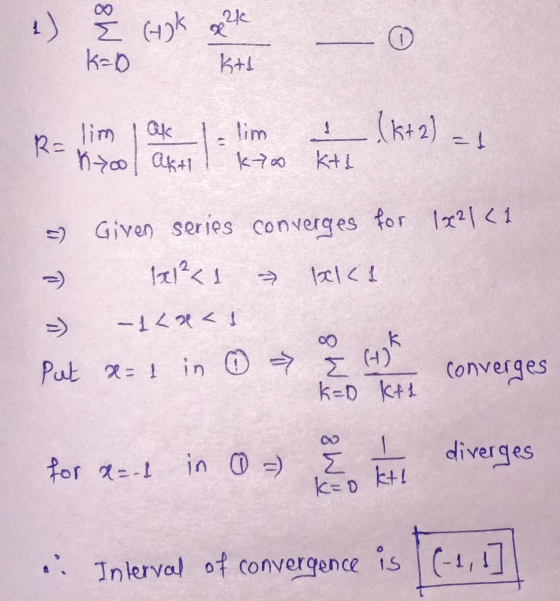
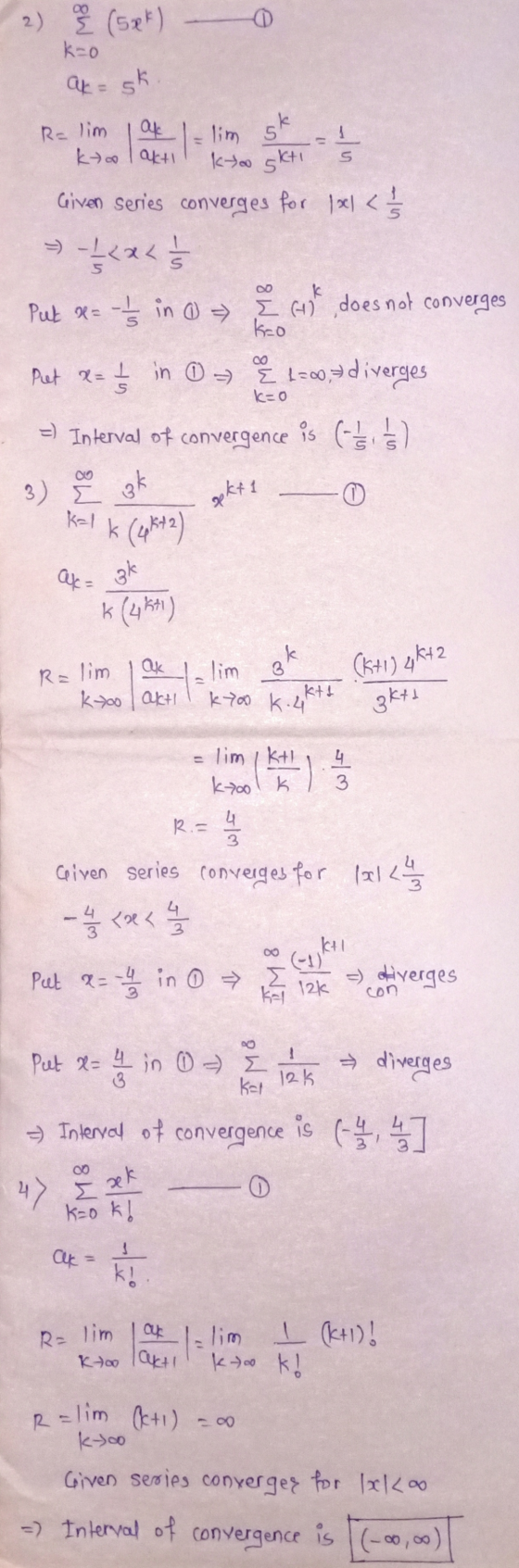
 show work for each problem and solve with ratio test.
Homework Answers
Add Answer to:
show work for each problem and solve with ratio test.
Use ratio test on all questions...
please answer all 2 questions and explain please! . thank you 9. Use the ratio test...
 please answer all 2 questions and explain please! . thank
you
9. Use the ratio test to find the radius and interval of convergence for the power series (6 pts) Ś (x-1) 32" (n+1 Radius of Convergence: Interval of Convergence: 10. Find a power series representation for f(x) = 1+3x2 and state its interval of convergence. (6 pts) Power Series: Interval of Convergence:
please answer all 2 questions and explain please! . thank
you
9. Use the ratio test to find the radius and interval of convergence for the power series (6 pts) Ś (x-1) 32" (n+1 Radius of Convergence: Interval of Convergence: 10. Find a power series representation for f(x) = 1+3x2 and state its interval of convergence. (6 pts) Power Series: Interval of Convergence:
Use the Ratio Test to find the interval of convergence for these power series. Use the...
 Use the Ratio Test to find the interval of convergence for these
power series.
Use the Ratio Test to find the interval of convergence for these power series. (8 points each) ) 3 x N
Use the Ratio Test to find the interval of convergence for these
power series.
Use the Ratio Test to find the interval of convergence for these power series. (8 points each) ) 3 x N
show all work and use calc 2 texhniques only 1. Find the radius of convergence and...
 show all work and use calc 2 texhniques only
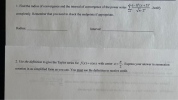
1. Find the radius of convergence and the interval of convergence of the power series 1) - ) Justify - n.2" completely. Remember that you need to check the endpoints if appropriate. Radius: Interval: 2. Use the definition to give the Taylor series for f(x) = cos x with center a Express your answer in summation notation in as simplified form as you can. You must use the definition to receive...
show all work and use calc 2 texhniques only
1. Find the radius of convergence and the interval of convergence of the power series 1) - ) Justify - n.2" completely. Remember that you need to check the endpoints if appropriate. Radius: Interval: 2. Use the definition to give the Taylor series for f(x) = cos x with center a Express your answer in summation notation in as simplified form as you can. You must use the definition to receive...
Please solve all. Show all of your work! 1. Find a power series representation of the...
 Please solve all.
Show all of your work! 1. Find a power series representation of the function f(0) = x arctan(2.c) and determine the raidus of convergence. 2. Let f(x) = 1 + r. (a) Find the Maclaurin series of radius of convergence? (ie the Taylor series centered at a = 0). What is the (b) Find the Taylor series of centered at a = 3. What is the radius of convergence?
Please solve all.
Show all of your work! 1. Find a power series representation of the function f(0) = x arctan(2.c) and determine the raidus of convergence. 2. Let f(x) = 1 + r. (a) Find the Maclaurin series of radius of convergence? (ie the Taylor series centered at a = 0). What is the (b) Find the Taylor series of centered at a = 3. What is the radius of convergence?
Question # 2. (2 marks) Show that the ratio test fails to apply to the series,...
 Question # 2. (2 marks) Show that the ratio test fails to apply to the series, 7-n+(-1)", but that the root test does apply. Use the root test to determine if the series converges or not. n=0 Question # 3. (3 marks) Consider the power series, f(x) = į an(x + 1)". Suppose we know that f(-4), as a series, diverges, while f(2) converges. Determine the radius of convergence of the power series for f'(x). Precisely name the results we...
Hope teacher could solve this question! 3) (n) Use the definition of the hyperbolic functions to show thet llelice,...
 Hope teacher could solve this question!
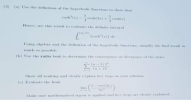
3) (n) Use the definition of the hyperbolic functions to show thet llelice, use this result '', evnlunte II", 'lefinite integral Using nlgebrn ond the definition of the hyperbolic functions, simplity the innl resalt ach us possible (b) Use the ratio test to determine the convergence or diversence of the series -1 Show all working and clenrly explain key steps in your solution e)Evaluate the imit um (1-3..( 2x )) Make sure mst hematical...
Hope teacher could solve this question!
3) (n) Use the definition of the hyperbolic functions to show thet llelice, use this result '', evnlunte II", 'lefinite integral Using nlgebrn ond the definition of the hyperbolic functions, simplity the innl resalt ach us possible (b) Use the ratio test to determine the convergence or diversence of the series -1 Show all working and clenrly explain key steps in your solution e)Evaluate the imit um (1-3..( 2x )) Make sure mst hematical...
Power Series Show all steps and explain. Do not answer if all steps aren't shown (5...
 Power Series
Show all steps and explain. Do not answer if all steps aren't
shown
(5 points) Find the radius of convergence and interval of convergence for the following power series. (-1)" (1 - 1)" (2n-1)2 n=1
Power Series
Show all steps and explain. Do not answer if all steps aren't
shown
(5 points) Find the radius of convergence and interval of convergence for the following power series. (-1)" (1 - 1)" (2n-1)2 n=1
please show all steps 6. For each series: • Use the specified test to deduce the...
 please show all steps
6. For each series: • Use the specified test to deduce the convergence or divergence of the following series. • If the test does not apply, explain why. Then use another test, that does aid in deducing if the series con- verges or divergesc All properties for each test must be formally stated/proved for the specified test. For example, if a test requires the corresponding sequence be decreasing, you must show why this is true. If...
please show all steps
6. For each series: • Use the specified test to deduce the convergence or divergence of the following series. • If the test does not apply, explain why. Then use another test, that does aid in deducing if the series con- verges or divergesc All properties for each test must be formally stated/proved for the specified test. For example, if a test requires the corresponding sequence be decreasing, you must show why this is true. If...
Use the Ratio Test to determine the convergence or divergence of the series. If the Ratio...
 Use the Ratio Test to determine the convergence or divergence of the series. If the Ratio Test is inconclusive, determine the convergence or divergence of the series using other methods. (If you need to use coor-69, enter INFINITY OF-INFINITY, respectively.) 3 ni lim x Your answer cannot be understood or graded. More Information 2 converges diverges
I need help with problem #9 For Questions 5 through 7, determine convergence or divergence of...
 I need help with problem #9
For Questions 5 through 7, determine convergence or divergence of the series using any test of your choice. If the series is geometric, give its sum. You must verify that all assumptions of the test you choose are satisfied. 5. (8 points) § (193) 6. (10 points) { $s 8. Find the radius of convergence and interval of convergence for the series below: (a) (6 points) mal (b) (6 points) { }(22+1)* sin 9....
I need help with problem #9
For Questions 5 through 7, determine convergence or divergence of the series using any test of your choice. If the series is geometric, give its sum. You must verify that all assumptions of the test you choose are satisfied. 5. (8 points) § (193) 6. (10 points) { $s 8. Find the radius of convergence and interval of convergence for the series below: (a) (6 points) mal (b) (6 points) { }(22+1)* sin 9....
 please answer all 2 questions and explain please! . thank
you
9. Use the ratio test to find the radius and interval of convergence for the power series (6 pts) Ś (x-1) 32" (n+1 Radius of Convergence: Interval of Convergence: 10. Find a power series representation for f(x) = 1+3x2 and state its interval of convergence. (6 pts) Power Series: Interval of Convergence:
please answer all 2 questions and explain please! . thank
you
9. Use the ratio test to find the radius and interval of convergence for the power series (6 pts) Ś (x-1) 32" (n+1 Radius of Convergence: Interval of Convergence: 10. Find a power series representation for f(x) = 1+3x2 and state its interval of convergence. (6 pts) Power Series: Interval of Convergence:
 Use the Ratio Test to find the interval of convergence for these
power series.
Use the Ratio Test to find the interval of convergence for these power series. (8 points each) ) 3 x N
Use the Ratio Test to find the interval of convergence for these
power series.
Use the Ratio Test to find the interval of convergence for these power series. (8 points each) ) 3 x N
 show all work and use calc 2 texhniques only
1. Find the radius of convergence and the interval of convergence of the power series 1) - ) Justify - n.2" completely. Remember that you need to check the endpoints if appropriate. Radius: Interval: 2. Use the definition to give the Taylor series for f(x) = cos x with center a Express your answer in summation notation in as simplified form as you can. You must use the definition to receive...
show all work and use calc 2 texhniques only
1. Find the radius of convergence and the interval of convergence of the power series 1) - ) Justify - n.2" completely. Remember that you need to check the endpoints if appropriate. Radius: Interval: 2. Use the definition to give the Taylor series for f(x) = cos x with center a Express your answer in summation notation in as simplified form as you can. You must use the definition to receive...
 Please solve all.
Show all of your work! 1. Find a power series representation of the function f(0) = x arctan(2.c) and determine the raidus of convergence. 2. Let f(x) = 1 + r. (a) Find the Maclaurin series of radius of convergence? (ie the Taylor series centered at a = 0). What is the (b) Find the Taylor series of centered at a = 3. What is the radius of convergence?
Please solve all.
Show all of your work! 1. Find a power series representation of the function f(0) = x arctan(2.c) and determine the raidus of convergence. 2. Let f(x) = 1 + r. (a) Find the Maclaurin series of radius of convergence? (ie the Taylor series centered at a = 0). What is the (b) Find the Taylor series of centered at a = 3. What is the radius of convergence?
 Question # 2. (2 marks) Show that the ratio test fails to apply to the series, 7-n+(-1)", but that the root test does apply. Use the root test to determine if the series converges or not. n=0 Question # 3. (3 marks) Consider the power series, f(x) = į an(x + 1)". Suppose we know that f(-4), as a series, diverges, while f(2) converges. Determine the radius of convergence of the power series for f'(x). Precisely name the results we...
 Hope teacher could solve this question!
3) (n) Use the definition of the hyperbolic functions to show thet llelice, use this result '', evnlunte II", 'lefinite integral Using nlgebrn ond the definition of the hyperbolic functions, simplity the innl resalt ach us possible (b) Use the ratio test to determine the convergence or diversence of the series -1 Show all working and clenrly explain key steps in your solution e)Evaluate the imit um (1-3..( 2x )) Make sure mst hematical...
Hope teacher could solve this question!
3) (n) Use the definition of the hyperbolic functions to show thet llelice, use this result '', evnlunte II", 'lefinite integral Using nlgebrn ond the definition of the hyperbolic functions, simplity the innl resalt ach us possible (b) Use the ratio test to determine the convergence or diversence of the series -1 Show all working and clenrly explain key steps in your solution e)Evaluate the imit um (1-3..( 2x )) Make sure mst hematical...
 Power Series
Show all steps and explain. Do not answer if all steps aren't
shown
(5 points) Find the radius of convergence and interval of convergence for the following power series. (-1)" (1 - 1)" (2n-1)2 n=1
Power Series
Show all steps and explain. Do not answer if all steps aren't
shown
(5 points) Find the radius of convergence and interval of convergence for the following power series. (-1)" (1 - 1)" (2n-1)2 n=1
 please show all steps
6. For each series: • Use the specified test to deduce the convergence or divergence of the following series. • If the test does not apply, explain why. Then use another test, that does aid in deducing if the series con- verges or divergesc All properties for each test must be formally stated/proved for the specified test. For example, if a test requires the corresponding sequence be decreasing, you must show why this is true. If...
please show all steps
6. For each series: • Use the specified test to deduce the convergence or divergence of the following series. • If the test does not apply, explain why. Then use another test, that does aid in deducing if the series con- verges or divergesc All properties for each test must be formally stated/proved for the specified test. For example, if a test requires the corresponding sequence be decreasing, you must show why this is true. If...
 Use the Ratio Test to determine the convergence or divergence of the series. If the Ratio Test is inconclusive, determine the convergence or divergence of the series using other methods. (If you need to use coor-69, enter INFINITY OF-INFINITY, respectively.) 3 ni lim x Your answer cannot be understood or graded. More Information 2 converges diverges
 I need help with problem #9
For Questions 5 through 7, determine convergence or divergence of the series using any test of your choice. If the series is geometric, give its sum. You must verify that all assumptions of the test you choose are satisfied. 5. (8 points) § (193) 6. (10 points) { $s 8. Find the radius of convergence and interval of convergence for the series below: (a) (6 points) mal (b) (6 points) { }(22+1)* sin 9....
I need help with problem #9
For Questions 5 through 7, determine convergence or divergence of the series using any test of your choice. If the series is geometric, give its sum. You must verify that all assumptions of the test you choose are satisfied. 5. (8 points) § (193) 6. (10 points) { $s 8. Find the radius of convergence and interval of convergence for the series below: (a) (6 points) mal (b) (6 points) { }(22+1)* sin 9....
Most questions answered within 3 hours.
-
Where is the error in this code sequence?
String s1 = "Hello";
String s2 = "ello";...
asked 10 months ago -
Financial data for Joel de Paris, Inc., for last year
follow:
Joel de Paris, Inc.
Balance...
asked 10 months ago -
Consider this reaction:
Al2(SO4)3 (aq)+ BaCl3
(aq) Al2Cl6 (aq)- +
3BaSO4(s) . What is the...
asked 10 months ago -
Suppose that Savneet is considering increasing her
recent random sample from 20 car rentals to 40...
asked 10 months ago -
Trucks arrive at an unloading terminal at an average rate of 120
per hour.
Trucks arrive...
asked 10 months ago -
Why are methanol and ethanol completely soluble in water while
octanol is not very little soluble....
asked 10 months ago -
A facilities manager at a university reads in a research report
that the mean amount of...
asked 10 months ago -
When the CuSO4 is rehydrated by adding water to the anhydrous
compound, is this an endothermic...
asked 10 months ago -
A ray of sunlight is passing from diamond into crown glass; the
angle of incidence is...
asked 10 months ago -
A block of mass 0.249 kg is placed on top of a light, vertical
spring of...
asked 10 months ago -
how do the kidneys compensate in the presences of acidosis
a) trigger hyperventilate
b) reserve acid...
asked 10 months ago -
Question 501 pts
The rental rate of capital to the firm increases. Which of the
following...
asked 10 months ago