
Homework Answers
Add Answer to:
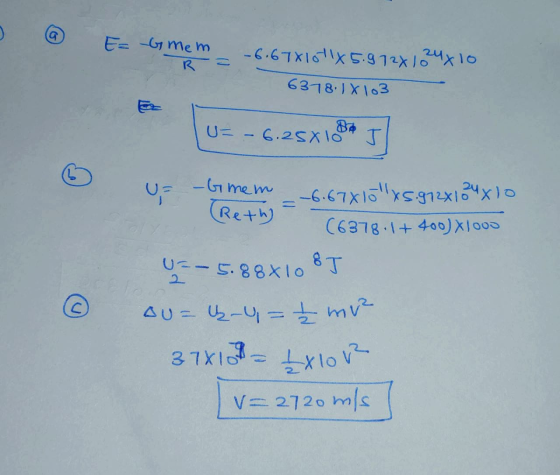
8. (a) Calculate the potential energy of a 10.0-kg mass on the surface of the Earth...
Part a) Calculate the energy required to lift 1 litre of gasoline from the surface of...
Part a) Calculate the energy required to lift 1 litre of gasoline from the surface of the Earth to an altitude of 3000 km above the surface of the Earth. Use g = 9.81 m s-2, the radius of the Earth is 6371 km, and the density of gasoline is 749 kg m-3. Part b) A planet orbits the Sun in a circular orbit. The force of gravity is the centripetal force of the circular motion. Assuming that potential energy...
QUESTION 10 A rocket of mass 2000 kg is launched straight upwards from the Earth's surface...
 QUESTION 10 A rocket of mass 2000 kg is launched straight upwards from the Earth's surface to an altitude of 10,000 km. How fast was the launch speed? Radius of the Earth is 6.37x10 m. Mass of the Earth is 5.97x10 kg. The Universal gravitational constant is 6.67x10" N /kg a 442.7 m/s Ob. 1390 m/s c.4119 m/s d. 8739 m/s Oe. 10841 m/s
Q1: A 1 036-kg satellite orbits the Earth at a constant altitude of 93-km. (a) How...
Q1: A 1 036-kg satellite orbits the Earth at a constant altitude of 93-km. (a) How much energy must be added to the system to move the satellite into a circular orbit with altitude 203 km? MJ (b) What is the change in the system's kinetic energy? MJ (c) What is the change in the system's potential energy? MJ Q2: A 475 kg satellite is in a circular orbit at an altitude of 575 km above the Earth's surface. Because...
Energy is required to move a 1590 kg mass from the Earth’s surface to an altitude...
Energy is required to move a 1590 kg mass from the Earth’s surface to an altitude 2.59 times the Earth’s radius RE. (RE=6.37 × 10⁶ m) What amount of energy is required to accomplish this move? Answer in units of J.
A 345 kg satellite is orbiting 15500 km above the surface of Earth. The mass and...
A 345 kg satellite is orbiting 15500 km above the surface of Earth. The mass and radius of Earth are 5.972e+24 kg and 6378 km respectively. What is the kinetic energy of the satellite?
A 507 kg satellite is in a circular orbit at an altitude of 754 km above...
A 507 kg satellite is in a circular orbit at an altitude of 754 km above a planet’s surface. This planet is similar to our Earth. Because of air friction, the satellite eventually is brought to the Earth’s surface, and it hits the Earth with a speed of 3 km/s. The radius of the planet is 7 × 10⁶ m and its mass is 8 × 1024 kg. The gravitational constant is 6.67259 × 10⁻¹¹ N m2 /kg2. How much...
A satellite of mass m 400 kg is observed with the initial speed v 3 km/s...
 A satellite of mass m 400 kg is observed with the initial speed v 3 km/s at the initial altitude h 4000 km above the Earth's surface. The satelite descends in a free fall and hits the ocean with the final speed w. Which one of the followings statements is the correct form of the 프~ Problem 6(3 point ed push of what energy conservation in this process? these equations M stands for the mass of the Earth, and R...
A satellite has a mass of 109 kg and is located at 1.97 106 m above the surface of Earth. (a) What is the potential ene...
 A satellite has a mass of 109 kg and is located at 1.97
106 m above the surface of Earth.
(a) What is the potential energy associated with the satellite
at this location?
J
(b) What is the magnitude of the gravitational force on the
satellite?
A satellite has a mass of 109 kg and is located at 1.97
106 m above the surface of Earth.
(a) What is the potential energy associated with the satellite
at this location?
J
(b) What is the magnitude of the gravitational force on the
satellite?
. An aircraft with a mass of 2,000 kg starts from rest at sea level and...
 . An aircraft with a mass of 2,000 kg starts from rest at sea level and takes off, then flies to a cruising speed of 620 km/h and altitude of 10 km. Assume g-9.8 m/s throughout the process What is the aircraft's change in potential energy? What is the aircraft's change in kinetic energy? a. b. Answers: About 200 and 30 MJ respectively
A 992-kg satellite orbits the Earth at a constant altitude of 94-km. (a) How much energy...
A 992-kg satellite orbits the Earth at a constant altitude of 94-km. (a) How much energy must be added to the system to move the satellite into a circular orbit with altitude 199 km? MJ (b) What is the change in the system's kinetic energy? MJ (c) What is the change in the system's potential energy? MJ
 QUESTION 10 A rocket of mass 2000 kg is launched straight upwards from the Earth's surface to an altitude of 10,000 km. How fast was the launch speed? Radius of the Earth is 6.37x10 m. Mass of the Earth is 5.97x10 kg. The Universal gravitational constant is 6.67x10" N /kg a 442.7 m/s Ob. 1390 m/s c.4119 m/s d. 8739 m/s Oe. 10841 m/s
 A satellite of mass m 400 kg is observed with the initial speed v 3 km/s at the initial altitude h 4000 km above the Earth's surface. The satelite descends in a free fall and hits the ocean with the final speed w. Which one of the followings statements is the correct form of the 프~ Problem 6(3 point ed push of what energy conservation in this process? these equations M stands for the mass of the Earth, and R...
 A satellite has a mass of 109 kg and is located at 1.97
106 m above the surface of Earth.
(a) What is the potential energy associated with the satellite
at this location?
J
(b) What is the magnitude of the gravitational force on the
satellite?
A satellite has a mass of 109 kg and is located at 1.97
106 m above the surface of Earth.
(a) What is the potential energy associated with the satellite
at this location?
J
(b) What is the magnitude of the gravitational force on the
satellite?
 . An aircraft with a mass of 2,000 kg starts from rest at sea level and takes off, then flies to a cruising speed of 620 km/h and altitude of 10 km. Assume g-9.8 m/s throughout the process What is the aircraft's change in potential energy? What is the aircraft's change in kinetic energy? a. b. Answers: About 200 and 30 MJ respectively
Most questions answered within 3 hours.
-
Where is the error in this code sequence?
String s1 = "Hello";
String s2 = "ello";...
asked 11 months ago -
Financial data for Joel de Paris, Inc., for last year
follow:
Joel de Paris, Inc.
Balance...
asked 11 months ago -
Consider this reaction:
Al2(SO4)3 (aq)+ BaCl3
(aq) Al2Cl6 (aq)- +
3BaSO4(s) . What is the...
asked 11 months ago -
Suppose that Savneet is considering increasing her
recent random sample from 20 car rentals to 40...
asked 11 months ago -
Trucks arrive at an unloading terminal at an average rate of 120
per hour.
Trucks arrive...
asked 11 months ago -
Why are methanol and ethanol completely soluble in water while
octanol is not very little soluble....
asked 11 months ago -
A facilities manager at a university reads in a research report
that the mean amount of...
asked 11 months ago -
When the CuSO4 is rehydrated by adding water to the anhydrous
compound, is this an endothermic...
asked 11 months ago -
A ray of sunlight is passing from diamond into crown glass; the
angle of incidence is...
asked 11 months ago -
A block of mass 0.249 kg is placed on top of a light, vertical
spring of...
asked 11 months ago -
how do the kidneys compensate in the presences of acidosis
a) trigger hyperventilate
b) reserve acid...
asked 11 months ago -
Question 501 pts
The rental rate of capital to the firm increases. Which of the
following...
asked 11 months ago