
Homework Answers
(A) Applying energy conservation,
PE + KE = constant
m g h + 0 = 0 + KE
KE = 1550 x 9.8 x 30 = 455700 J
KE = m v^2 /2
455700 = 1550 v^2 /2
v = 24.25 m/s
(B) applying energy conservation,
KE + spring PE +gravitational PE = constant
455700 + 0 + 0 = 0 + k d^2 /2 + m g (-d)
45000 d^2 - 15190 d - 455700 = 0
d = 3.35 m
(D) KE = 455700 - 45000d^2 + 15190d
d(KE)/dd = - 2(45000)d + 15190 = 0
d = 0.17 m
KE will be max at this distance.
KE = 455700 - 45000(0.17^2) + 15190(0.17) = 456981.8
v = 24.3 m/s
Add Answer to:
An elevator cable breaks and the 1550 kg elevator drops 30 m onto a large spring...
An elevator mass of 2600 kg falls from a height of 25 m after a sudden...
An elevator mass of 2600 kg falls from a height of 25 m after a sudden failure in the hoisting cable. The mass is stopped by a spring at the bottom of the shaft having a spring constant of 90 kN/m. Determine the spring's compression distance (in m) that brings the falling elevator momentarily to rest. An elevator mass of 2600 kg falls from a height of 25 m after a sudden failure in the hoisting cable. The mass is...
You are in an temporary elevator when the rope holding it breaks. Fortunately, there is a large b...
 You are in an temporary elevator when the rope holding it breaks. Fortunately, there is a large bumper, essentially a spring, at the bottom of the elevator shaft in case of just such a catastrophe. Your initial height above the top of the (uncompressed) spring is 1.07 m. The mass of the elevator (plus you) is 892 kg. The spring constant of the spring is 3.47 x 10 N/m. How far below the position of the top of the uncompressed...
You are in an temporary elevator when the rope holding it breaks. Fortunately, there is a...
You are in an temporary elevator when the rope holding it breaks. Fortunately, there is a large bumper, essentially a spring, at the bottom of the elevator shaft in case of just such a catastrophe. Your initial height above the top of the (uncompressed) spring is 1.01 m. The mass of the elevator (plus you) is 837 kg. The spring constant of the spring is 3.91 x 10⁴ N/m. How far below the position of the top of the uncompressed...
An elevator mass of 1700 kg falls from a height of 40 m after a sudden...
An elevator mass of 1700 kg falls from a height of 40 m after a sudden failure in the hoisting cable. The mass is stopped by a spring at the bottom of the shaft having a spring constant of 75 kN/m and spring's compression of 4.44589 m. Determine the acceleration in m/s2 that the elevator undergoes when brought to rest by the spring.
I need help on part C Problem 7.69 Constants | Periodic Table elevator cable breaks when...
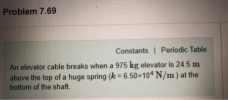 I need help on part C
Problem 7.69 Constants | Periodic Table elevator cable breaks when a 975 kg elevator is 24.5 m above the top of a huge spring (k 6.50-104 N/m) at the bottom of the shaft Part A Calculate the work done by gravity on the elevator before it hits the spring WG 2.34x10⁵ J Previous Answers Correct Part B Calculate the speed of the elevator just before striking the spring. v 21.9 m/s Previous Answers Correct...
I need help on part C
Problem 7.69 Constants | Periodic Table elevator cable breaks when a 975 kg elevator is 24.5 m above the top of a huge spring (k 6.50-104 N/m) at the bottom of the shaft Part A Calculate the work done by gravity on the elevator before it hits the spring WG 2.34x10⁵ J Previous Answers Correct Part B Calculate the speed of the elevator just before striking the spring. v 21.9 m/s Previous Answers Correct...
An elevator mass of 1700 kg falls from a height of 40 m after a sudden...
An elevator mass of 1700 kg falls from a height of 40 m after a sudden failure in the hoisting cable. The mass is stopped by a spring at the bottom of the shaft. Determine the spring constant (in kN/m) necessary to bring the elevator and occupants to rest without exceeding an acceleration of 4 g's.
A single mass m1 = 3.5 kg hangs from a spring in a motionless elevator. The...
A single mass m1 = 3.5 kg hangs from a spring in a motionless elevator. The spring is extended x = 15 cm from its unstretched length. 1) What is the spring constant of the spring? Now, three masses m1 = 3.5 kg, m2 = 10.5 kg and m3 = 7 kg hang from three identical springs in a motionless elevator. The springs all have the same spring constant that you just calculated above. What is the force the top...
A single mass (m1 = 4.4 kg) hangs from a spring in a motionless elevator.
 A single mass (m1 = 4.4 kg) hangs from a spring in a motionless elevator. The spring constant is k = 270 N/m. 1) What is the distance the spring is stretched from its unstretched length? 2) Now, three masses (m1 = 4.4 kg, m2 = 13.2 kg and m3 = 8.8) hang from three identical springs in a motionless elevator. The springs all have the same spring constant given above. What is the magnitude of the force the bottom spring exerts on the...
A skyscraper in Manhattan has an elevator that weighs 1000 kg when loaded. The elevator is...
A skyscraper in Manhattan has an elevator that weighs 1000 kg when loaded. The elevator is lifted at a constant rate to 480m above the ground by an electric winch motor. The drum of the winch motor is a solid uniform cylindrical drum in which a steel cable can wrap around it. The mass of the drum is 500 kg and has a diameter of 1 m. It takes the elevator a total of 120 s to get to the...
A single mass (m1 = 4.3 kg) hangs from a spring in a motionless elevator. The...
A single mass (m1 = 4.3 kg) hangs from a spring in a motionless elevator. The spring constant is k = 266 N/m. 1) What is the distance the spring is stretched from its unstretched length? 2) Now, three masses (m1 = 4.3 kg, m2 = 12.9 kg and m3 = 8.6) hang from three identical springs in a motionless elevator. The springs all have the same spring constant given above. What is the magnitude of the force the bottom...
 You are in an temporary elevator when the rope holding it breaks. Fortunately, there is a large bumper, essentially a spring, at the bottom of the elevator shaft in case of just such a catastrophe. Your initial height above the top of the (uncompressed) spring is 1.07 m. The mass of the elevator (plus you) is 892 kg. The spring constant of the spring is 3.47 x 10 N/m. How far below the position of the top of the uncompressed...
 I need help on part C
Problem 7.69 Constants | Periodic Table elevator cable breaks when a 975 kg elevator is 24.5 m above the top of a huge spring (k 6.50-104 N/m) at the bottom of the shaft Part A Calculate the work done by gravity on the elevator before it hits the spring WG 2.34x10⁵ J Previous Answers Correct Part B Calculate the speed of the elevator just before striking the spring. v 21.9 m/s Previous Answers Correct...
I need help on part C
Problem 7.69 Constants | Periodic Table elevator cable breaks when a 975 kg elevator is 24.5 m above the top of a huge spring (k 6.50-104 N/m) at the bottom of the shaft Part A Calculate the work done by gravity on the elevator before it hits the spring WG 2.34x10⁵ J Previous Answers Correct Part B Calculate the speed of the elevator just before striking the spring. v 21.9 m/s Previous Answers Correct...
Most questions answered within 3 hours.
-
Where is the error in this code sequence?
String s1 = "Hello";
String s2 = "ello";...
asked 10 months ago -
Financial data for Joel de Paris, Inc., for last year
follow:
Joel de Paris, Inc.
Balance...
asked 10 months ago -
Consider this reaction:
Al2(SO4)3 (aq)+ BaCl3
(aq) Al2Cl6 (aq)- +
3BaSO4(s) . What is the...
asked 10 months ago -
Suppose that Savneet is considering increasing her
recent random sample from 20 car rentals to 40...
asked 10 months ago -
Trucks arrive at an unloading terminal at an average rate of 120
per hour.
Trucks arrive...
asked 10 months ago -
Why are methanol and ethanol completely soluble in water while
octanol is not very little soluble....
asked 10 months ago -
A facilities manager at a university reads in a research report
that the mean amount of...
asked 10 months ago -
When the CuSO4 is rehydrated by adding water to the anhydrous
compound, is this an endothermic...
asked 10 months ago -
A ray of sunlight is passing from diamond into crown glass; the
angle of incidence is...
asked 10 months ago -
A block of mass 0.249 kg is placed on top of a light, vertical
spring of...
asked 10 months ago -
how do the kidneys compensate in the presences of acidosis
a) trigger hyperventilate
b) reserve acid...
asked 10 months ago -
Question 501 pts
The rental rate of capital to the firm increases. Which of the
following...
asked 10 months ago