
Homework Answers
Request Answer!
We need at least 10 more requests to produce the answer.
0 / 10 have requested this problem solution
The more requests, the faster the answer.
Add Answer to:
PDE
question
Consider the one dimensional wave equation on the half line: Ut(x,0) = g(x) Utt...
Problem 6: Consider the wave equation with a dumping term r > 0, Ut - c?Uzx...
 Problem 6: Consider the wave equation with a dumping term r > 0, Ut - c?Uzx + rut = 0, (t, x) € R2. This corresponds to the vibrations of an infinite string in a medium that resists its motion (e.g., air or water). Let the energy of the string be given by 1 E(t) = } } [u? (1, 2) + uș(t, 2)] dr. Show that E(t) decreases but E(t)e2rt increases, i.e., the string loses energy due to resistance...
Please detail Please detail PDE Utt = Uzx + 2a sin(at) sin(1x) 0 < x <1...
 Please detail
PDE Utt = Uzx + 2a sin(at) sin(1x) 0 < x <1 0<t< oo BCS S u(0,t) = 0 | u(1,t) = 0 0<t< oo ICs u(x,0) = 0 | u4(,0) = sin(nx) 0 < x <1 u (0,t) = f (t) u (L,t) = g(t) S Use sine transform Uz (0,t) = f(t) uz (L,t) = g(t)) Use cosine transform 2 L S [u (x,t)] = Sn (t) = 1 | u(x, t) sin (ntx/L)...
Please detail
Please detail
PDE Utt = Uzx + 2a sin(at) sin(1x) 0 < x <1 0<t< oo BCS S u(0,t) = 0 | u(1,t) = 0 0<t< oo ICs u(x,0) = 0 | u4(,0) = sin(nx) 0 < x <1 u (0,t) = f (t) u (L,t) = g(t) S Use sine transform Uz (0,t) = f(t) uz (L,t) = g(t)) Use cosine transform 2 L S [u (x,t)] = Sn (t) = 1 | u(x, t) sin (ntx/L)...
42.3) Write down the solutions to the follig inboundary value problems for the wave equation in t...
 #4.2.3 (e, f, g only) & #4.3.11 (all of it)
42.3) Write down the solutions to the follig inboundary value problems for the wave equation in the form of a Fourier series: (a) utt = uzz , u(t, 0) = u(t, π) = 0, a(0,2) 1, ut(0,x) = 0; (d) ut4u (e) ut.-uzz , u(t, 0)u1) 0, u(0,), u, (0,x; u(t, 0)=ux(t, 1)=0, a(0,2)=1, ut(0,2)=0; (g) utt = uzx , ux(t, 0)-u, (t, 1) = 0, u(0,x)-x(1-x), ut(0,2 )-0. Explain...
#4.2.3 (e, f, g only) & #4.3.11 (all of it)
42.3) Write down the solutions to the follig inboundary value problems for the wave equation in the form of a Fourier series: (a) utt = uzz , u(t, 0) = u(t, π) = 0, a(0,2) 1, ut(0,x) = 0; (d) ut4u (e) ut.-uzz , u(t, 0)u1) 0, u(0,), u, (0,x; u(t, 0)=ux(t, 1)=0, a(0,2)=1, ut(0,2)=0; (g) utt = uzx , ux(t, 0)-u, (t, 1) = 0, u(0,x)-x(1-x), ut(0,2 )-0. Explain...
4. Consider the semi-infinite string problem given by Utt = cʻuza, 0<x< 0,> 0 u(x,0) =...
 4. Consider the semi-infinite string problem given by Utt = cʻuza, 0<x< 0,> 0 u(x,0) = f(x), 0<x< ~ ut(2,0) = g(2), 0 < x < 0 u(0,t) = 0, t> 0 Suppose that c=1, f(0) = (x - 1) - h(2 – 3) and g(C) = 0. (a) Write out the appropriate semi-infinite d'Alembert's solution for this problem and simplify. (b) Plot the solution surface and enough time snapshots to demostrate the dynam- ics of the solution.
PDE: Ut = Uxx, -00 < x < 0, t> 0 IC: u(x,0) = 38(x) +...
 PDE: Ut = Uxx, -00 < x < 0, t> 0 IC: u(x,0) = 38(x) + 28(x – 6) where is the Dirac delta function (impulse). u(x, t) =
1. Consider the following inhomogeneous wave equation on (0,7) : utt - 4uxx = (1 -...
 1. Consider the following inhomogeneous wave equation on (0,7) : utt - 4uxx = (1 - x) cost Uz(0,t) = cost-1, uz(7,t) = cost u(3,0) = 2(7,0) = cos 3x (a) Convert the PDE to an equation with homogeneous boundary conditions by making an appropriate substitution u(x, t) = u(x, t) - p(x, t), implying u(,t) = v(x, t) + p(2,t) for an appropriate function p(x, t). (b) Finish solving the PDE using the Method of Eigenfunction expansion.
2. Consider the following 1-D wave equation with initial condition u (x, 0)- F (x) where F(x) is a given function. a) Show that u (x, t)-F (x - t) is a solution to the given PDE. b) If the function F...
 2. Consider the following 1-D wave equation with initial condition u (x, 0)- F (x) where F(x) is a given function. a) Show that u (x, t)-F (x - t) is a solution to the given PDE. b) If the function F is given as 1; x< 10 x > 10 u(x, 0) = F(x) = use part (a) to write the solution u(x, t) c) Sketch u(x,0) and u(x,1) on the same u-versus-x graph d) Explain in your own...
9. Consider the beam PDE for the transverse deflection u(x, t) of an elastic beam Utt...
 9. Consider the beam PDE for the transverse deflection u(x, t) of an elastic beam Utt + Kurz = 0 for 0 < x <L (30) where K > 0 is a constant. Suppose the boundary conditions are given by (31) u(0, t) = uz(0,t) = 0 Uwx (L, t) = Uzzz(L, t) = 0 (32) and the initial conditions are (33) u(x,0) = (x) u1(x,0) = V(x) (34) Use separation of variables to find the general solution to the...
PROBLEM 4.3. The one-dimensional wave equation is ə?u - 20u = 0, ət2 or where c>...
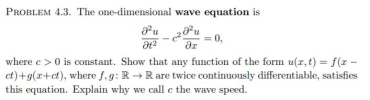 PROBLEM 4.3. The one-dimensional wave equation is ə?u - 20u = 0, ət2 or where c> 0 is constant. Show that any function of the form u(x, t) = f(x - ct)+9(2+ct), where f,g: RR are twice continuously differentiable, satisfies this equation. Explain why we call c the wave speed.
Problem 2 Consider the one dimensional version of the heat PDE in Problem1 2 0x2 a(0, z) = uo(z) ...
 Problem 2 Consider the one dimensional version of the heat PDE in Problem1 2 0x2 a(0, z) = uo(z) = e-r2. (a) Write down the Fourier transformed version of (2). Then, find the solution of this transformed version u(t,)-((,) (b) Invert the solution in part (a) to get the solution, u(t, x)-F-(u)(t, x), to (2)
Problem 2 Consider the one dimensional version of the heat PDE in Problem1 2 0x2 a(0, z) = uo(z) = e-r2. (a) Write down the...
Problem 2 Consider the one dimensional version of the heat PDE in Problem1 2 0x2 a(0, z) = uo(z) = e-r2. (a) Write down the Fourier transformed version of (2). Then, find the solution of this transformed version u(t,)-((,) (b) Invert the solution in part (a) to get the solution, u(t, x)-F-(u)(t, x), to (2)
Problem 2 Consider the one dimensional version of the heat PDE in Problem1 2 0x2 a(0, z) = uo(z) = e-r2. (a) Write down the...
 Problem 6: Consider the wave equation with a dumping term r > 0, Ut - c?Uzx + rut = 0, (t, x) € R2. This corresponds to the vibrations of an infinite string in a medium that resists its motion (e.g., air or water). Let the energy of the string be given by 1 E(t) = } } [u? (1, 2) + uș(t, 2)] dr. Show that E(t) decreases but E(t)e2rt increases, i.e., the string loses energy due to resistance...
 Please detail
PDE Utt = Uzx + 2a sin(at) sin(1x) 0 < x <1 0<t< oo BCS S u(0,t) = 0 | u(1,t) = 0 0<t< oo ICs u(x,0) = 0 | u4(,0) = sin(nx) 0 < x <1 u (0,t) = f (t) u (L,t) = g(t) S Use sine transform Uz (0,t) = f(t) uz (L,t) = g(t)) Use cosine transform 2 L S [u (x,t)] = Sn (t) = 1 | u(x, t) sin (ntx/L)...
Please detail
Please detail
PDE Utt = Uzx + 2a sin(at) sin(1x) 0 < x <1 0<t< oo BCS S u(0,t) = 0 | u(1,t) = 0 0<t< oo ICs u(x,0) = 0 | u4(,0) = sin(nx) 0 < x <1 u (0,t) = f (t) u (L,t) = g(t) S Use sine transform Uz (0,t) = f(t) uz (L,t) = g(t)) Use cosine transform 2 L S [u (x,t)] = Sn (t) = 1 | u(x, t) sin (ntx/L)...
 #4.2.3 (e, f, g only) & #4.3.11 (all of it)
42.3) Write down the solutions to the follig inboundary value problems for the wave equation in the form of a Fourier series: (a) utt = uzz , u(t, 0) = u(t, π) = 0, a(0,2) 1, ut(0,x) = 0; (d) ut4u (e) ut.-uzz , u(t, 0)u1) 0, u(0,), u, (0,x; u(t, 0)=ux(t, 1)=0, a(0,2)=1, ut(0,2)=0; (g) utt = uzx , ux(t, 0)-u, (t, 1) = 0, u(0,x)-x(1-x), ut(0,2 )-0. Explain...
#4.2.3 (e, f, g only) & #4.3.11 (all of it)
42.3) Write down the solutions to the follig inboundary value problems for the wave equation in the form of a Fourier series: (a) utt = uzz , u(t, 0) = u(t, π) = 0, a(0,2) 1, ut(0,x) = 0; (d) ut4u (e) ut.-uzz , u(t, 0)u1) 0, u(0,), u, (0,x; u(t, 0)=ux(t, 1)=0, a(0,2)=1, ut(0,2)=0; (g) utt = uzx , ux(t, 0)-u, (t, 1) = 0, u(0,x)-x(1-x), ut(0,2 )-0. Explain...
 4. Consider the semi-infinite string problem given by Utt = cʻuza, 0<x< 0,> 0 u(x,0) = f(x), 0<x< ~ ut(2,0) = g(2), 0 < x < 0 u(0,t) = 0, t> 0 Suppose that c=1, f(0) = (x - 1) - h(2 – 3) and g(C) = 0. (a) Write out the appropriate semi-infinite d'Alembert's solution for this problem and simplify. (b) Plot the solution surface and enough time snapshots to demostrate the dynam- ics of the solution.
 PDE: Ut = Uxx, -00 < x < 0, t> 0 IC: u(x,0) = 38(x) + 28(x – 6) where is the Dirac delta function (impulse). u(x, t) =
 1. Consider the following inhomogeneous wave equation on (0,7) : utt - 4uxx = (1 - x) cost Uz(0,t) = cost-1, uz(7,t) = cost u(3,0) = 2(7,0) = cos 3x (a) Convert the PDE to an equation with homogeneous boundary conditions by making an appropriate substitution u(x, t) = u(x, t) - p(x, t), implying u(,t) = v(x, t) + p(2,t) for an appropriate function p(x, t). (b) Finish solving the PDE using the Method of Eigenfunction expansion.
 2. Consider the following 1-D wave equation with initial condition u (x, 0)- F (x) where F(x) is a given function. a) Show that u (x, t)-F (x - t) is a solution to the given PDE. b) If the function F is given as 1; x< 10 x > 10 u(x, 0) = F(x) = use part (a) to write the solution u(x, t) c) Sketch u(x,0) and u(x,1) on the same u-versus-x graph d) Explain in your own...
 9. Consider the beam PDE for the transverse deflection u(x, t) of an elastic beam Utt + Kurz = 0 for 0 < x <L (30) where K > 0 is a constant. Suppose the boundary conditions are given by (31) u(0, t) = uz(0,t) = 0 Uwx (L, t) = Uzzz(L, t) = 0 (32) and the initial conditions are (33) u(x,0) = (x) u1(x,0) = V(x) (34) Use separation of variables to find the general solution to the...
 PROBLEM 4.3. The one-dimensional wave equation is ə?u - 20u = 0, ət2 or where c> 0 is constant. Show that any function of the form u(x, t) = f(x - ct)+9(2+ct), where f,g: RR are twice continuously differentiable, satisfies this equation. Explain why we call c the wave speed.
 Problem 2 Consider the one dimensional version of the heat PDE in Problem1 2 0x2 a(0, z) = uo(z) = e-r2. (a) Write down the Fourier transformed version of (2). Then, find the solution of this transformed version u(t,)-((,) (b) Invert the solution in part (a) to get the solution, u(t, x)-F-(u)(t, x), to (2)
Problem 2 Consider the one dimensional version of the heat PDE in Problem1 2 0x2 a(0, z) = uo(z) = e-r2. (a) Write down the...
Problem 2 Consider the one dimensional version of the heat PDE in Problem1 2 0x2 a(0, z) = uo(z) = e-r2. (a) Write down the Fourier transformed version of (2). Then, find the solution of this transformed version u(t,)-((,) (b) Invert the solution in part (a) to get the solution, u(t, x)-F-(u)(t, x), to (2)
Problem 2 Consider the one dimensional version of the heat PDE in Problem1 2 0x2 a(0, z) = uo(z) = e-r2. (a) Write down the...
Most questions answered within 3 hours.
-
Where is the error in this code sequence?
String s1 = "Hello";
String s2 = "ello";...
asked 11 months ago -
Financial data for Joel de Paris, Inc., for last year
follow:
Joel de Paris, Inc.
Balance...
asked 11 months ago -
Consider this reaction:
Al2(SO4)3 (aq)+ BaCl3
(aq) Al2Cl6 (aq)- +
3BaSO4(s) . What is the...
asked 11 months ago -
Suppose that Savneet is considering increasing her
recent random sample from 20 car rentals to 40...
asked 11 months ago -
Trucks arrive at an unloading terminal at an average rate of 120
per hour.
Trucks arrive...
asked 11 months ago -
Why are methanol and ethanol completely soluble in water while
octanol is not very little soluble....
asked 11 months ago -
A facilities manager at a university reads in a research report
that the mean amount of...
asked 11 months ago -
When the CuSO4 is rehydrated by adding water to the anhydrous
compound, is this an endothermic...
asked 11 months ago -
A ray of sunlight is passing from diamond into crown glass; the
angle of incidence is...
asked 11 months ago -
A block of mass 0.249 kg is placed on top of a light, vertical
spring of...
asked 11 months ago -
how do the kidneys compensate in the presences of acidosis
a) trigger hyperventilate
b) reserve acid...
asked 11 months ago -
Question 501 pts
The rental rate of capital to the firm increases. Which of the
following...
asked 11 months ago